Research Group

Robotics and Embedded Systems

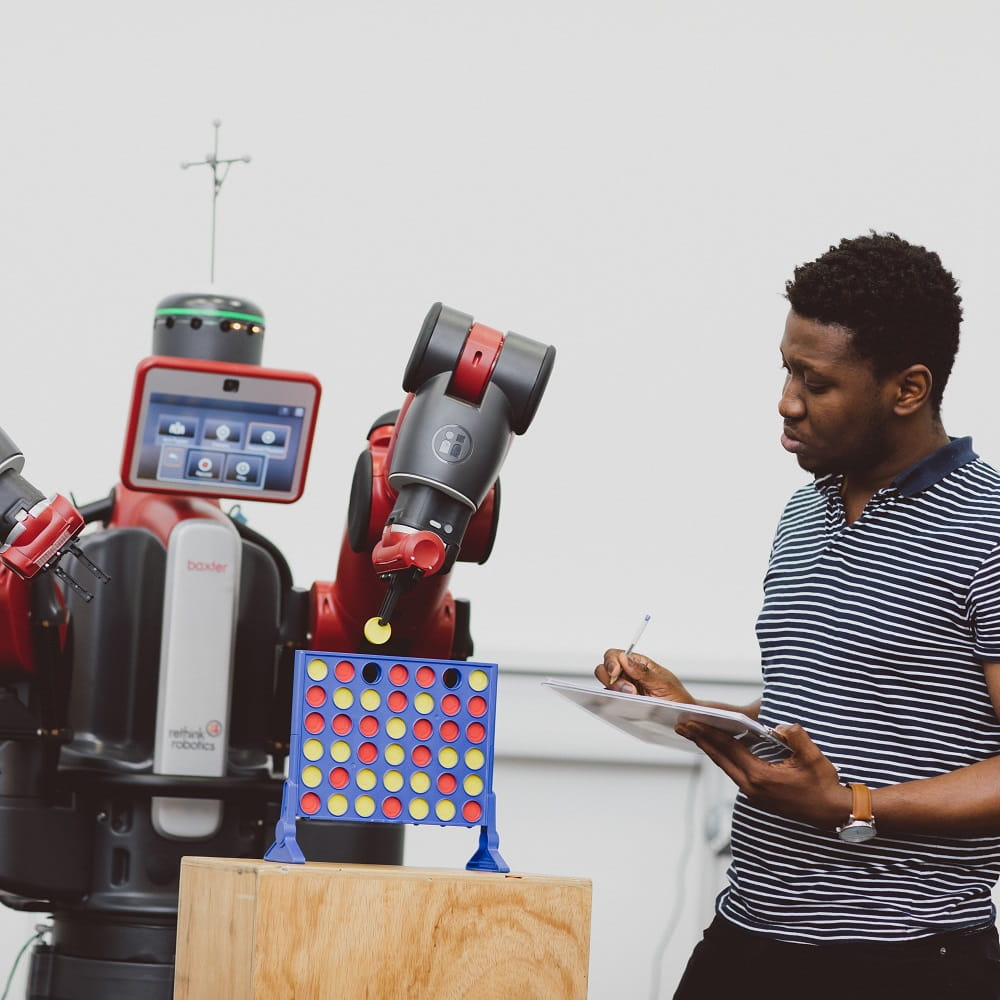
A young black man holding an iPad and stylus, standing to the right of a large red Baxter robot that is playing Connect-4.

About

Robotics research at Essex began in the 1990s. In 2005, the Embedded and Intelligent Systems (EIS) Laboratory was established following the relocation of the team from the University of Kent. Formal establishment of the Robotics and Embedded Systems (RES) Group in 2020 made us one of the largest robotics research groups in the UK.

The group’s mission is to solve fundamental problems in robotics and embedded systems particularly cover the ground, underwater, and airborne based robotic systems in order to tackle the research priority of autonomous systems, emphasising on industrial applications as well as embedded systems and System-on-Chip design and processor architectures targeted for cyber physical systems, automotive/industrial systems, computer vision, data analytics, Internet of Things and real-time critical systems. 

The group encompasses five associated special interest groups:

  • Agri-Food Robotics Laboratory
  • Intelligent Robotics and Interactive Systems (IRIS) Laboratory
  • Robotic for Under Millimetre Intervention (RUMI) Laboratory
  • Embedded and Intelligent Systems (EIS) Laboratory
  • Cyber Initiative

The research outputs benefit and impact a range of end users and stakeholders in Agricultural robotics, Assistive robotics for Social Care, Manufacturing, Electronic Products, Automotive and Nuclear Robotics.

Activity in the group

Research Excellence

The group routinely publishes articles in high profile engineering journals, many of which are available through the IEEE as well as presenting at top international conferences.

  • The group expanded its research in resilient embedded and intelligent systems in extreme environments (nuclear and space robotics), led by McDonald-Maier as a part of the EPSRC National Centre for Nuclear Robotics (NCNR) in collaboration with NASA Jet Propulsion Lab, BAE Systems, Kuka, Toshiba, Rolls-Royce and other world leaders. This has enabled us to expand our world-leading expertise in embedded systems and robotics to deliver unique intelligent infrastructure. Our role in this national centre is to increase the resilience and robustness of embedded and robotic systems in extreme environments and contribute new computer vision-based localisation methods. This work is carried with our long-term collaborator NASA JPL.
  • Research on embedded systems and Systems-on-Chip diagnostics and analytics through EPSRC and EU projects has contributed unique outputs and IP, where spin-out company UltraSoC Technologies, co-founded by McDonald-Maier, attracted some £20M investment, introduced disruptive technology into the market place and successfully exited to Siemens in an acquisition that delivered high return for all the stakeholders.
  • McDonald-Maier and Ehsan’s computer vision work detecting human rights violation in images, researched as part of the ESRC Human Rights and Big Data Technology (HRBDT) project, has been adopted by the United Nations (OHCHR – Office of the High Commissioner for Human Rights and UNHCR – High Commissioner for Refugees).
  • Essex’s AgriRobotics research featured in the influential ‘Future of Food 2040’ report of the National Farmers Union and plays an active role in further evolution of the Essex Plant Innovation Centre (EPIC).
  • Mohan and Woods lead an Innovate UK project on adaptive motion control of cutting machines and predictive maintenance with the UK's Leading CNC machine manufacturers Blackman&White.
  • The Robotics Laboratory offers dedicated space for indoor robots. The University has invested over £3M to equip this state-of-the-art laboratory for robotics research. The laboratory accommodates over 50 robotic systems, including wheeled, flying, humanoid, and wheelchair robots, as well as various robotic arms and hands. In addition, through a Strategic equipment award (2018) a new agricultural robot has been built at Essex comprising a Husky UGV carrying two UR3 arms, customized cutter/gripper, soft multi-fingered hand, and vacuum gripper. The facilities have been deployed in research projects funded by the EPSRC, including the NCNR, the EPSRC Robust Remote Sensing project and the EPSRC RoBoSaS, as well as Innovate UK and Industry.
  • The Embedded and Intelligent Systems Laboratory (EIS@Essex) has state-of-the-art design and prototyping facilities for advanced embedded systems design and system-processing architectures. Additionally, the EIS@Essex NCNR Lab has been expanded with dedicated embedded systems, FPGA/GPU units and sensors for extreme environments and autonomous systems (£120k investment by University and EPSRC/EU project funds). The Laboratory was crucial in conducting our research as part of the EPSRC funded RoBoSaS collaboration with NASA JPL, the Robust Remote Sensing, the NCNR, the ESPACENET, and RESIP EPSRC grants and the SYSIASS and COALAS EU ERDF grants. EIS@Essex encompasses the iSpace (intelligent flat) testbed for Internet of Things established from a University investment of £240k. EIS@Essex also includes £1.4M RCIF-funded facilities encompassing 3D projectors and high-resolution audio equipment which have been used in projects funded by DSTL and Innovate UK.

Research community

  • McDonald-Maier and Ehsan are key Co-I in the NCNR, a collaborative project involving international experts from 8 UK universities and 30+ partners from the nuclear industry and the research base, including NASA JPL, BAE Systems, EDF Energy, Japan Atomic Energy Agency, National Nuclear and Physical Laboratories, Rolls-Royce, Thales and Toshiba. The project is researching and developing cutting-edge technology to solve the problem of nuclear waste. McDonald-Maier leads the research strand on the development of resilient electronic systems that can function in areas of high radioactivity where robots are prone to failure and using computer vision in such extreme environments for localisation.
  • Most of the School’s externally-funded research is inherently collaborative, and often involves industry and policy/standardisation bodies. Such collaborative relationships form a natural starting point for impact creation. For example, the spin-out UltraSoC (one of our impact case studies, acquired by Siemens in 2020) arose from collaborative EPSRC research projects with Delphi and Infineon Technologies. In addition, collaboration within the ESRC-funded HRBDT led to another impact case study. Collaborations are also used to leverage significant in-kind support from industrial partners, for example, McDonald-Maier has secured approximately £10M+ in this way from organisations including Thales, Motorola and Rolls Royce.
  • Robotics technologies addresses the need for such systems to work as expected for their purpose, to be designed and tested to ensure that they work consistently and safely, and that they are appropriately developed within a legal, ethical and social context. This integrates and extends our technical research with social sciences and humanities research in a multi-disciplinary approach as part of IADS, HRBDT and the HRC.
  • Intellectual property created as part of our research has been extensively licenced and commercialised in spin-outs, such as key-less cybersecurity company Metrarc working with BT and the UK MoD in addition to UltraSoC, acquired by Siemens.
Get in touch
Professor Klaus McDonald-Maier Head of Robotics and Embedded Systems Research Group
login