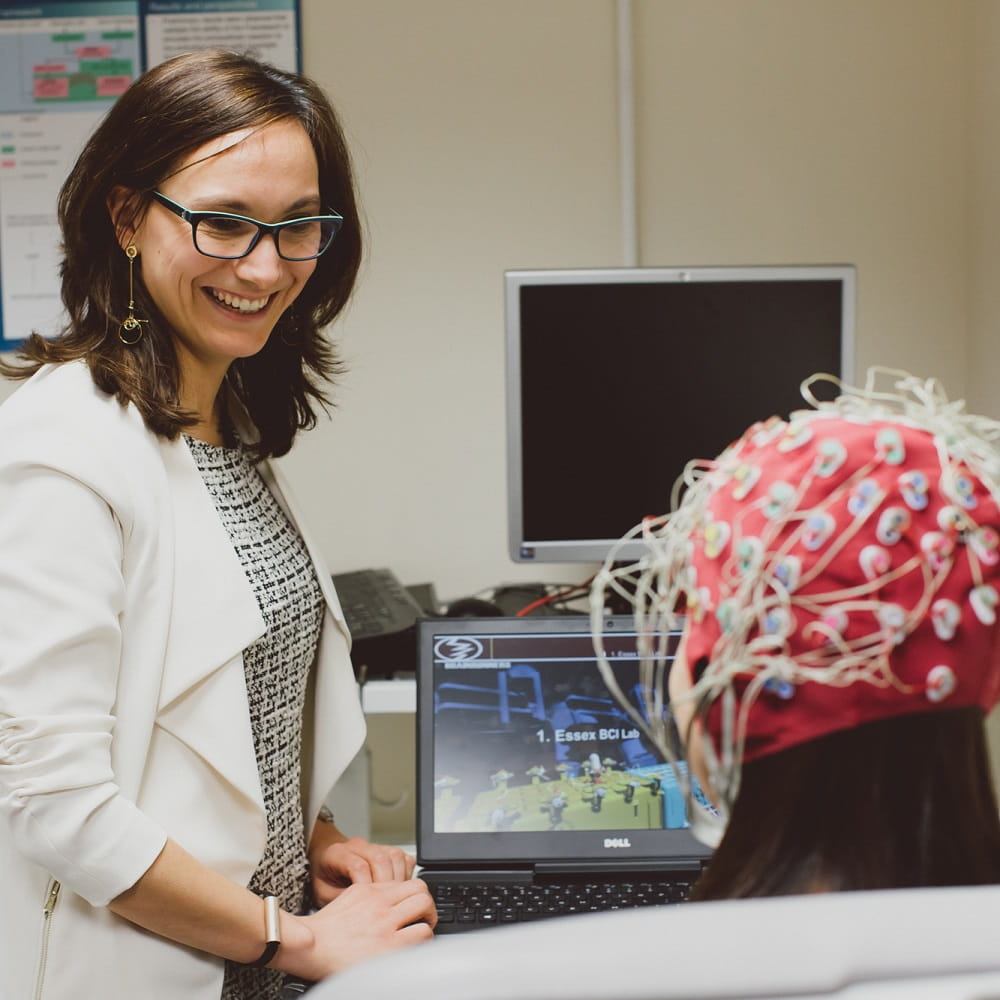
The Brain-Computer Interfaces and Neural Engineering (BCI-NE) Laboratory at the University of Essex is a global leader in neurotechnology, ranked #1 worldwide by citations and one of the largest BCI groups in Europe.
With over £12M in funding to date and £4.6M secured in the last five years, we represent a nexus of scientific excellence and social impact. Our collaborators have included MIT, NASA JPL, Harvard, Oxford, Imperial, UCL, NHS and many others.
Established in 2004, our mission is to conduct groundbreaking theoretical research that expands our fundamental understanding of the human brain, and to convert these discoveries into rigorous engineering principles. We sit at the multidisciplinary intersection of biomedical engineering, neuroscience, machine learning, and computational psychology to repair, replace, and enhance neural systems.
Our research group explores both fundamental neurophysiology and applied tech. Our work is broadly organized into three main areas:
We develop assistive technologies aimed at restoring autonomy, including for stroke patients and individual with motor disabilities, with a focus on real-world applicability, including dry EEG technology for portable and accessible BCIs. Our research includes BCIs for communication and control, neuro stimulation, control of prosthetic limbs, closed-loop technologies designed to restore sensory feedback, investigation of BCI technology for intervention in neurodegenerative and neuro-oncology models based on multimodal methods of stimulation.
To interpret the complex language of the brain and biomarker discovery, we build advanced machine learning algorithms, novel deep learning architectures, adaptive and generalisable models, and mathematical models of neural signals. This computational expertise allows us, for instance, to decode motor imagery, detect mental fatigue, and identify neural biomarkers for disorders.
We conduct pioneering studies in cognitive enhancement and augmentation, including neurofeedback training, memory enhancement, BCIs designed for group and individual decision-making, adaptive learning systems, multimodal affective computing, and development of systems that can monitor and respond to cognitive states like workload, fatigue, and emotional arousal in real time.
We have a state-of-the-art facility for researching the potential of biologically-inspired architectures (e.g., spiking neural networks, neuromorphic computing) for enhanced computational efficiency and robustness.
Our research includes both Non-invasive Brain-computer interfaces and Invasive neural interfaces. We also work on Neural prostheses and Neuromuscular electrical stimulation, Rehabilitation engineering, Biomedical signal analysis, and Computational neuroscience.
We research Sensorimotor neurophysiology and develop Mathematical models of muscles nerves, and neural signals. We apply machine learning to biomedical signals to study bio-signals such as Event-Related Potentials (ERPs). We also study implanted cuff electrodes and EMG for to build prostheses for hand amputees.
We study brain connectivity analysis in the EEG, fNIRS, and fMRI as well as motor learning, motor control and perception. We also research integration of brain stimulation with BCI to provide novel therapies.
Other areas of research include: multi-sensory BCIs, collaborative forms of BCI, brainwave entrainment and its benefits in Parkinson’s disease, BCIs for neuro-rehabilitation, technologies to restore sensory feedback in assistive devices, brain-to-brain communication, semantic BCIs, fatigue detection and learning. Finally, we are regular entrants in the Cybathlon competition.
A particularly successful direction for our recent research is developing Brain Computer Interfaces (BCIs) for decision-making. We collect neural, physiological and behavioural data of individuals performing decision making tasks, which are used by our BCIs to improve individual and group performance in decision-making. We are also exploring ways of making the BCI technology we develop usable in real-life decision making and have being awarded funding for this.
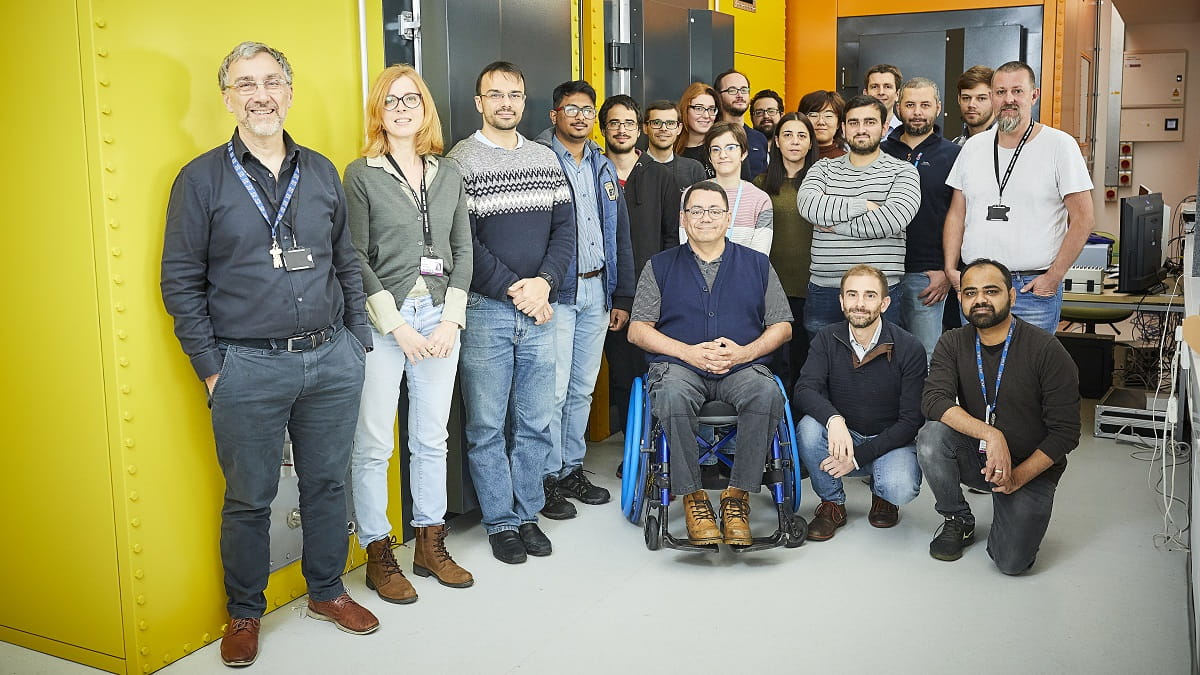
The lab is a shared resource available to the members of the BCI-NE group. Group members include five professors and nine lecturers whose primary group is BCI-NE and a larger group of people whose primary group is one of the other three groups in CSEE. In addition, we have many post-doctoral researchers and PhD students within the group.
Lecturer
School for Computer Science and Electronic Engineering, University of EssexSenior Lecturer
School of Computer Science and Electronic Engineering, University of EssexSenior Lecturer
School of Computer Science and Electronic Engineering, University of EssexLecturer
School of Computer Science and Electronic Engineering, University of EssexSenior Lecturer
School of Computer Science and Electronic Engineering, University of EssexLecturer
School of Computer Science and Electronic Engineering, University of EssexSenior Lecturer
School of Computer Science and Electronic Engineering, University of EssexProfessor
School for Computer Science and Electronic Engineering, University of EssexLecturer
School for Computer Science and Electronic Engineering, University of EssexSenior Lecturer
School for Computer Science and Electronic Engineering, University of EssexLecturer
School for Computer Science and Electronic Engineering, University of EssexSenior Lecturer
School of Computer Science and Electronic Engineering, University of EssexPostgraduate Research Student
School for Computer Science and Electronic Engineering, University of EssexPostgraduate Research Student
School of Computer Science and Electronic Engineering, University of EssexWe have recently created an exciting BEng Neural Engineering with Psychology course which is the first of its kind in Europe, and one of the very first in the world. Our BEng Neural Engineering with Psychology covers: brain-computer interfaces, the analysis and classification of neural signals, neuroimaging and brain stimulation technologies, brain and behaviour, the neuroscience of human nature, machine learning, and much more.
The course equips students with the knowledge and skills to be leaders in the development of novel technologies and applications for the rapidly developing and innovative neural engineering industry and as well as the well-established biomedical, electronic and software engineering.