The Integrated Master in Philosophy is a four-year degree that combines undergraduate study with advanced master's-level philosophy and research training.
You’ll explore some of the most fundamental questions about human existence, knowledge, morality, society and the world around us. Through rigorous discussion, analysis and independent research, you’ll develop the skills to challenge assumptions, examine ideas critically and construct well-reasoned arguments.
Why this course
The Integrated Master in Philosophy allows you to take your philosophical thinking further, combining a broad foundation in philosophy with advanced master's-level study in your final year.
Philosophy at Essex explores the questions that continue to shape human life and society. You’ll investigate issues such as the nature of knowledge, freedom, justice, ethics, politics, religion, identity and what it means to live a meaningful life.
You’ll explore how philosophy connects with contemporary challenges, including debates around healthcare, technology, public policy, capitalism, equality and social change. Rather than treating philosophy as purely abstract, you’ll examine how philosophical ideas influence the decisions and values that shape the world around us.
Learn from expert philosophers whose research strengths include ethics, political philosophy, philosophy of religion, modern European philosophy, critical theory, phenomenology and existentialism. Their research-led teaching brings current debates and diverse philosophical traditions into the classroom.
From your first year, you’ll develop the core skills of philosophical enquiry: analysing arguments, questioning assumptions, interpreting complex texts and communicating ideas clearly. In your final year, you’ll study master's-level modules and undertake advanced independent research.
The Integrated Master structure is ideal if you are considering postgraduate study or want to graduate with a deeper understanding of philosophy and highly developed analytical skills.
By the end of your degree, you’ll have the confidence to approach complex problems from different perspectives and apply philosophical reasoning across a wide range of professional and academic contexts.
Who should apply
Students who enjoy questioning ideas, exploring difficult questions and thinking deeply about the world around them
Curious thinkers interested in ethics, politics, society, knowledge and human experience
Learners considering postgraduate study or careers requiring advanced analytical and communication skills
Students looking for a challenging degree that develops independent thinking and intellectual confidence
What you’ll learn
Ethics and moral philosophy: Explore questions about right and wrong, responsibility, justice and human values
Political philosophy: Examine ideas about power, freedom, equality, democracy and the organisation of society
Knowledge and reality: Investigate questions about truth, perception, consciousness and the nature of existence
History of philosophy: Study influential philosophical thinkers and traditions from ancient philosophy to contemporary thought
European philosophy and critical theory: Explore modern philosophical approaches including phenomenology, existentialism and social critique
Advanced research: Develop independent research skills and produce substantial philosophical work at master's level
Your learning experience
Master’s-level study: Develop advanced philosophical knowledge through specialist modules in your final year
Research-led teaching: Learn from academics whose research contributes to contemporary philosophical debates
Small-group discussion: Develop your ideas through debate, discussion and close engagement with philosophical texts
Independent research project: Complete an advanced final project exploring a philosophical question of your choice
Interdisciplinary learning: Explore connections between philosophy and areas including politics, culture, law, medicine and society
Optional study abroad year: Spend time studying at one of our partner universities and experience another culture with the Study Abroad programme
Optional placement year: Gain professional experience in an organisation with university support from Placements at Essex
Specialist facilities: Access extensive library collections, digital research resources and academic expertise within the School of Philosophical, Historical and Interdisciplinary Studies
Careers and outcomes
An Integrated Master in Philosophy degree can prepare you for careers in sectors and roles such as:
Research and academia: Postgraduate study, doctoral research and academic careers
Government and public policy: Policy research, civil service, public administration and advisory roles
Law and professional services: Legal research, consultancy, compliance and analytical roles
Media and communications: Journalism, publishing, communications and content development
Education: Teaching, learning support and educational roles
Business and organisations: Strategy, management, ethics, research and roles requiring critical thinking
Employers of graduates from this course
Graduates from this course develop highly transferable analytical, research and communication skills valued across a wide range of organisations, including:
Universities and research institutions
Government departments and public bodies
Legal and professional services organisations
Media and publishing organisations
Charities and policy organisations
Businesses and consultancy organisations
Why we're great.
Achieve a Masters-level qualification with this four-year course.
Work alongside industry-active professionals.
Focus on the existential questions of human life and receive a critical perspective on the social, political and economic challenges that we face today.
Course content
Components and modules explained
Components
Components are the blocks of study that make up your course. A component may have a set module which you must study, or a number of modules from which you can choose.
Each component has a status and carries a certain number of credits towards your qualification.
Status
What this means
Core
You must take the set module for this component and you must pass. No failure can be permitted.
Core with Options
You can choose which module to study from the available options for this component but you must pass. No failure can be permitted.
Compulsory
You must take the set module for this component. There may be limited opportunities to continue on the course/be eligible for the qualification if you fail.
Compulsory with Options
You can choose which module to study from the available options for this component. There may be limited opportunities to continue on the course/be eligible for the qualification if you fail.
Optional
You can choose which module to study from the available options for this component. There may be limited opportunities to continue on the course/be eligible for the qualification if you fail.
The modules that are available for you to choose for each component will depend on several factors, including which modules you have chosen for other components, which modules you have completed in previous years of your course, and which term the module is taught in.
Modules
Modules are the individual units of study for your course. Each module has its own set of learning outcomes and assessment criteria and also carries a certain number of credits.
In most cases you will study one module per component, but in some cases you may need to study more than one module. For example, a 30-credit component may comprise of either one 30-credit module, or two 15-credit modules, depending on the options available.
Modules may be taught at different times of the year and by a different department or school to the one your course is primarily based in. You can find this information from the module code. For example, the module code HR100-4-FY means:
HR
100
4
FY
The department or school the module will be taught by.
In this example, the module would be taught by the Department of History.
Begin your study of philosophy with an exploration of epistemology (the theory of knowledge) and identity theory. What does it mean to say that we ‘know’ something? What if that something is ourselves? How do our modes of practical interaction with the world and each other shape our ability to know different kinds of objects? Are there vices of the mind that distort our reasoning and lead our practical deliberations astray? How important is trust in a functional knowledge community? What kind of creatures must we be in order to be capable of knowing things? What role does self-responsibility play in effective knowing? What is it to be a self? How does that differ from having an identity or identities? To what extent are our identities determined by others? Are they up to us? How can the study of philosophy help us with these questions?
This course introduces key academic, professional and personal skills to support a successful transition beyond undergraduate study. Students develop confidence in critical thinking, communication, teamwork and self reflection while exploring future study and career options.
What is the nature and limits of human knowledge? Does our common-sense view of the world have a philosophical foundation? Does sensory experience provide the only path to knowledge of the world or can we gain knowledge through the exercise of pure reason? What role, if any, does God play in knowledge? What is the relation between the body and the mind? Do we know that the sun will rise tomorrow? Study the philosophical texts of the modern era that helped lay the conceptual foundations for these questions and others. We will begin with a close reading of Descartes' Meditations before exploring both rationalist (Spinoza and Leibniz) and empiricist (Locke and Hume) responses.
This year, we will explore some of the things that worry people about morality. These are matters that may be thought of as challenges to morality and that seem either to make morality impossible or to undermine our commitment to it. For instance, if morality is just a matter of what we happen to like or dislike, or it is only relative to the standards of one's culture, the idea that we can ask and give moral reasons appears to be undermined, or significantly limited. Analogously, the fact that moral discussions (unlike arguments about matters of fact) often end up in irresolvable disagreements seems to threaten the rationality of moral arguments. The role that matters of luck play in our moral evaluations seems to involve holding people responsible for things that are not really under their control, thus compromising the idea that we can really assess the moral value of their actions. In the first term, we will look at these and other challenges to morality, and we will also explore some of the metaethical questions that these challenges raise: can we say that our moral judgements are capable of being true or false? If they are, does their truth depend on certain moral facts? Can we describe these facts as natural?
In this module we will intensively examine a classic philosophical text, treating it not only as a historical document, but principally with regard to its ongoing contribution to philosophical thinking.
This is an intensive final-year module running over five weeks during the summer term. It involves a guided and structured approach to support you in completing a research project of your own.
This is the final project module for students on the Integrated Masters in Philosophy. It consists of a mixture of skills workshops and individual supervisions in the summer term to enable students to draft a article-length final project.
120 UCAS tariff points from a minimum of the equivalent of 2 full A-levels.
IB: 30 points in the IB Diploma or 120 UCAS tariff points to include a minimum of 2 Higher Level subjects.
We accept A-levels, AAQs, BTECs, Access to HE Diploma, T-levels and most other qualifications that hold UCAS tariff points. Acceptability of some non A-level qualifications (such as BTECs) may depend on the subject studied and units taken.
You can calculate your UCAS tariff points on the UCAS website.
Whilst International A-levels and BTECs aren't on the UCAS tariff calculator, we assign them the same tariff points as their UK counterparts.
Don't meet the entry requirements?
We know everyone's journey is different. If your achieved or predicted grades don’t match our entry requirements, you have a non-traditional educational background, or you're returning to study as a mature student, we'd still encourage you to apply. We review every application individually and may be able to offer you a place on this course, or an alternative route such as a foundation year.
Find out more about applying, personal statements, references, visas, deferred entry, extenuating circumstances, and support for mature students on our undergraduate application information page.
Contextual Offers:
We are committed to ensuring that all students with the merit and potential to benefit from an Essex education are supported to do so. We make Contextual Offers to applicants from underrepresented groups residing in the UK. Our Contextual Offers policy outlines the full eligibility criteria.
112 UCAS tariff points from a minimum of 2 full A-levels.
International & EU entry requirements
We accept a wide range of qualifications from applicants studying in the EU and other countries. Get in touch with any questions you may have about the qualifications we accept. Remember to tell us about the qualifications you have already completed or are currently taking.
Sorry, the entry requirements for the country that you have selected are not available here. Please contact our Undergraduate Admissions team at ugquery@essex.ac.uk to request the entry requirements for this country.
English language requirements
English language requirements for applicants whose first language is not English
IELTS 6.0 overall with a minimum of 5.5 in each component, or specified score in an equivalent test that we accept.
Details of English language requirements and the tests we accept for applicants who require a Student visa (excluding Nationals of Majority English Speaking Countries) can be found here
If we accept the English component of an international qualification it will be included in the academic levels listed above for the relevant countries.
Pre-sessional English courses
If you do not meet our IELTS requirements then you may be able to complete a pre-sessional English pathway that enables you to start your course without retaking IELTS.
Additional Notes
If you’re an international student, but do not meet the academic requirements for direct admission to this degree, you could prepare and gain entry through a pathway course. Find out more about opportunities available to you at the University of Essex International College
Fees and funding
Home/UK fee
£10,050 per year
International fee
£22,575 per year
Fees will increase for each academic year of study.
If your course has the option to include a placement year or study abroad, and you choose to do so, you will pay the following:
Our events are a great way to find out more about studying at Essex. We run a number of Open Days throughout the year which enable you to discover what our campus has to offer.
You have the chance to:
tour our campus and accommodation
find out answers to your questions about our courses, student finance, graduate employability, student support and more
meet our students and staff
Check out our Visit Us pages to find out more information about booking onto one of our events. And if the dates aren’t suitable for you, feel free to book a campus tour here.
Our UK students, and some of our EU and international students, who are still at school or college, can apply through their school. Your school will be able to check and then submit your completed application to UCAS. Our other international applicants (EU or worldwide) or independent applicants in the UK can also apply online through UCAS Apply.
The UCAS code for our University of Essex is ESSEX E70. The individual campus codes for our Loughton and Southend Campuses are 'L' and 'S' respectively.
You can find further information on how to apply, including information on transferring from another university, applying if you are not currently at a school or college, and applying for readmission on our How to apply and entry requirements page.
If you receive an undergraduate offer to study with us in October 2026 and live in the UK, you will receive an email invitation to book onto one of our Open Days. These events provide the opportunity to meet your department, join interesting taster sessions, tour our campus and accommodation, and chat to current students. You can visit our Open Days event page for more information, including terms and conditions.
Visit Colchester Campus
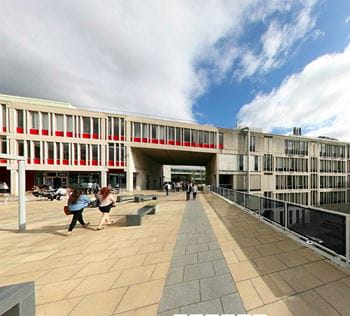
Set within 200 acres of award-winning parkland - Wivenhoe Park and located two miles from the historic city centre of Colchester – England's oldest recorded development. Our Colchester Campus is also easily reached from London and Stansted Airport in under one hour.
If you live too far away to come to Essex (or have a busy lifestyle), no problem. Our 360-degree virtual tour allows you to explore our University from the comfort of your home. Check out our Colchester virtual tour to see accommodation options, facilities and social spaces.
At Essex we pride ourselves on being a welcoming and inclusive student community. We offer a wide range of support to individuals and groups of student members who may have specific requirements, interests or responsibilities.
The University makes every effort to ensure that this information on its programme specification is accurate and up-to-date. Exceptionally it can be necessary to make changes, for example to courses, facilities or fees. Examples of such reasons might include, but are not limited to: strikes, other industrial action, staff illness, severe weather, fire, civil commotion, riot, invasion, terrorist attack or threat of terrorist attack (whether declared or not), natural disaster, restrictions imposed by government or public authorities, epidemic or pandemic disease, failure of public utilities or transport systems or the withdrawal/reduction of funding. Changes to courses may for example consist of variations to the content and method of delivery of programmes, courses and other services, to discontinue programmes, courses and other services and to merge or combine programmes or courses. The University will endeavour to keep such changes to a minimum, and will also keep students informed appropriately by updating our programme specifications. The University would inform and engage with you if your course was to be discontinued, and would provide you with options, where appropriate, in line with our Compensation and Refund Policy.
The full Procedures, Rules and Regulations of the University governing how it operates are set out in the Charter, Statutes and
Ordinances and in the University Regulations, Policy and Procedures.
3.png?mw=300)





.jpg?mh=512&mw=512&hash=991C301D451DC15789BE838A5956FA16)






.jpg&lastYear=0&title=Integrated Master in Philosophy: Philosophy)
.jpg&lastYear=0&title=Integrated Master in Philosophy: Philosophy)
.jpg&lastYear=0&title=Integrated Master in Philosophy: Philosophy)
.jpg&lastYear=0&title=Integrated Master in Philosophy: Philosophy)
.jpg&lastYear=0&title=Integrated Master in Philosophy: Philosophy)
.jpg&lastYear=0&title=Integrated Master in Philosophy: Philosophy)
.jpg&lastYear=0&title=Integrated Master in Philosophy: Philosophy)
.jpg&lastYear=0&title=Integrated Master in Philosophy: Philosophy)
.jpg&lastYear=0&title=Integrated Master in Philosophy: Philosophy)
.jpg&lastYear=1&title=Integrated Master in Philosophy: Philosophy)
.jpg&lastYear=1&title=Integrated Master in Philosophy: Philosophy)