The BA Liberal Arts is a three-year degree, extendable to four with an optional placement or study abroad year.
You'll explore the big questions shaping our world by studying across the humanities and social sciences, rather than limiting yourself to a single subject. With the flexibility to build your own pathway around your interests, you'll combine disciplines to develop the knowledge, creativity and critical thinking needed to tackle complex global challenges.
Why this course
Knowledge doesn't exist in neat subject boundaries. The BA Liberal Arts encourages you to make connections across disciplines, exploring how history, politics, philosophy, literature, sociology, psychology, languages and the arts help us better understand the world and the people within it.
Choose a major in Psychology, History, Literature, Art History, Philosophy, Politics, Media Studies or Sociology, then tailor your degree by selecting optional modules from across the humanities and social sciences. This flexibility allows you to create a degree that reflects your interests, ambitions and career goals.
You'll explore challenging ideas, question dominant perspectives and develop new ways of thinking about contemporary issues through research-led teaching from academics across multiple disciplines. Every module helps you build confidence in analysing evidence, debating ideas and communicating complex arguments.
Add a placement year or study abroad to broaden your academic experience, gain valuable professional skills and experience different cultures and perspectives.
By the end of your degree, you'll have developed outstanding analytical, research, communication and problem-solving skills, alongside the adaptability and interdisciplinary thinking increasingly valued by employers across a wide range of sectors.
Who should apply
Students who enjoy studying a range of humanities and social science subjects rather than specialising in just one
Curious learners who enjoy asking big questions and exploring different perspectives
Students who want the flexibility to shape their own degree around their interests
Anyone looking to develop transferable skills valued across a wide range of graduate careers
What you'll learn
Interdisciplinary thinking: Explore how different subjects connect to explain complex social, cultural and global issues
Critical analysis: Evaluate evidence, question assumptions and develop well-supported arguments
Global perspectives: Examine ideas, cultures and histories from around the world
Flexible study: Build your own degree through optional modules across the humanities and social sciences
Research and communication: Develop advanced writing, presentation, collaboration and independent research skills
Your learning experience
Choose your pathway: Major in Psychology, History, Literature, Art History, Philosophy, Politics, Media Studies or Sociology
Flexible module choices: Select optional modules across literature, film, philosophy, history, politics, sociology, linguistics, modern languages and more
Research-led teaching: Learn from experts across multiple disciplines whose research informs contemporary debates
Optional study abroad year: Spend a year at one of our partner universities and experience another culture with the Study Abroad programme
Optional placement year: Gain professional experience in a business or organisation with university support from Placements at Essex
Supportive community: Study in a collaborative environment where you'll be encouraged to explore ideas across disciplines and develop your own academic interests
Careers and outcomes
A BA Liberal Arts degree can prepare you for careers in sectors and roles such as:
Public policy and government: Policy advisor, civil servant, local government and public administration
Media and communications: Journalism, marketing, public relations and digital communications
Education and research: Teaching, academic research and educational organisations
Arts, culture and heritage: Museums, galleries, cultural organisations and charities
Business and consultancy: Project management, consultancy, strategy and organisational development
Further study: Postgraduate study across the humanities, social sciences and related disciplines
Employers of graduates from this course
Graduates from this course develop adaptable skills valued across a wide range of organisations, including:
Government departments
Charities and NGOs
Media and communications organisations
Cultural and heritage organisations
National and international businesses
Why we're great.
State of the art facilities.
Become a true researcher with our multi-faceted approach.
As our most flexible course, you can build your own degree as your interests develop
Course content
Components and modules explained
Components
Components are the blocks of study that make up your course. A component may have a set module which you must study, or a number of modules from which you can choose.
Each component has a status and carries a certain number of credits towards your qualification.
Status
What this means
Core
You must take the set module for this component and you must pass. No failure can be permitted.
Core with Options
You can choose which module to study from the available options for this component but you must pass. No failure can be permitted.
Compulsory
You must take the set module for this component. There may be limited opportunities to continue on the course/be eligible for the qualification if you fail.
Compulsory with Options
You can choose which module to study from the available options for this component. There may be limited opportunities to continue on the course/be eligible for the qualification if you fail.
Optional
You can choose which module to study from the available options for this component. There may be limited opportunities to continue on the course/be eligible for the qualification if you fail.
The modules that are available for you to choose for each component will depend on several factors, including which modules you have chosen for other components, which modules you have completed in previous years of your course, and which term the module is taught in.
Modules
Modules are the individual units of study for your course. Each module has its own set of learning outcomes and assessment criteria and also carries a certain number of credits.
In most cases you will study one module per component, but in some cases you may need to study more than one module. For example, a 30-credit component may comprise of either one 30-credit module, or two 15-credit modules, depending on the options available.
Modules may be taught at different times of the year and by a different department or school to the one your course is primarily based in. You can find this information from the module code. For example, the module code HR100-4-FY means:
HR
100
4
FY
The department or school the module will be taught by.
In this example, the module would be taught by the Department of History.
Interdisciplinary Research and Problem-Solving: An Introduction
(15 CREDITS)
The world does not have disciplines; it has problems. What's more, the most important problems we face - problems like climate change, migration, sustainable economic production, democratic governance, and so on - cannot be solved with the tools of any single discipline. Such problems require collaborative, creative, and interdisciplinary approaches, and this module introduces students to this type of interdisciplinary thinking. Students will learn how to approach complex problems by drawing on theories and methods from multiple disciplines, learning how to think flexibly and work with others to find creative solutions to real-world problems.
This interdisciplinary module explores the rich diversity of ways of knowing the world. We examine different frameworks of knowing that have characterised and shaped human societies historically and today.
This course introduces key academic, professional and personal skills to support a successful transition beyond undergraduate study. Students develop confidence in critical thinking, communication, teamwork and self reflection while exploring future study and career options.
Addressing the Environmental Crisis: Historical Origins, Current Causes, Sustainable Solutions
(15 CREDITS)
How have contemporary societies been shaped by the legacies of the Enlightenment, colonialism, and the different phases of capitalism? This interdisciplinary module helps you to critically understand some of the key forces and processes that have shaped the challenges we face in the 20th and 21st century. It is divided into three broad themes; Empire, The Self, and Nature. We’ll be examining processes of ‘othering’ that were intrinsic to colonialism; changing conceptions of the self; as well as both the causes of and potential solutions to the ecological crisis we are confronting today. The module is co-taught by academics from Art History, ISC, LiFTs, Philosophy, Psychoanalytic Studies and Sociology.
This module has been designed to enable students to integrate their subject knowledge with an understanding of sustainable development, acquiring the skills and competencies essential for addressing the urgent sustainability challenges of the 21st century.
112 UCAS tariff points from a minimum of 2 full A-levels.
IB: 29 points in the IB Diploma or 112 UCAS tariff points to include a minimum of 2 Higher Level subjects.
We accept A-levels, AAQs, BTECs, Access to HE Diploma, T-levels and most other qualifications that hold UCAS tariff points. Acceptability of some non A-level qualifications (such as BTECs) may depend on the subject studied and units taken.
You can calculate your UCAS tariff points on the UCAS website.
Whilst International A-levels and BTECs aren't on the UCAS tariff calculator, we assign them the same tariff points as their UK counterparts.
Don't meet the entry requirements?
We know everyone's journey is different. If your achieved or predicted grades don’t match our entry requirements, you have a non-traditional educational background, or you're returning to study as a mature student, we'd still encourage you to apply. We review every application individually and may be able to offer you a place on this course, or an alternative route such as a foundation year.
Find out more about applying, personal statements, references, visas, deferred entry, extenuating circumstances, and support for mature students on our undergraduate application information page.
Contextual Offers:
We are committed to ensuring that all students with the merit and potential to benefit from an Essex education are supported to do so. We make Contextual Offers to applicants from underrepresented groups residing in the UK. Our Contextual Offers policy outlines the full eligibility criteria.
96 UCAS tariff points from a minimum of 2 full A-levels.
International & EU entry requirements
We accept a wide range of qualifications from applicants studying in the EU and other countries. Get in touch with any questions you may have about the qualifications we accept. Remember to tell us about the qualifications you have already completed or are currently taking.
Sorry, the entry requirements for the country that you have selected are not available here. Please contact our Undergraduate Admissions team at ugquery@essex.ac.uk to request the entry requirements for this country.
English language requirements
English language requirements for applicants whose first language is not English
IELTS 6.0 overall with a minimum of 5.5 in each component, or specified score in an equivalent test that we accept.
Details of English language requirements and the tests we accept for applicants who require a Student visa (excluding Nationals of Majority English Speaking Countries) can be found here
If we accept the English component of an international qualification it will be included in the academic levels listed above for the relevant countries.
Pre-sessional English courses
If you do not meet our IELTS requirements then you may be able to complete a pre-sessional English pathway that enables you to start your course without retaking IELTS.
Additional Notes
If you’re an international student, but do not meet the academic requirements for direct admission to this degree, you could prepare and gain entry through a pathway course. Find out more about opportunities available to you at the University of Essex International College
Fees and funding
Home/UK fee
£10,050 per year
International fee
£22,575 per year
Fees will increase for each academic year of study.
If your course has the option to include a placement year or study abroad, and you choose to do so, you will pay the following:
Our events are a great way to find out more about studying at Essex. We run a number of Open Days throughout the year which enable you to discover what our campus has to offer.
You have the chance to:
tour our campus and accommodation
find out answers to your questions about our courses, student finance, graduate employability, student support and more
meet our students and staff
Check out our Visit Us pages to find out more information about booking onto one of our events. And if the dates aren’t suitable for you, feel free to book a campus tour here.
Our UK students, and some of our EU and international students, who are still at school or college, can apply through their school. Your school will be able to check and then submit your completed application to UCAS. Our other international applicants (EU or worldwide) or independent applicants in the UK can also apply online through UCAS Apply.
The UCAS code for our University of Essex is ESSEX E70. The individual campus codes for our Loughton and Southend Campuses are 'L' and 'S' respectively.
For information on transferring from another university, applying when you are not at school or college, and applying for readmission, please see How to apply and entry requirements.
Visit Colchester Campus
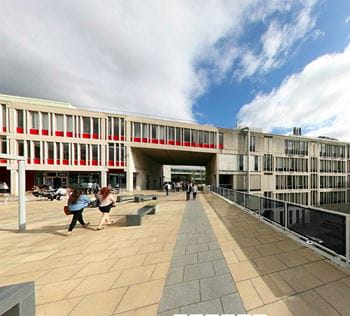
Set within 200 acres of award-winning parkland - Wivenhoe Park and located two miles from the historic city centre of Colchester – England's oldest recorded development. Our Colchester Campus is also easily reached from London and Stansted Airport in under one hour.
If you live too far away to come to Essex (or have a busy lifestyle), no problem. Our 360-degree virtual tour allows you to explore our University from the comfort of your home. Check out our Colchester virtual tour to see accommodation options, facilities and social spaces.
At Essex we pride ourselves on being a welcoming and inclusive student community. We offer a wide range of support to individuals and groups of student members who may have specific requirements, interests or responsibilities.
The University makes every effort to ensure that this information on its programme specification is accurate and up-to-date. Exceptionally it can be necessary to make changes, for example to courses, facilities or fees. Examples of such reasons might include, but are not limited to: strikes, other industrial action, staff illness, severe weather, fire, civil commotion, riot, invasion, terrorist attack or threat of terrorist attack (whether declared or not), natural disaster, restrictions imposed by government or public authorities, epidemic or pandemic disease, failure of public utilities or transport systems or the withdrawal/reduction of funding. Changes to courses may for example consist of variations to the content and method of delivery of programmes, courses and other services, to discontinue programmes, courses and other services and to merge or combine programmes or courses. The University will endeavour to keep such changes to a minimum, and will also keep students informed appropriately by updating our programme specifications. The University would inform and engage with you if your course was to be discontinued, and would provide you with options, where appropriate, in line with our Compensation and Refund Policy.
The full Procedures, Rules and Regulations of the University governing how it operates are set out in the Charter, Statutes and
Ordinances and in the University Regulations, Policy and Procedures.
3.png?mw=300)