What is the MSc International Marketing and Business Intelligence?
The MSc International Marketing and Business Intelligence explores marketing strategy and business within different international and cultural environments.
You'll develop your understanding of marketing planning, strategy, communications and customer-centred business, while building your creative, critical thinking, analytical, strategic and leadership skills. You do not need to have previously studied marketing to apply for this course.
Explore the theoretical and practical approaches to international marketing, from planning and strategy to communications and customer-centred business.
Understand how marketing approaches can be adapted across different international and cultural environments, and how they apply to organisations at different stages of formation, growth and change.
Develop your creativity alongside the critical thinking, analytical, strategic and leadership skills needed to approach international marketing challenges.
Who should apply
Those interested in developing a career in international marketing
Those looking to understand how marketing operates across different countries and cultures
Those interested in combining marketing strategy with business and entrepreneurship
Those looking to develop their creative, analytical and strategic skills
Those without previous marketing experience who want to develop their knowledge in this area
What you'll learn
Marketing communications: Explore advertising, public relations, personal selling, sales promotion and direct marketing
Marketing strategy: Develop your understanding of product, pricing, promotion and distribution strategies
New product development: Explore the development of new products within a business environment
Supply chains and operations: Develop your understanding of supply chain management and operations
Entrepreneurship: Explore the theories and practices of entrepreneurship and new business creation
Your learning experience
International marketing: Explore marketing across different international and cultural environments
Strategic thinking: Develop your understanding of the strategic and functional aspects of international marketing
Creativity and critical thinking: Build the skills to approach marketing challenges creatively and critically
Entrepreneurial thinking: Explore how approaches to new business creation can be applied across international borders
Careers and outcomes
The course provides a foundation for developing a career in international marketing or starting your own entrepreneurial venture.
You'll develop your understanding of international marketing strategy and how approaches to new business creation can be applied across international borders.
Graduates have gone on to set up their own businesses and manage marketing activities within organisations of different sizes. Recent graduate destinations include:
KPMG
HP
Groupon
Wefarm
Footprint Digital
Coast Digital
Career support
Our Student Support team works closely with the University's Employability and Careers service to provide careers information, advice and CV support, as well as help finding work experience, internships, placements and voluntary opportunities.
We also work with the Essex Startups team to support students looking to develop their own business ideas.
Read our graduate profiles to find out more about the organisations our Masters students go on to work for.
Professional accreditation
Accredited by The Chartered Institute of Marketing (CIM) for the purpose of gaining CIM qualifications through the Graduate Gateway.
Why we're great.
This course is accredited by The Chartered Institute of Marketing (CIM) meaning you can earn exemptions towards your professional graduate qualifications.
You can choose to complete an international marketing plan instead of a dissertation.
This course is perfect if you do not have a first degree in business or marketing but want to start your own business.
"My Masters ended up being very relevant to the field I now work in. After completing my degree at Essex I moved back to Pakistan, my home country. Here I joined a digital marketing agency as a Business Development Manager and got promoted to Operations Manager and Social Media Lead. I have been able to use my degree to search for new strategies and the quality of my work has enhanced my position in the company."
Momina Malik
Course content
Course structure
We offer a flexible course structure with a mixture of core/compulsory modules, and optional modules chosen from lists. Please be aware that we are planning changes to our first year to make it more relevant to your chosen course.
Our research-led teaching is continually evolving to address the latest challenges and breakthroughs in the field. The following modules are based on the current course structure and may change in response to new curriculum developments and innovation.
We understand that deciding where and what to study is a very important decision for you. We'll make all reasonable efforts to provide you with the courses, services and facilities as described on our website. However, if we need to make material changes, for example due to significant disruption, such as COVID-19, we'll let our applicants and students know as soon as possible.
Components and modules explained
Components
Components are the blocks of study that make up your course. A component may have a set module which you must study, or a number of modules from which you can choose.
Each component has a status and carries a certain number of credits towards your qualification.
Status
What this means
Core
You must take the set module for this component and you must pass. No failure can be permitted.
Core with Options
You can choose which module to study from the available options for this component but you must pass. No failure can be permitted.
Compulsory
You must take the set module for this component. There may be limited opportunities to continue on the course/be eligible for the qualification if you fail.
Compulsory with Options
You can choose which module to study from the available options for this component. There may be limited opportunities to continue on the course/be eligible for the qualification if you fail.
Optional
You can choose which module to study from the available options for this component. There may be limited opportunities to continue on the course/be eligible for the qualification if you fail.
The modules that are available for you to choose for each component will depend on several factors, including which modules you have chosen for other components, which modules you have completed in previous years of your course, and which term the module is taught in.
Modules
Modules are the individual units of study for your course. Each module has its own set of learning outcomes and assessment criteria and also carries a certain number of credits.
In most cases you will study one module per component, but in some cases you may need to study more than one module. For example, a 30-credit component may comprise of either one 30-credit module, or two 15-credit modules, depending on the options available.
Modules may be taught at different times of the year and by a different department or school to the one your course is primarily based in. You can find this information from the module code. For example, the module code HR100-4-FY means:
HR
100
4
FY
The department or school the module will be taught by.
In this example, the module would be taught by the Department of History.
Data analytics presents a massive opportunity for business leaders, managers and entrepreneurs alike in modern globalised economies. You explore how crucial data analytics is in today's business world, and consider real-world examples where businesses have harnessed this power to solve critical problems. You learn a wide variety of data mining, visual and analytical techniques which can be applied to data generated from different markets and businesses.
This module explores how to develop profitable business strategies. You learn how to analyse a firm’s external environment, including examining the economy and its competitors, assess its internal resources and set objectives. You examine the differences between corporate, competitive and functional business strategies and develop your decision making and analytical skills. By the end of the module, you understand how a manger can shape a firm’s direction to meet its goals and stakeholder expectations.
Gain the key skills and competencies to carry out management research or prepare a comprehensive business plan, suitable for the completion of a Masters level programme. You address the philosophical issues underlying management research, and discover how to select methods and judge the quality and value of research outcomes.
Develop your critical understanding of the strategic and functional aspects of international marketing activities of firms of varying sizes and industries. You explore the roles of external and internal environments against key international marketing decisions such as modes of foreign market entry and market selection, or the design and implementation of marketing mix approaches at the international level.
Develop the academic, research and professional skills essential for success at postgraduate level and in graduate employment. This module supports your transition to master’s study by strengthening independent learning, critical thinking and research capabilities, including the ethical and effective use of AI as a learning tool. You’ll also build key employability skills to enhance professional practice, support projects and dissertations, and improve graduate career outcomes.
In this module, you develop the quantitative skills required to model and solve managerial challenges. You learn how to use mathematical programming methods and specialised software to represent and solve decision making problems. We equip you with a deep understanding of key optimisation methods so you can identify the most relevant approach to solve particular issues.
This module focuses on the impact of 'digital' on the world of Marketing. You explore the changing nature of business and consumer behaviour, communication, and market research. You will investigate current practical and theoretical issues within Digital Marketing and Social Media.
You will study the academic field concerned with marketing and digital media and the challenges and opportunities it affords to marketers, consumers, organisations and society at large. Marketing practices have dramatically changed with the rise of social media, mobile apps and new technological developments in devices, platforms, and applications.
We will explore together the rapid evolution of the digital environment presents new opportunities and challenges for marketers.
We combine theory with practical exercises to hone your transferable employability skills:
shape your own degree by choosing from a selection of optional modules, including the chance to create your own international marketing plan
benefit from a learning experience centred on problem-solving
take part in the Essex Business School open seminar series and hear from world-respected lecturers
research is at the heart of our curriculum; you explore real-world marketing and entrepreneurial challenges
Assessment
Regular assessment is by coursework, presentations, case studies, group work, tests, simulation game assignments and examinations
Dissertation
You submit a 15,000 word dissertation or an international marketing plan
Entry requirements
UK entry requirements
A 2:2 degree or international equivalent, in any discipline.
We will also consider applicants who hold a professional qualification such as a CIM, CIPD or CMI and two years' relevant Professional or Managerial experience.
You may also be considered with a lower class degree, where you have at least three year’s relevant work experience (please provide your CV in your application).
International & EU entry requirements
We accept a wide range of qualifications from applicants studying in the EU and other countries. Get in touch with any questions you may have about the qualifications we accept. Remember to tell us about the qualifications you have already completed or are currently taking.
Sorry, the entry requirements for the country that you have selected are not available here. Please contact our Graduate Admissions team at pgquery@essex.ac.uk to request the entry requirements for this country.
English language requirements
If English is not your first language, we require IELTS 6.5 overall with a minimum score of 5.5 in all components.
If you do not meet our IELTS requirements then you may be able to complete a pre-sessional English
pathway that enables you to start your course without retaking IELTS.
Additional Notes
The University uses academic selection criteria to determine an applicant’s ability to
successfully complete a course at the University of Essex. Where appropriate, we may ask
for specific information relating to previous modules studied or work experience.
We hold Open Days for all our applicants throughout the year. Our Colchester Campus events are a great way to find out more about studying at Essex, and give you the chance to:
tour our campus and accommodation
find out answers to your questions about our courses, student finance, graduate employability, student support and more
meet our students and staff
If the dates of our organised events aren’t suitable for you, feel free to get in touch by emailing tours@essex.ac.uk and we’ll arrange an individual campus tour for you.
We aim to respond to applications within two weeks. If we are able to offer you a place, you will be contacted via email.
For information on our deadline to apply for this course, please see our ‘how to apply' information.
Visit Colchester Campus
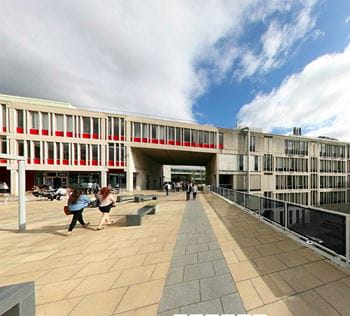
Set within 200 acres of award-winning parkland - Wivenhoe Park and located two miles from the historic city centre of Colchester – England's oldest recorded development. Our Colchester Campus is also easily reached from London and Stansted Airport in under one hour.
If you live too far away to come to Essex (or have a busy lifestyle), no problem. Our 360-degree virtual tour allows you to explore our University from the comfort of your home. Check out our Colchester virtual tour to see accommodation options, facilities and social spaces.
At Essex we pride ourselves on being a welcoming and inclusive student community. We offer a wide range of support to individuals and groups of student members who may have specific requirements, interests or responsibilities.
The University makes every effort to ensure that this information on its programme specification is accurate and up-to-date. Exceptionally it can be necessary to make changes, for example to courses, facilities or fees. Examples of such reasons might include, but are not limited to: strikes, other industrial action, staff illness, severe weather, fire, civil commotion, riot, invasion, terrorist attack or threat of terrorist attack (whether declared or not), natural disaster, restrictions imposed by government or public authorities, epidemic or pandemic disease, failure of public utilities or transport systems or the withdrawal/reduction of funding. Changes to courses may for example consist of variations to the content and method of delivery of programmes, courses and other services, to discontinue programmes, courses and other services and to merge or combine programmes or courses. The University will endeavour to keep such changes to a minimum, and will also keep students informed appropriately by updating our programme specifications. The University would inform and engage with you if your course was to be discontinued, and would provide you with options, where appropriate, in line with our Compensation and Refund Policy.
The full Procedures, Rules and Regulations of the University governing how it operates are set out in the Charter, Statutes and
Ordinances and in the University Regulations, Policy and Procedures.
Ask us a question
Want to quiz us about your course? Got a question that just needs answering? Get in touch with us on live chat!
3.png?mw=300)