What is the BSc (Hons) Business Management (Including Foundation Year)?
The BSc (Hons) Business Management (Including Foundation Year) is a four-year degree designed for UK and EU students whose qualifications do not yet meet the entry requirements for a three-year course.
Your Foundation Year helps you develop the academic skills, confidence and subject knowledge needed for university study while becoming part of Essex Business School from day one. You'll then progress onto the BSc (Hons) Business Management degree, where you'll explore how organisations operate, develop strategies, lead people and respond to today's business challenges.
Why this course
Benefit from a Foundation Year that prepares you for university-level study through dedicated academic skills support and subject-specific teaching.
Develop a broad understanding of business, from leadership and organisational behaviour to strategy, innovation and ethical management.
Graduate ready to pursue careers across business, management, consultancy or entrepreneurship with the confidence to succeed in a changing business environment.
Who should apply
UK and EU applicants whose qualifications do not yet meet the entry requirements for the three-year degree
Future business leaders, managers and entrepreneurs
Students interested in business strategy, organisational behaviour and management
Those looking to build confidence and academic skills before progressing to degree-level study
What you'll learn
Business strategy: Examine how organisations operate, develop strategies and navigate complex challenges in a changing world
Leadership and people: Explore organisational behaviour, leadership and human resource management
Core business knowledge: Develop your understanding of accounting, finance, marketing and ethical business management
Innovation and technology: Explore how AI, digital technologies and innovation are transforming the way organisations operate and create value
Your learning experience
Integrated Foundation Year: Build your academic skills while becoming part of Essex Business School from your first day, with at least 25% of your Foundation Year teaching delivered by the School
Academic skills support: Study dedicated modules designed to prepare you for university-level learning and build confidence in your studies
Real-world learning: Develop your knowledge through practical business topics, collaborative learning and contemporary organisational challenges
Independent research: Complete a final-year research project or dissertation investigating a business topic that interests you
Expert teaching: Learn from internationally recognised academics and researchers committed to responsible management and ethical business practices
Careers and outcomes
A BSc (Hons) Business Management (Including Foundation Year) prepares you for a wide range of careers, including:
Business management: Operations, business development and organisational management
Consultancy: Business analysis and innovation management
Leadership: Human resource management, project management and team leadership
Entrepreneurship: Launching your own business or driving innovation within established organisations
Employers of Business Management graduates
Graduates from Essex Business School who studied Business Management have progressed to roles in national and international organisations, including:
CEO and Founder of WYSPR - a 'Friendvertising' social media start-up
Business Development Manager at Footprint Digital - a fast-growing digital marketing agency
Sales and Marketing Manager at Chrysodalia - a Cyprus-based food manufacturing company
Digital Marketing Executive at Premier Labellers - a machinery manufacturer based in Essex
In addition to the skills development offered by Essex Business School, BSc (Hons) Business Management students can also take advantage of the University of Essex Careers Service, which supports undergraduate employability through careers fairs, mentoring, skills development, careers advice and guidance, placement support, job opportunities, start-up support and more.
Why we're great.
Take advantage of Essex Startups, the support scheme for entrepreneurial students.
We're world renowned for our research on workplace behaviour and management.
We are ranked in the Top 150 for business and economics in the THE World University Rankings by Subject 2026.
We have studied some really insightful case studies in my business management modules and our assignments have involved a lot of practical work, including: market research; writing a marketing plan: ethnographic research; strategy and analysis - which altogether has given me a sound understanding of how the concepts and models taught in the lectures are applied in the real-life setting.
This course is designed to provide you with a broad overview of all the main areas of business management, whilst also allowing you to be flexible to study your own areas of interest.
Year zero provides with you the necessary skills and knowledge in order for you to progress onto your chosen area of study. Successful completion of year zero guarantees you entry to the first year of your undergraduate degree course.
In the first year our current students cover the fundamentals that every business manager needs to know. However, we are planning some changes to our first year and we'll be tailoring it more closely to your chosen course. Then in second and final year you will have a mixture of compulsory and optional modules.
We offer a flexible course structure with a mixture of core/compulsory modules, and optional modules chosen from lists. Please be aware that we are planning changes to our first year to make it more relevant to your chosen course.
Our research-led teaching is continually evolving to address the latest challenges and breakthroughs in the field. The following modules are based on the current course structure and may change in response to new curriculum developments and innovation.
We understand that deciding where and what to study is a very important decision for you. We'll make all reasonable efforts to provide you with the courses, services and facilities as described on our website and in line with your contract with us. However, if we need to make material changes, for example due to significant disruption, we'll let our applicants and students know as soon as possible.
Components and modules explained
Components
Components are the blocks of study that make up your course. A component may have a set module which you must study, or a number of modules from which you can choose.
Each component has a status and carries a certain number of credits towards your qualification.
Status
What this means
Core
You must take the set module for this component and you must pass. No failure can be permitted.
Core with Options
You can choose which module to study from the available options for this component but you must pass. No failure can be permitted.
Compulsory
You must take the set module for this component. There may be limited opportunities to continue on the course/be eligible for the qualification if you fail.
Compulsory with Options
You can choose which module to study from the available options for this component. There may be limited opportunities to continue on the course/be eligible for the qualification if you fail.
Optional
You can choose which module to study from the available options for this component. There may be limited opportunities to continue on the course/be eligible for the qualification if you fail.
The modules that are available for you to choose for each component will depend on several factors, including which modules you have chosen for other components, which modules you have completed in previous years of your course, and which term the module is taught in.
Modules
Modules are the individual units of study for your course. Each module has its own set of learning outcomes and assessment criteria and also carries a certain number of credits.
In most cases you will study one module per component, but in some cases you may need to study more than one module. For example, a 30-credit component may comprise of either one 30-credit module, or two 15-credit modules, depending on the options available.
Modules may be taught at different times of the year and by a different department or school to the one your course is primarily based in. You can find this information from the module code. For example, the module code HR100-4-FY means:
HR
100
4
FY
The department or school the module will be taught by.
In this example, the module would be taught by the Department of History.
Want to use mathematical techniques to solve problems? And to calculate basic statistical measures? Develop mathematical skills like number work, algebra, geometry, probability and statistics that can be used on any course requiring mathematics above Higher GCSE standard. Learn to solve relevant problems and know how to present data clearly.
Academic Skills covers the key areas that you will experience during your degree, preparing you for aspects of academic study at undergraduate level. The module enables you to develop and enhance your existing abilities by focusing on the core skills of reading, writing, listening and speaking in an academic context. It does this with both generic texts and also, crucially, those related to your subject area. Academic Skills provides strategies for successful communication and interaction through independent and collaborative learning offering opportunity to further enhance your research skills. The content is designed to ensure that you acquire a range of transferable employability and life skills.
This module begins with the realm of management, exploring decision-making at individual, firm, and market levels. It covers essential management topics including models of management, corporate responsibility, communication, and innovation. Subsequently, the module transitions into examining economics perspectives on the role of market in determining prices and resource allocation, offering diverse viewpoints on decision-making to address economic challenges. It then extends into interactions between sectors such as household, firm, financial institution, government and foreign trade.
There is no assumption of prior knowledge of management or economics. It aims to equip students with a holistic understanding of economic and managerial dynamics. Real-life events, case studies and examples, combined with theories and concepts in management and economics, will be explored to foster deeper understanding.
The module aims to provide students with a basic understanding of essential elements of Financial Accounting, Corporate Finance and Marketing. The module assumes no prior knowledge and begins with how to start a business. It covers accounting as an information system and this is followed by corporate finance which focuses on how to raise, manage and invest business resources. The module finishes with a very important part of running a business, marketing, where students will learn how to identify, anticipate and satisfy customer needs. The syllabus will cover financial statement preparation, ratio analysis, short-term finance, financing strategies, investment appraisal, market research, branding, advertising and social media marketing, as well as the critical core of social marketing.
Introduction to Management is a broad-ranging module intended to provide a foundation in the most significant issues in management theory and practice, as well as to prepare you for related modules in subsequent years of your course. Because theoretical explanations, i.e. academic interpretations of what managers do and even of what they say they do, and what managers actually do in real organisations on a day-to-day basis, may differ, we will also draw out some of the connections and disjunctures between management theory and management practice. Our teaching also emphasises the ethics of managing and how to balance the bottom line of the business with the organisation's wider responsibilities to society and other stakeholders. The module also looks to explore how AI is being employed by managers and how this is changing the roles and responsibilities of the managers across sectors whilst also creating new risks and challenges.
A key module across all our Business, Management, and Marketing courses Introduction to Marketing sets out the fundamental principles of marketing and covers the core elements of marketing management. The module explores marketing planning; the segmentation, targeting and positioning (STP) process; and the extended marketing mix (product, price, promotion, place, people, process, and physical environment). The module aims to help students develop marketing knowledge and skills that are important for future modules as well as the workplace.
It’s essential that every aspiring entrepreneur, manager and leader understands the basics of accounting and finance. In this introductory module you’ll explore the principles of financial and management accounting; the recording of transactions; the preparation of financial statements and their analysis; the principles of cost accumulation and decision making in businesses; techniques of cost control; the management of working capital; the sources of funding and investment appraisal. You’ll explore the key theories, carry out problem-solving exercises and learn how to apply these within companies.
If you’re looking to start your own business, or to help an existing business to grow, then this module provides the essential knowledge you’ll need. You develop a greater understanding of the various aspects involved in new venture creation and growth, from opportunity identification, evaluation and implementation through to continued growth and management. Using practical exercises, case studies and videos, you learn about the business life cycle from start-up to growth and maturity and explore business development from economic and behavioural perspectives.
This module introduces you to key economic theories and concepts, covering highly topical issues affecting the business world. Using real-life case studies, you explore the key microeconomics principles and concepts that can help to explain why economic activities occur and explore whether it is possible to improve economic situations for society.
At Essex Business School we’re proud of our international community, bringing international expertise into the classroom. In this module you are introduced to the global business environment and how this impacts upon corporations and their decision to operate internationally. You explore the different strategies organisations can adopt when entering international markets and examine aspects of managing multinational corporations, such as marketing, human resource management and global supply chain management.
Introduction to Business Analytics will allow you to develop core knowledge and skills in the domain of business analytics and data science.
You’ll focus on different tools and approaches to support data analysis and decision making in business environment. The module is designed to enhance your ability of data analysis to uncover embedded information useful for decision making.Learn how to valuate the potential of data analytics in supporting complex decision making in real-world business environment.
This Professional and Academic Development module helps you build a foundation in core academic skill requirements to further improve the standard of your academic work across all of your first-year modules. This module also introduces you to the themes of career planning, employability skills, and awareness of career paths.
Principles of Operations and Supply Chain Management
(15 CREDITS)
The Principles of Operations and Supply Chain Management module integrates topics from manufacturing-operations, process design, capacity and inventory planning, and supply chain management. This module will give you an opportunity to develop knowledge and skills to manage business operations and supply chain effectively in a real-world environment.
The aim of this module is to provide comprehensive understanding of key principles, concepts and approaches used to ensure effective management of business operations and supply chain management. The module covers an extensive range of issues including structure and scope of operations, process design, capacity and inventory management, supply chain management and quality management.
This module builds on your understanding of management, work and organisation, exploring how these concepts have evolved over time and how they are understood now. You look at how management theory relates to organisational practice, examine the social dynamics underpinning the field of organisation studies and analyse some of the most important themes affecting management today.
This module introduces a number of business and management research methods, with a particular focus on entrepreneurship and small business. You explore philosophical research issues, such as selecting appropriate research methods and judging the quality and value of findings. You learn how to write a research proposal and design and plan quantitative and qualitative research. This includes collecting data, analysing findings and presenting results.
This module will give you a clear understanding of feedback, Dweck`s concept of a `growth mindset`, and how you can use these to improve your studies and career.
We want you to have a passion for learning, a willingness to challenge yourself, and an eagerness to learn from mistakes, so this module will help you to understand group work and presentations and to acquire the relevant skills to successfully undertake both.
The module also serves as a bridge for your final year, so that students should be able to understand the expectations of the final year and the possible career paths you can take after you graduate, and how you can use summer vacations to get ahead.
The business world is increasingly global, complex and fast changing. While some organisations are consistently successful over a long period of time, many fail and are forgotten forever. In theory it should become consecutively easier to imitate the strategies of winning companies and dissipate their profits. In practice, however, only a few firms become long-term leaders. In this course, you explore why that is.
The module aims to develop your understanding of leadership in organisations. You explore a range of traditional and current leadership theories and relate these to business and managerial practice. You also examine business ethics and develop your teamwork, critical thinking, and problem-solving skills.
This module explores the ethical dimensions, societal implications, and practical considerations of implementing Artificial Intelligence (AI) in the organisations and analytics context. It focuses on key themes such as fairness, transparency, privacy, and accountability, while examining fundamental concepts like algorithmic fairness, transparency, and ethical decision-making. Engaging with debates around AI autonomy, bias mitigation, and regulatory frameworks, students will develop a comprehensive understanding of the responsible AI landscape.
Political, economic, and socio-cultural changes have culminated in the emergence of Human Resource Management (HRM) as a distinct function within many organisations.
In particular, HRM has taken an increasingly strategic view of the organisations' employees as drivers of competitive advantage with primary HRM functions including recruitment and selection, performance and reward management, and training and development, which are correspondingly aligned with this aim. This is also accompanied by an increasing emphasis being placed on a host of new devolvement's including the use of digitised employee management systems and an emphasis on promoting organisational sustainability.
This module will explore existing theories and approaches to contemporary strategic HRM, while also adopting a critical perspective on their impact and implementation. In doing so, it will consider how institutional and cultural contexts shape the ways in which employer-employee relationships are constructed, enforced, and normalised and will seek to highlight and explain the oft-observed gaps between theory and practice. This will enable you to develop a critical appreciation of strategic HRM challenges and an understanding of its potential impact on individuals, organisations, and the wider society.
This module builds on your understanding of management and organisation by considering the ethics of business activity. You are introduced to the origins, practice and theory of business ethics and corporate social responsibility (CSR). You consider a range of perspectives and use business literature to critically examine organisational ethics and analyse its constraints.
This module has been designed to enable students to integrate their subject knowledge with an understanding of sustainable development, acquiring the skills and competencies essential for addressing the urgent sustainability challenges of the 21st century.
This module will help you to understand the interests, skills and competencies which are relevant to your future career choices.
You will learn how to find the graduate-level roles and career paths available to business students and you will learn about the skills necessary to successfully compete in the graduate labour market after you graduate.
Undergraduate students at the Department of Essex Business School typically have 12 hours of teaching time per week.
Teaching includes a combination of lectures, seminars and computer-based lab sessions
Modules delivered by experts in the field as well as guest speakers
Contribute and interact in lectures through the use of smart technology
Lecture presentations and notes are uploaded online beforehand to help you prepare in advance
Complete your final-year project in consultation with a personal supervisor
Assessment
Assessed through traditional methods of end-of-year exams and multiple-choice questions in class tests and essays
Plus more innovative and creative assessments include laboratory work, poster presentations, real-business case problems and group presentations
Your first year marks do not count towards your final degree
Entry requirements
UK entry requirements
UK and EU applicants:
All applications for degree courses with a foundation year (Year Zero) will be considered individually, whether you
think you might not have the grades to enter the first year of a degree course;
have non-traditional qualifications or experience;
are returning to university after some time away from education; or
are looking for more support during the transition into university study.
Standard offer:
Our standard offer is 72 UCAS tariff points from at least two full A-levels, or equivalent.
For this course all applicants must also hold GCSE Maths at grade C/4 or above (or equivalent). We may be able to consider a pass in OFQUAL regulated Level 2 Functional Skills Maths where you cannot meet the requirements for Maths at GCSE level. However, you are advised to try to retake GCSE Mathematics if possible as this will better prepare you for university study and future employment.
Mature applicants and non-traditional academic backgrounds:
We welcome applications from mature students (over 21) and students with non-traditional academic backgrounds (might not have gone on from school to take level 3 qualifications). We will consider your educational and employment history, along with your personal statement and reference, to gain a rounded view of your suitability for the course.
You will still need to meet our GCSE requirements.
International applicants:
We are unable to accept applications from international students for our foundation year courses. Foundation pathways for international students are available at the University of Essex International College and are delivered and awarded by Kaplan, in partnership with the University of Essex. Successful completion will enable you to progress to the relevant degree course at the University of Essex.
International & EU entry requirements
We accept a wide range of qualifications from applicants studying in the EU and other countries. Get in touch with any questions you may have about the qualifications we accept. Remember to tell us about the qualifications you have already completed or are currently taking.
Sorry, the entry requirements for the country that you have selected are not available here. Please contact our Undergraduate Admissions team at ugquery@essex.ac.uk to request the entry requirements for this country.
English language requirements
English language requirements for applicants whose first language is not English
IELTS 5.5 overall with a minimum of 5.5 in each component, or specified score in an equivalent test that we accept.
If we accept the English component of an international qualification it will be included in the academic levels listed above for the relevant countries.
Pre-sessional English courses
If you do not meet our IELTS requirements then you may be able to complete a pre-sessional English pathway that enables you to start your course without retaking IELTS.
Additional Notes
If you’re an international student, but do not meet the requirements for direct admission to this degree or the first year of a degree at Essex, you could prepare and gain entry through a pathway course. Find out more about opportunities available to you at the University of Essex International College
Our events are a great way to find out more about studying at Essex. We run a number of Open Days throughout the year which enable you to discover what our campus has to offer.
You have the chance to:
tour our campus and accommodation
find out answers to your questions about our courses, student finance, graduate employability, student support and more
meet our students and staff
Check out our Visit Us pages to find out more information about booking onto one of our events. And if the dates aren’t suitable for you, feel free to book a campus tour here.
Our UK students, and some of our EU students, who are still at school or college, can apply through their school. Your school will be able to check and then submit your completed application to UCAS. Our other EU applicants or independent applicants in the UK can also apply online through UCAS Apply.
The UCAS code for our University of Essex is ESSEX E70. The individual campus codes for our Loughton and Southend Campuses are ‘L' and ‘S' respectively.
For information on transferring from another university, applying when you are not at school or college, and applying for readmission, please see How to apply and entry requirements
Please note that this course is not open to international applicants.
Visit Colchester Campus
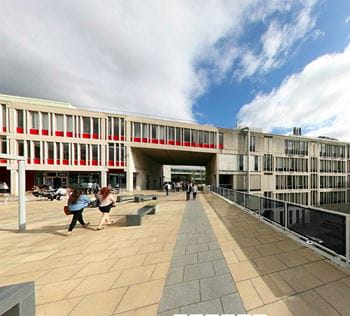
Set within 200 acres of award-winning parkland - Wivenhoe Park and located two miles from the historic city centre of Colchester – England's oldest recorded development. Our Colchester Campus is also easily reached from London and Stansted Airport in under one hour.
If you live too far away to come to Essex (or have a busy lifestyle), no problem. Our 360-degree virtual tour allows you to explore our University from the comfort of your home. Check out our Colchester virtual tour to see accommodation options, facilities and social spaces.
Chat to us
Got a question about this course? Chat with Dr Jordon Lazell, Director of Student Recruitment in Essex Business School.
At Essex we pride ourselves on being a welcoming and inclusive student community. We offer a wide range of support to individuals and groups of student members who may have specific requirements, interests or responsibilities.
The University makes every effort to ensure that this information on its programme specification is accurate and up-to-date. Exceptionally it can be necessary to make changes, for example to courses, facilities or fees. Examples of such reasons might include, but are not limited to: strikes, other industrial action, staff illness, severe weather, fire, civil commotion, riot, invasion, terrorist attack or threat of terrorist attack (whether declared or not), natural disaster, restrictions imposed by government or public authorities, epidemic or pandemic disease, failure of public utilities or transport systems or the withdrawal/reduction of funding. Changes to courses may for example consist of variations to the content and method of delivery of programmes, courses and other services, to discontinue programmes, courses and other services and to merge or combine programmes or courses. The University will endeavour to keep such changes to a minimum, and will also keep students informed appropriately by updating our programme specifications. The University would inform and engage with you if your course was to be discontinued, and would provide you with options, where appropriate, in line with our Compensation and Refund Policy.
The full Procedures, Rules and Regulations of the University governing how it operates are set out in the Charter, Statutes and
Ordinances and in the University Regulations, Policy and Procedures.
3.png?mw=300)