History with Human Rights is an undergraduate degree that combines the study of history with critical engagement in human rights. The standard programme runs for three years, with optional variants including a placement year, a foundation year or a year abroad for those who wish to extend their studies or gain additional experience.
You will explore how ideas of human rights, justice and freedom have developed over time, while studying key historical periods and events that have shaped societies across the world. By graduation, you will have developed strong historical knowledge alongside a deep understanding of human rights, preparing you for careers that value critical thinking, ethical judgement and contextual analysis.
Why this course
History with Human Rights enables you to understand contemporary human rights issues through their historical foundations. The course encourages you to examine how political, social and cultural change has influenced the development of rights, laws and institutions.
You will study history from the early modern period to the present day, alongside human rights perspectives drawn from politics, sociology, philosophy and law. This combined approach allows you to explore questions of justice, inequality, power, citizenship and identity in a historically informed way.
This course is ideal if you are interested in how past events and ideas continue to shape modern debates around human rights, social justice and global responsibility.
Who should apply
Students interested in history, justice and social change, who want to understand human rights in historical context
Learners who enjoy analysing complex texts, historical sources and competing interpretations
Those considering careers where ethical reasoning, research and critical analysis are essential
People seeking a humanities degree with strong relevance to contemporary global issues
What you will learn
Historical study of early modern and modern periods, examining political, social and cultural change
The development of human rights ideas, movements and frameworks over time
Interdisciplinary perspectives on human rights, including political, sociological, philosophical and economic approaches
Analytical skills including historical research, critical thinking, argument construction and structured writing
Your learning experience
Flexible study options including a foundation year, placement year or year abroad
Interdisciplinary teaching that combines history with human rights perspectives
Small group seminars that encourage discussion, debate and independent thought
Assessment through essays, critical commentaries, research projects and an extended dissertation
The course supports the development of strong research and communication skills, helping you to connect historical knowledge with contemporary human rights challenges.
Careers and outcomes
Graduates with a degree in History with Human Rights can pursue careers in a wide range of fields, including:
Human rights, social justice and advocacy organisations
Public policy, government and civil service roles
Education, research and heritage sectors
Media, communications and campaigning roles
Further academic study, including postgraduate degrees in history, law, human rights or related disciplines
Why we're great.
Our senior Human Rights scholars have held - and continue to occupy - key positions in the United Nations human rights and development fields.
You can choose from a unique and diverse range of topics, periods and countries.
We offer financial assistance for voluntary work at local museums, archives and heritage sites.
Study abroad
>
Course content
Components and modules explained
Components
Components are the blocks of study that make up your course. A component may have a set module which you must study, or a number of modules from which you can choose.
Each component has a status and carries a certain number of credits towards your qualification.
Status
What this means
Core
You must take the set module for this component and you must pass. No failure can be permitted.
Core with Options
You can choose which module to study from the available options for this component but you must pass. No failure can be permitted.
Compulsory
You must take the set module for this component. There may be limited opportunities to continue on the course/be eligible for the qualification if you fail.
Compulsory with Options
You can choose which module to study from the available options for this component. There may be limited opportunities to continue on the course/be eligible for the qualification if you fail.
Optional
You can choose which module to study from the available options for this component. There may be limited opportunities to continue on the course/be eligible for the qualification if you fail.
The modules that are available for you to choose for each component will depend on several factors, including which modules you have chosen for other components, which modules you have completed in previous years of your course, and which term the module is taught in.
Modules
Modules are the individual units of study for your course. Each module has its own set of learning outcomes and assessment criteria and also carries a certain number of credits.
In most cases you will study one module per component, but in some cases you may need to study more than one module. For example, a 30-credit component may comprise of either one 30-credit module, or two 15-credit modules, depending on the options available.
Modules may be taught at different times of the year and by a different department or school to the one your course is primarily based in. You can find this information from the module code. For example, the module code HR100-4-FY means:
HR
100
4
FY
The department or school the module will be taught by.
In this example, the module would be taught by the Department of History.
Rebellious Pasts: Challenging and Creating Histories
(30 CREDITS)
The past is never dead. It’s not even past’. In a world of conspiracy theories, toppling statues, and ‘culture wars’, the novelist William Faulkner’s most famous line resonates more than ever. Across the globe, History is co-opted to multiple causes and used to justify contradictory positions. Such uses of History often rely on myths, stereotypes, and misunderstandings. How can we separate political belief, personal opinion, and false information about the past from historical knowledge and understanding?
Rebellious Pasts looks at the creation, consolidation, and operation of historical myths and stereotypes – and at how we, as historians, can use the tools of our trade to identify and challenge misleading representations of the past, replacing them with richer forms of understanding. The module helps you to develop the critical mindset needed to analyse historical arguments wherever you find them, but also the constructive skills essential to researching and writing your own histories. It combines lectures and seminars exploring how history “works” in different contexts with archive visits and library workshops that expose you to the raw materials of History.
On Rebellious Pasts, you will undertake self-directed research drawing upon digitized collections, archives, and heritage sector institutions, and translate your findings into accessible public history artefacts. At its heart, History is the refusal to accept easy assumptions and the insistence on negotiating with evidence, no matter how tricky that is. By the end of the module, you will understand why History is a rebellious discipline – and how to harness its unruly powers.
What are human rights? How do we protect them? And what challenges do we face when promoting human rights on an international level? Discover the fundamental principles and practices, including topics related to international law and ethics, which underpin the protection and promotion of our human rights.
This course introduces key academic, professional and personal skills to support a successful transition beyond undergraduate study. Students develop confidence in critical thinking, communication, teamwork and self reflection while exploring future study and career options.
History is never neutral. It is always a response to the questions historians choose to ask of the past. Historians decide what questions to ask for all kinds of reasons – out of interest, to aid understanding of specific aspects of the world around them, because certain types of evidence are available, or because the work of other historians has prompted them to think anew. These questions shape the evidence that historians look at, and therefore the kinds of answers they are likely to find. History is always a trialogue between the historian, the questions, and the evidence – and it is therefore a product of the present as well as the past.
Exploring History focuses on the relationship between questions and evidence in forming historical knowledge. Consolidating and extending the skills and abilities introduced in the Year 1 module Rebellious Pasts, it charts the development of the historical discipline, examines specific examples of historical debate (or what is known as “historiography”), and introduces you to different types of historical evidence and ways of analysing this evidence. Through exploring historical debates you will gain new insight into how history is researched, written, and contested. Through in-depth examinations of different kinds of primary sources you will develop new skills in historical research. Finally, you will bring these abilities together to research and write an extended essay on a topic of your choice, developing and practising the skills you will employ in your final year History Research Project.
Human Rights, Regional Systems & Global Challenges
(30 CREDITS)
This module builds on the foundations laid in the first year and introduces students to the institutions that uphold and enforce international human rights standards, as well as the multidisciplinary nature of Human Rights and Social Justice.
Beyond the BA: Building Career and Employability Readiness
(0 CREDITS)
This course focuses on preparing students for the graduate job market and wider professional life. Students develop practical employability skills including career planning, applications, interviews and professional identity, while reflecting on their strengths and goals.
You’ve spent years studying History – now is the opportunity to off your skills as a historian. The History Research Project is the culmination of the degree scheme. Building on and extending the skills developed in the earlier parts of the degree, you will contribute to historical knowledge and understanding through conducting independent research on a topic of your choice.
You also have the opportunity to choose how you want to present your research. You can choose to submit an 8,000-word dissertation or a 5,000-word research report plus a public history output such as a podcast, web resources, or film script that showcases historical research for a non-academic audience. Whichever route you choose, you will be supported by the expert guidance of an academic supervisor who will help you to identify and analyse primary sources, place these in the context of secondary sources, and understand your topic in relation to wider themes and debates.
How important are human rights today? What role do they play in contemporary society? And can you analyse their impact on topics like freedom of expression or global justice? Learn to identify and evaluate human rights issues in range of real-life situations, within a regional, national and international context.
This course supports students as they prepare for life after university. It focuses on advanced professional skills, independent learning and personal development, helping students navigate work, further study and wider life challenges with confidence.
112 UCAS tariff points from a minimum of 2 full A-levels.
IB: 29 points in the IB Diploma or 112 UCAS tariff points to include a minimum of 2 Higher Level subjects.
We accept A-levels, AAQs, BTECs, Access to HE Diploma, T-levels and most other qualifications that hold UCAS tariff points. Acceptability of some non A-level qualifications (such as BTECs) may depend on the subject studied and units taken.
You can calculate your UCAS tariff points on the UCAS website.
Whilst International A-levels and BTECs aren't on the UCAS tariff calculator, we assign them the same tariff points as their UK counterparts.
Don't meet the entry requirements?
We know everyone's journey is different. If your achieved or predicted grades don’t match our entry requirements, you have a non-traditional educational background, or you're returning to study as a mature student, we'd still encourage you to apply. We review every application individually and may be able to offer you a place on this course, or an alternative route such as a foundation year.
Find out more about applying, personal statements, references, visas, deferred entry, extenuating circumstances, and support for mature students on our undergraduate application information page.
Contextual Offers:
We are committed to ensuring that all students with the merit and potential to benefit from an Essex education are supported to do so. We make Contextual Offers to applicants from underrepresented groups residing in the UK. Our Contextual Offers policy outlines the full eligibility criteria.
96 UCAS tariff points from a minimum of 2 full A-levels.
International & EU entry requirements
We accept a wide range of qualifications from applicants studying in the EU and other countries. Get in touch with any questions you may have about the qualifications we accept. Remember to tell us about the qualifications you have already completed or are currently taking.
Sorry, the entry requirements for the country that you have selected are not available here. Please contact our Undergraduate Admissions team at ugquery@essex.ac.uk to request the entry requirements for this country.
English language requirements
English language requirements for applicants whose first language is not English
IELTS 6.0 overall with a minimum of 5.5 in each component, or specified score in an equivalent test that we accept.
Details of English language requirements and the tests we accept for applicants who require a Student visa (excluding Nationals of Majority English Speaking Countries) can be found here
If we accept the English component of an international qualification it will be included in the academic levels listed above for the relevant countries.
Pre-sessional English courses
If you do not meet our IELTS requirements then you may be able to complete a pre-sessional English pathway that enables you to start your course without retaking IELTS.
Additional Notes
If you’re an international student, but do not meet the academic requirements for direct admission to this degree, you could prepare and gain entry through a pathway course. Find out more about opportunities available to you at the University of Essex International College
Fees and funding
Home/UK fee
£10,050 per year
International fee
£22,575 per year
Fees will increase for each academic year of study.
If your course has the option to include a placement year or study abroad, and you choose to do so, you will pay the following:
Our events are a great way to find out more about studying at Essex. We run a number of Open Days throughout the year which enable you to discover what our campus has to offer.
You have the chance to:
tour our campus and accommodation
find out answers to your questions about our courses, student finance, graduate employability, student support and more
meet our students and staff
Check out our Visit Us pages to find out more information about booking onto one of our events. And if the dates aren’t suitable for you, feel free to book a campus tour here.
Our UK students, and some of our EU and international students, who are still at school or college, can apply through their school. Your school will be able to check and then submit your completed application to UCAS. Our other international applicants (EU or worldwide) or independent applicants in the UK can also apply online through UCAS Apply.
The UCAS code for our University of Essex is ESSEX E70. The individual campus codes for our Loughton and Southend Campuses are 'L' and 'S' respectively.
You can find further information on how to apply, including information on transferring from another university, applying if you are not currently at a school or college, and applying for readmission on our How to apply and entry requirements page.
If you receive an undergraduate offer to study with us in October 2026 and live in the UK, you will receive an email invitation to book onto one of our Open Days. These events provide the opportunity to meet your department, join interesting taster sessions, tour our campus and accommodation, and chat to current students. You can visit our Open Days event page for more information, including terms and conditions.
Applicant Days and interviews
If you are an undergraduate student who has received an offer from us to study with us from October 2021, you will be invited to attend a Virtual Applicant Day so that you can get to know us from the comfort of your own home. Our Virtual Applicant Days will run until June 2021 and give you the chance meet academics online from the department you've applied to, and attend live talks and Q&A's on our Virtual Applicant Day platform.
Some of our courses also require a compulsory interview. If you have applied to one of these courses you will receive an invite to a Zoom interview via email, along with further details about the interview process.
Visit Colchester Campus
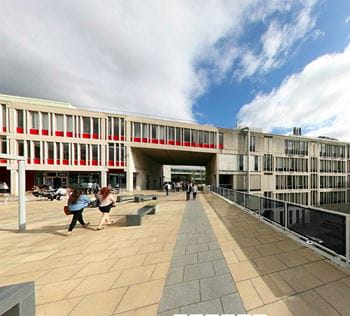
Set within 200 acres of award-winning parkland - Wivenhoe Park and located two miles from the historic city centre of Colchester – England's oldest recorded development. Our Colchester Campus is also easily reached from London and Stansted Airport in under one hour.
If you live too far away to come to Essex (or have a busy lifestyle), no problem. Our 360-degree virtual tour allows you to explore our University from the comfort of your home. Check out our Colchester virtual tour to see accommodation options, facilities and social spaces.
At Essex we pride ourselves on being a welcoming and inclusive student community. We offer a wide range of support to individuals and groups of student members who may have specific requirements, interests or responsibilities.
The University makes every effort to ensure that this information on its programme specification is accurate and up-to-date. Exceptionally it can be necessary to make changes, for example to courses, facilities or fees. Examples of such reasons might include, but are not limited to: strikes, other industrial action, staff illness, severe weather, fire, civil commotion, riot, invasion, terrorist attack or threat of terrorist attack (whether declared or not), natural disaster, restrictions imposed by government or public authorities, epidemic or pandemic disease, failure of public utilities or transport systems or the withdrawal/reduction of funding. Changes to courses may for example consist of variations to the content and method of delivery of programmes, courses and other services, to discontinue programmes, courses and other services and to merge or combine programmes or courses. The University will endeavour to keep such changes to a minimum, and will also keep students informed appropriately by updating our programme specifications. The University would inform and engage with you if your course was to be discontinued, and would provide you with options, where appropriate, in line with our Compensation and Refund Policy.
The full Procedures, Rules and Regulations of the University governing how it operates are set out in the Charter, Statutes and
Ordinances and in the University Regulations, Policy and Procedures.
Ask us a question
Want to quiz us about your course? Got a question that just needs answering? Get in touch with us on live chat!
3.png?mw=300)