What is the BEng (Hons) Computer Systems Engineering?
The BEng (Hons) Computer Systems Engineering is a three-year degree, extendable to four with an optional year in placement or abroad.
You’ll build a strong foundation in core computer science theory as well as the architecture and components of digital computer, electronic and embedded systems.
Why this course
The BEng (Hons) Computer Systems Engineering gives you the theory and practical knowledge to understand – and create – computer systems that make a real impact on the world.
You’ll learn from active computer scientists and engineers whose work and teaching are driven by creativity and imagination as well as technical excellence. Discover which areas you’re interested in exploring further such as assistive technologies, computer games, artificial intelligence, evolutionary computation, Big Data or robotics.
You’ll also be able to undertake a project or product development specified by one of our academics or partner companies.
Add a placement year or study abroad to put your learning into practice, expand your perspective and build confidence in professional or international settings.
By graduation, you’ll have the confidence and ability to dig deeper into how computer systems influence people’s lives. You’ll be ready for careers in systems analysis, engineering and programming.
Who should apply
Future computer scientists and engineers
Students eager to develop their own computer systems, from everyday use to unique applications
Those considering a career that benefits from a broad understanding of how computers and digital systems work
People who get to the heart of how things work
What you’ll learn
Programming: Learn to programme with multiple programming languages
Digital systems: Grasp the software and hardware underpinning digital computer systems
Design: Choose from advanced modules in digital and embedded systems design
Data: Explore ways to work with data from data structures to Big Data
Specialise: Tailor your degree through your choice of optional modules
Your learning experience
Optional study abroad year: Spend a year at one of our partner universities and experience another culture with the Study Abroad programme
Optional placement year: Gain professional experience in a business or organisation with university support from Placements at Essex
Expert teaching: Learn from leading researchers revolutionising industries such as agriculture and healthcare
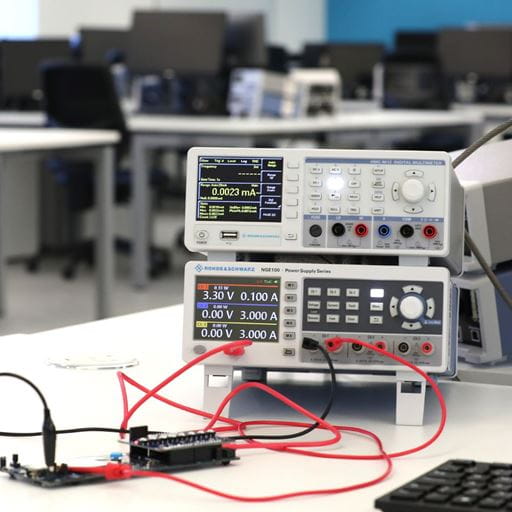
Specialist facilities: Access 24/7 computing labs with a range of programming software and specialist facilities for brain-computer interfaces, intelligent environments and more
Employability support: Take work-based learning modules with live employer projects or a placement
Careers and outcomes
A BEng (Hons) Computer Systems Engineering degree prepares you for diverse careers in:
IT: Systems and applications analysis, computer network architecture, database systems administration, security analysis
Healthcare: Biomedical technology, clinical data and systems administration
Business and finance: Financial analysis, data analysis, risk management
Energy: Energy generation and distribution systems, data analysis, technological improvement
Computer games: Development, programming
Professional accreditation
Accredited by BCS, the Chartered Institute for IT for the purposes of fully meeting the academic requirement for registration as a Chartered IT Professional.
Accredited by BCS, the Chartered Institute for IT on behalf of the Engineering Council for the purposes of fully meeting the academic requirement for Incorporated Engineer and partially meeting the academic requirement for a Chartered Engineer.
Accredited by the Institution of Engineering and Technology (IET) on behalf of the Engineering Council for the purposes of fully meeting the academic requirement for registration as an Incorporated Engineer and partially meeting the academic requirement for registration as a Chartered Engineer.
Why we're great.
8th for student positivity in engineering (National Student Survey 2026, English broad-discipline institutions)
92% student positivity score for academic support in the School of Computer Science and Electronic Engineering (National Student Survey 2026)
Top 150 (joint 10th in the UK) for telecommunications engineering in Shanghai Ranking’s Global Ranking of Academic Subjects 2025
Our research-led teaching is continually evolving to address the latest challenges and breakthroughs in the field. The following modules are based on the current course structure and may change in response to new curriculum developments and innovation.
We understand that deciding where and what to study is a very important decision for you. We'll make all reasonable efforts to provide you with the courses, services and facilities as described on our website and in line with your contract with us. However, if we need to make material changes, for example due to significant disruption, we'll let our applicants and students know as soon as possible.
Components and modules explained
Components
Components are the blocks of study that make up your course. A component may have a set module which you must study, or a number of modules from which you can choose.
Each component has a status and carries a certain number of credits towards your qualification.
Status
What this means
Core
You must take the set module for this component and you must pass. No failure can be permitted.
Core with Options
You can choose which module to study from the available options for this component but you must pass. No failure can be permitted.
Compulsory
You must take the set module for this component. There may be limited opportunities to continue on the course/be eligible for the qualification if you fail.
Compulsory with Options
You can choose which module to study from the available options for this component. There may be limited opportunities to continue on the course/be eligible for the qualification if you fail.
Optional
You can choose which module to study from the available options for this component. There may be limited opportunities to continue on the course/be eligible for the qualification if you fail.
The modules that are available for you to choose for each component will depend on several factors, including which modules you have chosen for other components, which modules you have completed in previous years of your course, and which term the module is taught in.
Modules
Modules are the individual units of study for your course. Each module has its own set of learning outcomes and assessment criteria and also carries a certain number of credits.
In most cases you will study one module per component, but in some cases you may need to study more than one module. For example, a 30-credit component may comprise of either one 30-credit module, or two 15-credit modules, depending on the options available.
Modules may be taught at different times of the year and by a different department or school to the one your course is primarily based in. You can find this information from the module code. For example, the module code HR100-4-FY means:
HR
100
4
FY
The department or school the module will be taught by.
In this example, the module would be taught by the Department of History.
Our Team Project Challenge gives you the opportunity to develop a range of professional skills by working as part of a small student team on a specific project. The projects are research-based and incorporate the concepts of specifications, design, and implementation. You’ll learn about sustainability, project and time management, design, legal issues, health and safety, data analysis and presentation, team reporting, and self-evaluation.
You’ll also develop skills such as critical thinking and problem solving, agility, leadership, collaboration across networks, and effective oral and written communication, as well as curiosity and imagination, all of which will enhance your knowledge, confidence and social skills necessary to innovate and succeed in a competitive global environment.
The aim of this module is to cover fundamental mathematics for Computer Scientists. It does not assume A-level mathematics, and the emphasis and delivery will be on understanding the key concepts as they apply to Computer Science.
This module will provide you with an introduction to fundamental concepts of computer programming in the C language, which is particularly relevant to programming embedded systems and for electronic engineers.
Want to become a Java programmer? Topics covered in this module include control structures, classes, objects, inheritance, polymorphism, interfaces, file I/O, event handling, graphical components, and more. You will develop your programming skills in supervised lab sessions where help will be at hand should you require it.
Databases are everywhere. They are employed in banking, production control and the stock market, as well as in scientific and engineering applications. For example, the Human Genome Project had the goal of mapping the sequence of chemical base pairs which make up human DNA. The result is a genome database. This module introduces the underlying principles of databases, database design and database systems. It covers the fundamental concepts of databases, and prepares the student for their use in commerce, science and engineering.
Data structures and algorithms are two of the foundations of computer science, distinguishing it from just programming. In this module, you will learn what algorithms are and how they can be implemented even in very simple computers. You will cover fundamental algorithms for sorting and searching, along with data structures for lists and trees, and will be introduced to the analysis of algorithm efficiency.
Computers, embedded systems, and digital systems in general have become an essential part of most people's lives, whether directly or indirectly. The aim of this module is to introduce the software and hardware underpinnings of such systems at an introductory yet challenging level suitable for future computer scientists and engineers. Topics covered in the module include both top-view as well as bottom-view approaches to understanding digital computers. They range from the more theoretical (e.g., state machines, logic circuits, and von Neumann's architecture) to the more practical (e.g., how transistors produce binary signals, operating system functions, memory management, and common hardware devices). The module also includes problem solving classes in which a guided discussion of weekly exercises is aimed at giving the student an opportunity to consolidate his/her understanding of the topics involved. Upon completion of this module, students should have a good conceptual and practical understanding of the nature and architecture of digital computer systems and their components.
This module develops the fundamental concepts introduced in the Digital Systems Architecture. We examine how data are represented within digital systems, including floating point, 'text' and 'data' files, and how the conversions between internal and human-readable forms are performed. The design and applications of higher-level logic elements such as counters, registers and multiplexers are discussed, as well as the more general concept of the finite state machine and its design. Transmission of digital data between systems is introduced by examination of the RS232 protocol. Further, fundamental decisions on how such sources should be represented in digital format include sample rates and quantization accuracy are discussed. In the case of audio and video especially, the possibilities for signal processing and data compression are investigated
This module introduces fundamental concepts of digital signal processing and their applications in the analysis of biomedical signals. It describes how signals can be represented as digital waveforms, explores the application of digital filtering techniques to enhance noisy signals, and looks at analysis of signals in both the time and frequency domains. Additionally, the module explores the extraction of biomedical signal characteristics for classification tasks. The module is designed to teach Digital Signal Processing to students without prior knowledge of calculus or Fourier analysis. However, you should take an introductory mathematics module to prepare you for this module, such as Mathematics for Computing.
The overall goal of this module is to provide you with an understanding of how programs are written in C (a computer programming language) to solve engineering problems. Learn how to program an embedded microprocessor in C and how to design embedded microprocessor systems as solutions to various problems. Explore the design input and output modules for an embedded system.
This course covers the principles of project management, team working, communication, legal issues, finance, and company organisation. Working in small teams, students will go through the full project life-cycle of design, development and implementation, for a bespoke software requirement. In this course, students gain vital experience to enable them to enter the computer science/Electrical engineering workforce, with a degree backed by the British Computer Society, and by the Institute of Engineering and Technology.
The highlight of our undergraduate degree courses is the individual capstone project. This project module provides students with the opportunity to bring together all the skills they have gained during their degree and demonstrate that they can develop a product from the starting point of a single 1/2 page description, provided either by an academic member of staff or an external company. In all the student spends 450 hours throughout the academic year, reporting to their academic tutor, and in the case of company projects, to a company mentor. All projects are demonstrated to external companies on our Project Open Day.
On a placement year you gain relevant work experience within an external business or organisation, giving you a competitive edge in the graduate job market and providing you with key contacts within the industry. The rest of your course remains identical to the three-year degree.
Year abroad
On your year abroad, you have the opportunity to experience other cultures and languages, to broaden your degree socially and academically, and to demonstrate to employers that you are mature, adaptable, and organised. The rest of your course remains identical to the three-year degree.
Teaching
Courses are taught by a combination of lectures, laboratory work, assignments, and individual and group project activities.
Undergraduate students in the School of Computer Science and Electronic Engineering typically attend a two-hour lecture and a two-hour lab for each 15-credit module.
A significant amount of practical lab work will need to be undertaken for written assignments and as part of your learning.
Assessment
In your first year, you will have exams before the start of term in January.
You are assessed through a combination of written examinations and coursework.
All our modules include a significant coursework element.
You receive regular feedback on your progress through in-term tests.
Entry requirements
UK entry requirements
GCSE: Mathematics C/4.
Plus one of the level 3 qualifications below:
112 UCAS tariff points from a minimum of the equivalent of 2 full A-levels.
IB: 29 points in the IB Diploma or 112 UCAS tariff points to include a minimum of 2 Higher Level subjects. Our Maths requirement can be met with either: 2 in Standard level Maths; 2 in Higher level Maths; or 4 in IB Middle Years Maths.
We accept A-levels, AAQs, BTECs, Access to HE Diploma, T-levels and most other qualifications that hold UCAS tariff points. Acceptability of some non A-level qualifications (such as BTECs) may depend on the subject studied and units taken.
You can calculate your UCAS tariff points on the UCAS website.
Whilst International A-levels and BTECs aren't on the UCAS tariff calculator, we assign them the same tariff points as their UK counterparts.
Don't meet the entry requirements?
We know everyone's journey is different. If your achieved or predicted grades don’t match our entry requirements, you have a non-traditional educational background, or you're returning to study as a mature student, we'd still encourage you to apply. We review every application individually and may be able to offer you a place on this course, or an alternative route such as a foundation year.
Find out more about applying, personal statements, references, visas, deferred entry, extenuating circumstances, and support for mature students on our undergraduate application information page.
Contextual Offers:
We are committed to ensuring that all students with the merit and potential to benefit from an Essex education are supported to do so. We make Contextual Offers to applicants from underrepresented groups residing in the UK. Our Contextual Offers policy outlines the full eligibility criteria.
GCSE Mathematics C/4 plus
96 UCAS tariff points from a minimum of 2 full A-levels.
International & EU entry requirements
We accept a wide range of qualifications from applicants studying in the EU and other countries. Get in touch with any questions you may have about the qualifications we accept. Remember to tell us about the qualifications you have already completed or are currently taking.
Sorry, the entry requirements for the country that you have selected are not available here. Please contact our Undergraduate Admissions team at ugquery@essex.ac.uk to request the entry requirements for this country.
English language requirements
English language requirements for applicants whose first language is not English
IELTS 6.0 overall with a minimum of 5.5 in each component, or specified score in an equivalent test that we accept.
Details of English language requirements and the tests we accept for applicants who require a Student visa (excluding Nationals of Majority English Speaking Countries) can be found here
If we accept the English component of an international qualification it will be included in the academic levels listed above for the relevant countries.
Pre-sessional English courses
If you do not meet our IELTS requirements then you may be able to complete a pre-sessional English pathway that enables you to start your course without retaking IELTS.
Additional Notes
If you’re an international student, but do not meet the academic requirements for direct admission to this degree, you could prepare and gain entry through a pathway course. Find out more about opportunities available to you at the University of Essex International College
Fees and funding
Home/UK fee
£10,050 per year
International fee
£26,325 per year
Fees will increase for each academic year of study.
If your course has the option to include a placement year or study abroad, and you choose to do so, you will pay the following:
Our events are a great way to find out more about studying at Essex. We run a number of Open Days throughout the year which enable you to discover what our campus has to offer.
You have the chance to:
tour our campus and accommodation
find out answers to your questions about our courses, student finance, graduate employability, student support and more
meet our students and staff
Check out our Visit Us pages to find out more information about booking onto one of our events. And if the dates aren’t suitable for you, feel free to book a campus tour here.
Our UK students, and some of our EU and international students, who are still at school or college, can apply through their school. Your school will be able to check and then submit your completed application to UCAS. Our other international applicants (EU or worldwide) or independent applicants in the UK can also apply online through UCAS Apply.
The UCAS code for our University of Essex is ESSEX E70. The individual campus code for our Loughton Campus is 'L'.
You can find further information on how to apply, including information on transferring from another university, applying if you are not currently at a school or college, and applying for readmission on our How to apply and entry requirements page.
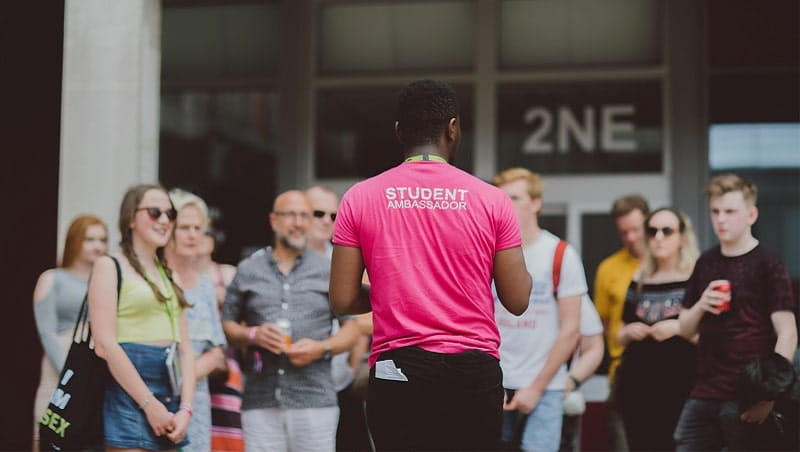
If you receive an undergraduate offer to study with us in October 2026 and live in the UK, you will receive an email invitation to book onto one of our Open Days. These events provide the opportunity to meet your department, join interesting taster sessions, tour our campus and accommodation, and chat to current students. You can visit our Open Days event page for more information, including terms and conditions.
Visit Colchester Campus
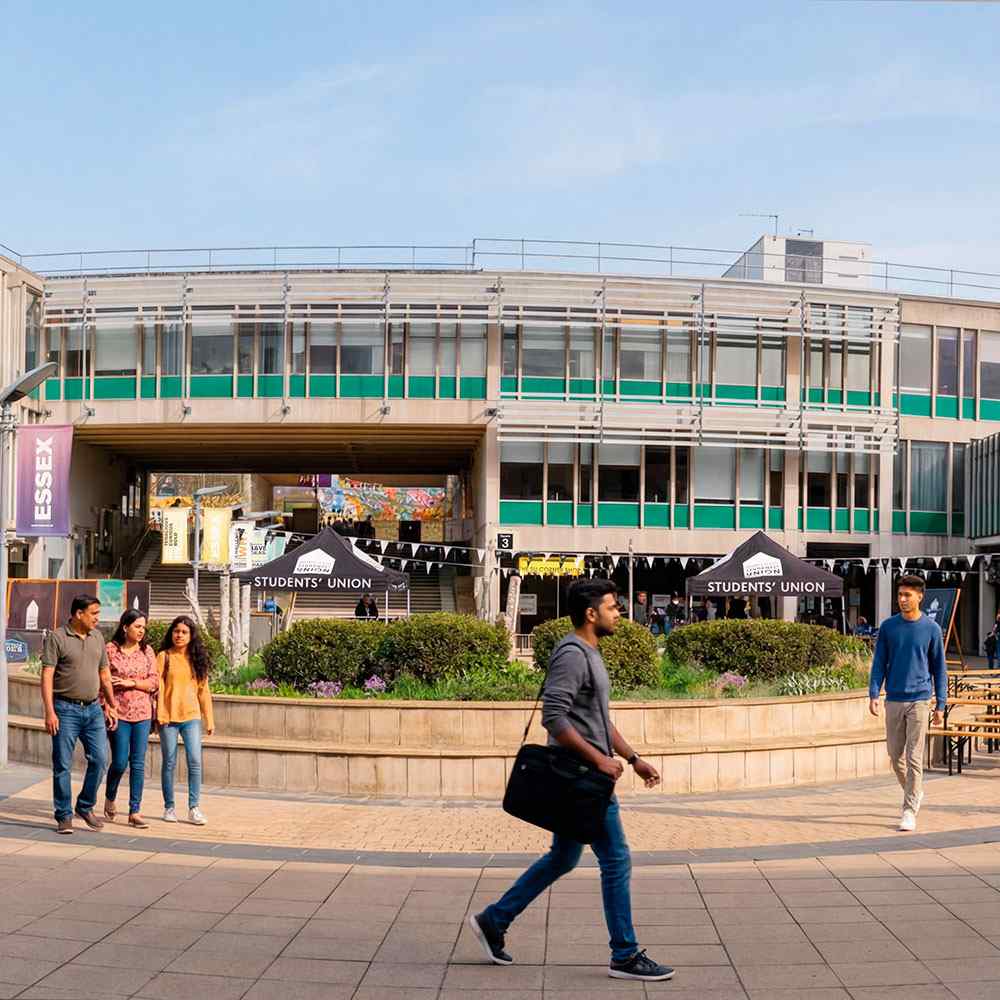
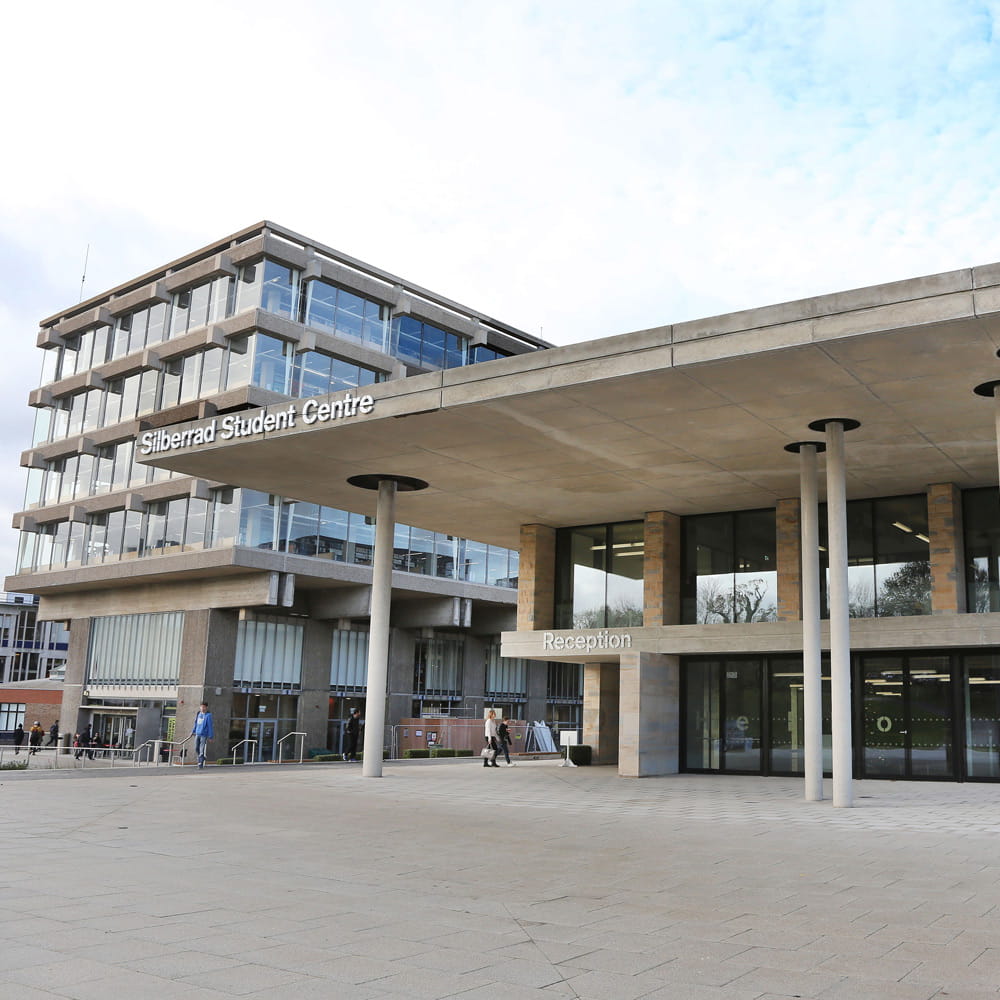
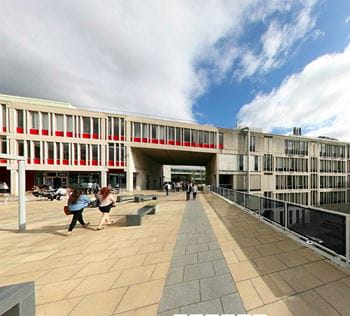
Set within 200 acres of award-winning parkland - Wivenhoe Park and located two miles from the historic city centre of Colchester – England's oldest recorded development. Our Colchester Campus is also easily reached from London and Stansted Airport in under one hour.
If you live too far away to come to Essex (or have a busy lifestyle), no problem. Our 360-degree virtual tour allows you to explore our University from the comfort of your home. Check out our Colchester virtual tour to see accommodation options, facilities and social spaces.
Chat to us
Got a question about this course? Chat with one of our academics in the School of Computer Science and Electronic Engineering.
Meet the lecturers, discover our alumni’s achievements, and learn about undergraduate study in the School of Computer Science and Electronic Engineering.
At Essex we pride ourselves on being a welcoming and inclusive student community. We offer a wide range of support to individuals and groups of student members who may have specific requirements, interests or responsibilities.
The University makes every effort to ensure that this information on its programme specification is accurate and up-to-date. Exceptionally it can be necessary to make changes, for example to courses, facilities or fees. Examples of such reasons might include, but are not limited to: strikes, other industrial action, staff illness, severe weather, fire, civil commotion, riot, invasion, terrorist attack or threat of terrorist attack (whether declared or not), natural disaster, restrictions imposed by government or public authorities, epidemic or pandemic disease, failure of public utilities or transport systems or the withdrawal/reduction of funding. Changes to courses may for example consist of variations to the content and method of delivery of programmes, courses and other services, to discontinue programmes, courses and other services and to merge or combine programmes or courses. The University will endeavour to keep such changes to a minimum, and will also keep students informed appropriately by updating our programme specifications. The University would inform and engage with you if your course was to be discontinued, and would provide you with options, where appropriate, in line with our Compensation and Refund Policy.
The full Procedures, Rules and Regulations of the University governing how it operates are set out in the Charter, Statutes and
Ordinances and in the University Regulations, Policy and Procedures.
3.png?mw=300)