What we do

Our research focuses on tackling loneliness and social isolation among young adults in coastal communities, with a strong commitment to ensuring that the needs of young LGBT+ people and those from minority ethnic backgrounds are addressed equitably. Evidence shows that the burden of poor mental health across Essex, Southend and Thurrock falls predominantly in coastal areas, making this a priority focus for the initial stage.

During the first two years of the programme, we will identify specific determinants and correlates of loneliness and social isolation in this target population. This will be supported by in-depth insights from arts-based and qualitative work to capture lived experiences within the target communities and populations. We will also focus on developing capacity of local organisations to identify, collect and utilise standardised data on local mental health initiatives.

In years 3-5, we will develop and tests interventions and system-level innovations in formed by our findings from the initial stage. These innovations will be designed specifically for areas characterised by limited public transport, dispersed public services, high levels of social inequality, and limited employment opportunities for young people with particular attention to groups experiencing the greatest disadvantage.

Projects

Social causes of loneliness and isolation in young adults

Examining social determinants of social isolation and loneliness in young adults

This project will use Understanding Society data to examine to what extent is poor mental health is associated with social isolation and loneliness among young adults and how this varies by ethnic group or sexual orientation.

We will examine how loneliness and social isolation impacts mental health at different lifestages (pre- and post-university; pre- and post- first job; pre- and post- moving out of parental home; pre- and post-lockdown) and will look at whether household composition impacts on these associations. In addition we will examine whether associations vary by area-level characteristics such as coastal vs inland area, ethnic density, socioeconomic deprivation and crime.

For more information contact: Alvin Hui (a.hui@essex.ac.uk).

Understanding isolation and loneliness in young adults in coastal regions

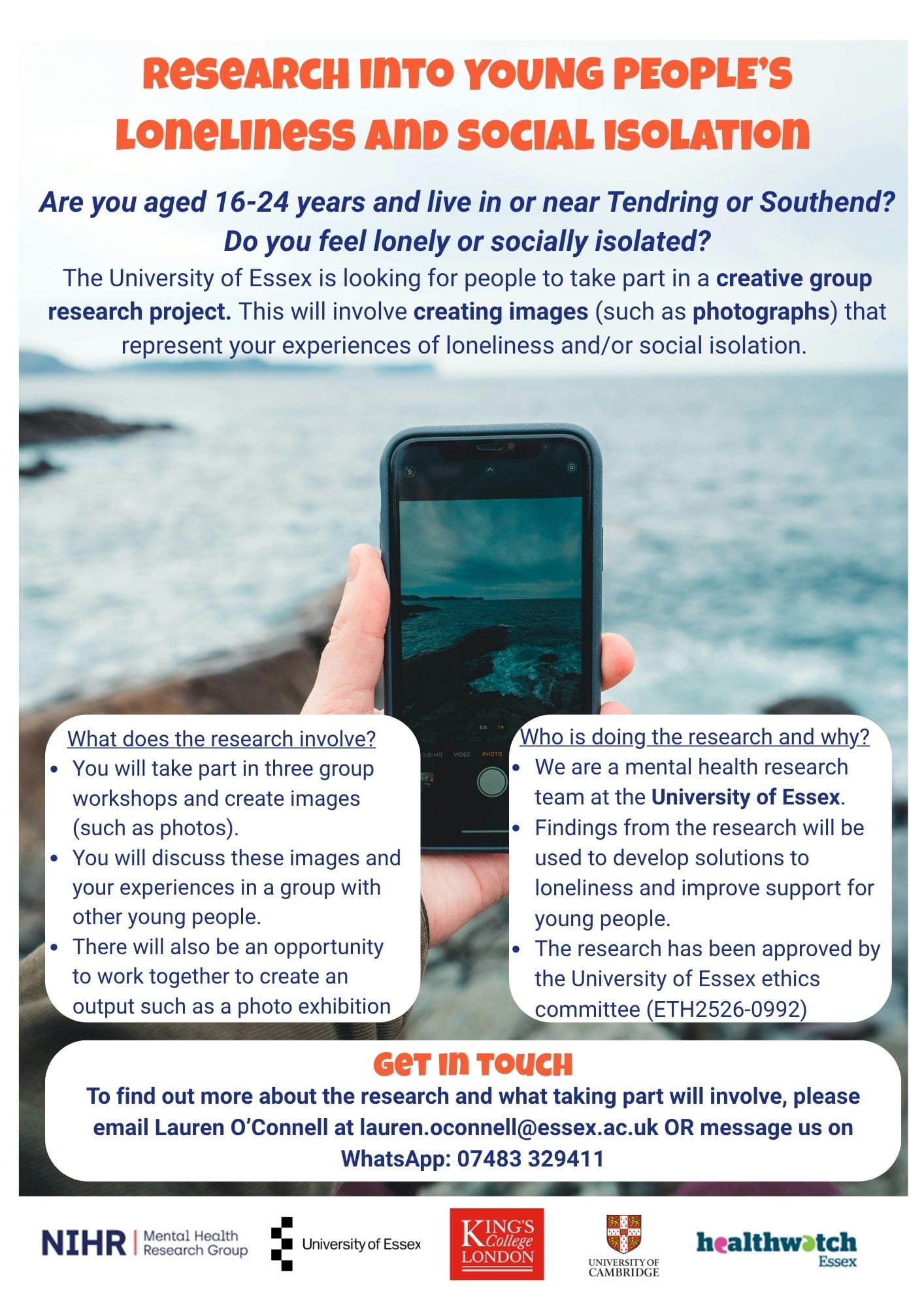
Using qualitative methodology to explore in-depth experiences of social isolation/loneliness among young adults living in coastal areas in Essex, Southend and Thurrock including those in ethnic minority and/or LGBT groups

This project will use qualitative and/or arts-based methods to explore the role of social isolation/loneliness in driving mental distress and suicidal ideation in young adults living in coastal areas.

We will explore barriers to accessing support and how community initiatives might enable greater inclusion for young adults including those in ethnic minority and/or LGBT groups.

This project is now looking for young people aged 16-24 to take part in the research. Download the flyer (.jpeg) for more information.
 
To find out more or express interest, contact lauren.o’connell@essex.ac.uk or WhatsApp 07843 329411

Helping local services understand their impact

Developing evaluation capacity across local authority and third sector services

This work will focus on developing an evaluation network that brings together groups of voluntary and statutory sector organisations across Greater Essex to strengthen internal evaluation capacity and promote a more consistent, outcomes-focused approach.

Working in partnership with local authority and third sector organisations, we will establish a network comprising local services with a shared interest in collaborating on a standardised evaluation framework. Through this network, partners will collectively identify priority outcome areas such as wellbeing, quality of life, that reflect both service objectives and population need.

Building on this, a proposal will be developed for a minimum dataset, including protected characteristics and a small number of simple pre- and post-intervention/ service delivery outcome measures, designed to be feasible for routine use within voluntary sector settings. This proposal will be shaped by stakeholders during workshops, consultations and consensus meetings.

For more information contact: Vicky Bird (v.bird@essex.ac.uk).

login