The BA Journalism is a practical, industry-focused degree that prepares you for a career creating news and digital content across a rapidly changing media landscape.
You’ll develop the skills needed to investigate stories, interview sources, write compelling copy, produce multimedia content, and understand the role journalism plays in society. Combining practical training with critical understanding of the media, this course equips you with the confidence and experience to pursue careers across journalism, communications, publishing, and digital media.
Why this course
The BA Journalism gives you the opportunity to learn journalism by doing it. You’ll develop essential reporting skills including researching stories, conducting interviews, writing news articles, creating digital content, and understanding how stories are shaped for different audiences and platforms.
You’ll learn from experienced academics and media professionals who understand the challenges and opportunities facing journalism today. Your studies will explore key issues including media ethics, freedom of speech, journalism’s role in democracy, and how digital technologies are transforming the way news is produced and consumed.
From your first year, you’ll build practical skills across different forms of journalism, including written, online, audio, and visual storytelling. You’ll learn how to use industry-standard approaches to create engaging content while developing the critical thinking skills needed to investigate, analyse, and communicate complex issues.
You’ll gain experience producing journalism for real audiences, developing your portfolio and building confidence in your own voice as a journalist. Through practical assignments and newsroom-style learning, you’ll graduate with examples of your work to showcase to future employers.
You can choose to add a placement year or study abroad year, giving you the chance to gain professional experience, develop industry connections, and broaden your understanding of journalism in different cultural and professional contexts.
By the end of the degree, you’ll have developed the practical, creative, and analytical skills needed to succeed in journalism and a wide range of media-related careers.
Who should apply
Students who are curious about the world and want to investigate stories, question information, and inform audiences
Aspiring journalists who want practical experience creating news content across written, digital, audio, and visual platforms
Learners who enjoy researching, interviewing, writing, and exploring important social and political issues
Anyone looking for a creative and challenging degree that develops transferable skills for careers in media, communications, and beyond
What you’ll learn
News reporting: Develop skills in researching, writing, and producing accurate and engaging news stories
Digital journalism: Learn how journalism is created and shared across websites, social media, and emerging platforms
Broadcast and multimedia storytelling: Explore audio, video, and visual approaches to journalism
Media ethics and law: Understand the responsibilities of journalists, including accuracy, regulation, and professional standards
Investigative and critical thinking skills: Learn how to analyse information, verify sources, and develop original story ideas
Your learning experience
Practical journalism training: Build your skills through hands-on reporting, writing, and content creation
Portfolio development: Create work that demonstrates your abilities and supports your future career applications
Expert teaching: Learn from academics with expertise across journalism, media, and communications
Industry-focused learning: Develop an understanding of professional newsroom practices and the changing media landscape
Optional placement or study abroad year: Gain professional experience or explore journalism in an international context
Careers and outcomes
A BA Journalism degree prepares you for careers in:
Journalism: News reporter, digital journalist, feature writer, political journalist, or investigative journalist
Broadcast and digital media: Content producer, multimedia journalist, podcast producer, or video journalist
Communications: Public relations, communications, social media, and content roles
Publishing and creative industries: Editorial, publishing, and content development roles
Further study: Postgraduate study in journalism, media, communications, or related fields
Employers of graduates from this course
Graduates from this course have the skills needed to progress into roles across journalism, media, and communications organisations, including:
National and regional news organisations
Broadcasting companies and digital media outlets
Publishing and creative agencies
Public relations and communications organisations
Charities, public sector organisations, and businesses requiring skilled content creators
Why we're great.
Our journalism teaching staff have a broad range of up-to-date, hands-on industry experience.
You draw on expertise from across the University by developing your own final year project .
You create and broadcast your own online content, radio and TV programmes using our on campus facilities.
"The work placements programme encompasses the major employers in the local area and further afield in East Anglia, and the students are enjoying the experience of spending time in working newsrooms so early in their course."
The NCTJ accreditation panel
Course content
Components and modules explained
Components
Components are the blocks of study that make up your course. A component may have a set module which you must study, or a number of modules from which you can choose.
Each component has a status and carries a certain number of credits towards your qualification.
Status
What this means
Core
You must take the set module for this component and you must pass. No failure can be permitted.
Core with Options
You can choose which module to study from the available options for this component but you must pass. No failure can be permitted.
Compulsory
You must take the set module for this component. There may be limited opportunities to continue on the course/be eligible for the qualification if you fail.
Compulsory with Options
You can choose which module to study from the available options for this component. There may be limited opportunities to continue on the course/be eligible for the qualification if you fail.
Optional
You can choose which module to study from the available options for this component. There may be limited opportunities to continue on the course/be eligible for the qualification if you fail.
The modules that are available for you to choose for each component will depend on several factors, including which modules you have chosen for other components, which modules you have completed in previous years of your course, and which term the module is taught in.
Modules
Modules are the individual units of study for your course. Each module has its own set of learning outcomes and assessment criteria and also carries a certain number of credits.
In most cases you will study one module per component, but in some cases you may need to study more than one module. For example, a 30-credit component may comprise of either one 30-credit module, or two 15-credit modules, depending on the options available.
Modules may be taught at different times of the year and by a different department or school to the one your course is primarily based in. You can find this information from the module code. For example, the module code HR100-4-FY means:
HR
100
4
FY
The department or school the module will be taught by.
In this example, the module would be taught by the Department of History.
This module introduces you to storytelling and narrative. You’ll discuss the nature of news and how to identify a story, obtaining and deciphering information, editing and considering wording and tone. You will begin to learn the basics of multimedia production, and start producing content for print, online and television outlets.
This module provides a broad introduction to the law and how it affects all varieties of journalism. It covers the main legal issues encountered by journalists - knowledge you will need to apply in practice as you undertake all forms of reporting, in particular the proceedings of the courts. The module will enable you to sit the NCTJ Essential Media Law which is an element of the NCTJ Diploma in Journalism.
This module provides an introduction to the workings of central and local government and social and political institutions at local, national and European levels, in the context of reporting the workings of government at all levels in an informed and engaging way. It also contributes to the NCTJ Diploma in Journalism and you will sit the NCTJ examination in Essential Public Affairs.
The Journalistic Imagination: Contemporary Issues in Journalism
(15 CREDITS)
This module covers the history of journalism in Britain from its beginnings in the 17th century to the start of the internet age. Topics include: the impact of printing; the first news serials; government attempts to control the press from the 17th to the 19th centuries; the emergence of mass circulation papers; the role of press barons in the 20th century; radio and the rise of the BBC; the press from 1945 to 2000; the arrival and development of television; ownership and control of the media; and the impact of the internet. The module critically considers the evolving political, economic and social contexts of journalism and the media more generally, underpinning and informing the content of all other elements of the degree course.
This module will get you up and running in the world of podcasting. You’ll learn advanced production skills and develop the ability to tell great stories through sound. In this module the classroom becomes a studio and the instructor becomes an editor. You will work both individually and collaboratively to produce your own short and long-form podcasts.
You will learn such production skills as recording, editing, mixing and mastering; and become familiar with a wide range of production equipment including microphones, field recorders and audio interfaces. You will also develop such enduring journalistic skills as researching, scripting, and interviewing for stories.
In this module, you will complete your studies – begun in Year 1 - of the principal areas of the law relating to journalism, and prepare for and sit the NCTJ examination in Media Law. You will also expand your exploration of the wider constraints affecting journalism, voluntary and otherwise. These include media regulation, the Ofcom Broadcasting Code, the Editors’ Code of Practice and other expressions of good, ethical practice.
Audio and Video for Broadcast and Online (Single honours)
(30 CREDITS)
In this module you will learn, through class teaching and practical experience, how to write and adapt news stories and features for broadcast platforms. Building on the core reporting skills you have developed in Year 1, you will learn more about the particular demands and characteristics of the different media platforms and the editorial and production techniques required to deliver high quality broadcast journalism.
In this module you will learn, through practical experience, how to write features, how to edit and adapt news stories and features for print and online and how to produce print and online publications.
Building on the core reporting and production skills you have developed in your first year, you will learn more about the relationship between news and features and the particular demands and characteristics of the different media platforms, with the first term concentrating on feature-writing and print production and the second largely taken up with a print and online magazine production project.
This module starts with traditional investigative research methods - analysing documents, using archives, accessing public records, using FOIA. In the latter sessions, it focuses on cutting edge, digital open source journalism where students will learn to collect, analyse and document publicly available online information for use in law, advocacy, or journalism.
Students will learn to authenticate audio-visual data, geolocate photos and videos, and mine social media for useful information. Students will also learn advanced fact-checking methods. Guest sessions will be conducted by open-source journalism pioneers and fact-checking experts from leading investigative agencies.
This module introduces you to the theory and practice of journalism in a global context, and current important debates in media and communication. It aims to complement the practical skills you have developed in producing for multiple media platforms.
The module addresses contemporary trends at the heart of global journalism and ensuing critical questions, by exploring journalistic practices and their meaning in different political, regulatory and cultural contexts.
It aims to expand your horizons to assess critical questions going beyond the simple production of a news story. We will explore topical and timely issues such as globalisation, mediatization and mediation, framing conflicts, international politics, propaganda, democracy, and populism, among other important topics.
This module deals with the principles and practicalities of photojournalism. It starts with a review of the basic principles of newsgathering and production, moves to the practical skills required of the relevant legal and ethical considerations.
Technical skills addressed include selection and composition, use of the camera, management of images and meta-data and image production.
This module builds on everything you have learned so far about writing, reporting and production, with a particular emphasis on the broadcast media of radio and television. You will already have had the opportunity to gain extensive experience of newspaper and online reporting, and this module will bring your broadcast skills up to the same high standard of knowledge and expertise. This module will also prepare you for the Specialist Option element of your NCTJ Diploma.
In your final year you will undertake a capstone project designed to demonstrate your understanding of the theory and practice of reporting, your ability to work across broadcast platforms, and your ability to identify, research and deliver an original story. You will carry out scoping and preparatory work necessary for you to proceed with the project. This might include exploring story possibilities, commissioning or conducting research, reading round the subject and seeking interviews and assistance from experts and protagonists.
This module represents your ‘capstone’ project. It is work that you have carried out on your own, on the basis of the groundwork carried out during the Multimedia Project Preparation module. It will demonstrate your command of much that you have learned and practised during your first two years in terms of defining a story, gathering information, conducting research, handling data, newsgathering by means of interviews, reading, and presentation across media platforms. This work will be published on the course website.
This module helps you develop your skills in research and investigation with particular reference to the new areas emerging on the web, through the Freedom of Information Act and through social media. It will also give you confidence in handling statistics-based stories, questioning methodology and assumptions.
112 UCAS tariff points from a minimum of 2 full A-levels.
IB: 29 points in the IB Diploma or 112 UCAS tariff points to include a minimum of 2 Higher Level subjects.
We accept A-levels, AAQs, BTECs, Access to HE Diploma, T-levels and most other qualifications that hold UCAS tariff points. Acceptability of some non A-level qualifications (such as BTECs) may depend on the subject studied and units taken.
You can calculate your UCAS tariff points on the UCAS website.
Whilst International A-levels and BTECs aren't on the UCAS tariff calculator, we assign them the same tariff points as their UK counterparts.
Don't meet the entry requirements?
We know everyone's journey is different. If your achieved or predicted grades don’t match our entry requirements, you have a non-traditional educational background, or you're returning to study as a mature student, we'd still encourage you to apply. We review every application individually and may be able to offer you a place on this course, or an alternative route such as a foundation year.
Find out more about applying, personal statements, references, visas, deferred entry, extenuating circumstances, and support for mature students on our undergraduate application information page.
Contextual Offers:
We are committed to ensuring that all students with the merit and potential to benefit from an Essex education are supported to do so. We make Contextual Offers to applicants from underrepresented groups residing in the UK. Our Contextual Offers policy outlines the full eligibility criteria.
96 UCAS tariff points from a minimum of 2 full A-levels.
International & EU entry requirements
We accept a wide range of qualifications from applicants studying in the EU and other countries. Get in touch with any questions you may have about the qualifications we accept. Remember to tell us about the qualifications you have already completed or are currently taking.
Sorry, the entry requirements for the country that you have selected are not available here. Please contact our Undergraduate Admissions team at ugquery@essex.ac.uk to request the entry requirements for this country.
English language requirements
English language requirements for applicants whose first language is not English
IELTS 6.0 overall with a minimum of 5.5 in each component, or specified score in an equivalent test that we accept.
Details of English language requirements and the tests we accept for applicants who require a Student visa (excluding Nationals of Majority English Speaking Countries) can be found here
If we accept the English component of an international qualification it will be included in the academic levels listed above for the relevant countries.
Pre-sessional English courses
If you do not meet our IELTS requirements then you may be able to complete a pre-sessional English pathway that enables you to start your course without retaking IELTS.
Additional Notes
If you’re an international student, but do not meet the academic requirements for direct admission to this degree, you could prepare and gain entry through a pathway course. Find out more about opportunities available to you at the University of Essex International College
Fees and funding
Home/UK fee
£10,050 per year
International fee
£22,575 per year
Fees will increase for each academic year of study.
If your course has the option to include a placement year or study abroad, and you choose to do so, you will pay the following:
Our events are a great way to find out more about studying at Essex. We run a number of Open Days throughout the year which enable you to discover what our campus has to offer.
You have the chance to:
tour our campus and accommodation
find out answers to your questions about our courses, student finance, graduate employability, student support and more
meet our students and staff
Check out our Visit Us pages to find out more information about booking onto one of our events. And if the dates aren’t suitable for you, feel free to book a campus tour here.
Our UK students, and some of our EU and international students, who are still at school or college, can apply through their school. Your school will be able to check and then submit your completed application to UCAS. Our other international applicants (EU or worldwide) or independent applicants in the UK can also apply online through UCAS Apply.
The UCAS code for our University of Essex is ESSEX E70. The individual campus codes for our Loughton and Southend Campuses are ‘L' and ‘S' respectively.
You can find further information on how to apply, including information on transferring from another university, applying if you are not currently at a school or college, and applying for readmission on our How to apply and entry requirements page.
If you receive an undergraduate offer to study with us in October 2026 and live in the UK, you will receive an email invitation to book onto one of our Open Days. These events provide the opportunity to meet your department, join interesting taster sessions, tour our campus and accommodation, and chat to current students. You can visit our Open Days event page for more information, including terms and conditions.
Visit Colchester Campus
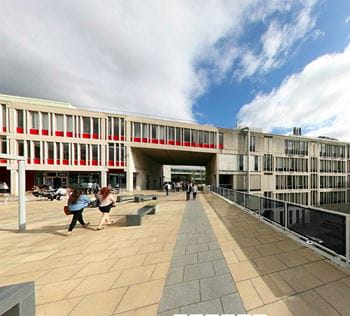
Set within 200 acres of award-winning parkland - Wivenhoe Park and located two miles from the historic city centre of Colchester – England's oldest recorded development. Our Colchester Campus is also easily reached from London and Stansted Airport in under one hour.
If you live too far away to come to Essex (or have a busy lifestyle), no problem. Our 360-degree virtual tour allows you to explore our University from the comfort of your home. Check out our Colchester virtual tour to see accommodation options, facilities and social spaces.
At Essex we pride ourselves on being a welcoming and inclusive student community. We offer a wide range of support to individuals and groups of student members who may have specific requirements, interests or responsibilities.
The University makes every effort to ensure that this information on its programme specification is accurate and up-to-date. Exceptionally it can be necessary to make changes, for example to courses, facilities or fees. Examples of such reasons might include, but are not limited to: strikes, other industrial action, staff illness, severe weather, fire, civil commotion, riot, invasion, terrorist attack or threat of terrorist attack (whether declared or not), natural disaster, restrictions imposed by government or public authorities, epidemic or pandemic disease, failure of public utilities or transport systems or the withdrawal/reduction of funding. Changes to courses may for example consist of variations to the content and method of delivery of programmes, courses and other services, to discontinue programmes, courses and other services and to merge or combine programmes or courses. The University will endeavour to keep such changes to a minimum, and will also keep students informed appropriately by updating our programme specifications. The University would inform and engage with you if your course was to be discontinued, and would provide you with options, where appropriate, in line with our Compensation and Refund Policy.
The full Procedures, Rules and Regulations of the University governing how it operates are set out in the Charter, Statutes and
Ordinances and in the University Regulations, Policy and Procedures.
Ask us a question
Want to quiz us about your course? Got a question that just needs answering? Get in touch with us on live chat!
3.png?mw=300)