We ranked 1st for social work in the UK! (The Times and Sunday Times Good University Guide 2026)
What is the BA Social Work?
The BA Social Work is a three-year undergraduate degree designed to prepare you for a professional career in social work. Social work focuses on supporting individuals, families and communities to improve wellbeing, promote social justice and protect the most vulnerable in society.
On this course, you’ll develop the knowledge, skills and professional values required for contemporary social work practice, combining academic study with practice-based learning in a range of social work settings.
Why this course
As a student of BA Social Work at Essex you experience a lively, informal environment with many possibilities to pursue your own interests whilst being part of a multidisciplinary school. We provide you with an active and stimulating environment for your studies and the chance to really make a difference within an essential profession in today's society.
A unique feature of our School of Health and Social Care is that many of our staff work with our Local Authorities and other local agencies, which enhances our grasp of the contemporary links between academic research, the major issues of the day and practice.
Who should apply?
Social work is all about people: it is an extremely rewarding and challenging profession. You'll need to be hard working, adaptable, honest and, above all, passionate about finding long-term solutions and supporting positive changes for children, adults and families. You develop the skills, knowledge and understanding of how to support people to improve personal, practical, psychological and social aspects of their lives.
Your learning experience
You’ll engage with theoretical, legal and policy frameworks that underpin social work, while developing critical thinking, reflective practice and professional judgement. Learning is closely aligned to practice-based contexts, enabling you to apply theory to real-world social work scenarios and prepare effectively for placement learning.
A unique feature of our School of Health and Social Care is that our staff continue to work within social care and other local agencies, which enhances our grasp of the contemporary links between academic research, and the issues of current social work practice.
The Social Work Team includes (in alphabetical order)
The School of Health and Social Care is proud to work closely with our Service User Reference Group (SURG). SURG is made up of service users, carers, and volunteers who generously share their first-hand experiences of health and social care. We work collaboratively with SURG to design our courses to ensure that we truly are putting the needs of patients and clients at the heart of what we do. SURG are involved as part of our course application processes and often form part of our interview panels. This helps us to be confident that we are selecting the right applicants for the course and their future careers. SURG members also support the delivery of our teaching sessions and research activity, which means you'll benefit from an insight into their lived experiences of living with a diagnosis, health condition, or circumstance. You'll find that not only does your clinical knowledge expand, but your empathy, compassion and ability to advocate develops also.
Placement and Transport information
All Social Work programmes in the UK require completion of two placements during your period of study. There is a 70-day placement in year two and a 100-day placement in year three of your course. The Social Work programme is a full-time course. Placements typically run over three days per week in year two and four days per week in year three with the remaining time spent at university. The full-time nature of the course can limit the amount of paid work students can undertake during their studies with us.
Essex is a large and rural county, and some rural areas do not have regular public transport. Although admission to the BA Social Work programme at Essex does not require you to drive, many of our statutory placement providers, such as Local Authorities and Private Fostering and Adoption agencies require students to have a driving licence and access to a vehicle as a requirement of placement with them. Being a licensed driver with access to a vehicle can therefore be a significant advantage, offering greater flexibility and access to a wider range of placement opportunities. The advantageous nature of driving is not unique to Essex university. Many local authorities across the UK require or strongly prefer that students have access to a car and valid driving licence, as placements often involve travel to multiple sites and home visits to service users and carers.
If you are unable to drive and/or do not have access to a vehicle, your choice of placement will be limited and there may be a delay in starting your final year placement. Many employers consider driving an essential requirement of the social work role.
The Placement Coordinator will try to ensure that all placements are located with 1.5 hours travelling time of the students’ home or the university. However, this may not always be possible due to placement availability. Please note that you are also responsible for covering the cost of travel to and from placement.
Social work students may be eligible to apply for the NHS Social Work bursary which can help with living and travel costs. More information is available on the More information is available on the NHS Business Services Authority website.
DBS and Occupational Health Checks
This course requires a satisfactory Occupational Health Check and enhanced Disclosure and Barring Service (DBS) Check (including child and adult barred list check) - both of these are organised by the University. Please contact our DBS team or Occupational Health team if you have any questions in relation to these checks.
You will also be required to register for the DBS Update Service (information relating to this service can be found here). You will need to register for this within 30 days of your DBS certificate being issues. The Update Service costs £16 per year, which the University will reimburse. You will need to keep the subscription to this Service active for the duration of your course. If you do not register for the Update Service within 30 days, or your registration lapses, and you later attend placement where this is a requirement, you will have to pay for a new DBS check, which will enable you to sign up to the Update Service. Please contact our DBS team if you have any questions relating to this.
A satisfactory Overseas Criminal Record Check/Local Police Certificate is also required, in addition to a DBS Check, where you have lived outside of the UK in the last 5 years for 6 months or more. Further information about how to obtain an Overseas Criminal Record check can be found on the Gov.uk website.
We continue to recommend Covid and flu vaccination to all of our students. This is to protect both yourself and the vulnerable people that you may meet throughout your placement.
Professional accreditation
Approved by Social Work England (SWE) for the purpose of providing eligibility to apply for registration with SWE as a social worker in England.
Why we're great.
Our partnerships with placement providers ensure you gain effective high-quality training.
We meet Social Work England's standards and you study a wide range of specialist areas to gain the broadest possible perspective.
We ranked 1st for social work in the UK (The Times and Sunday Times Good University Guide 2026)
This course consists of three years, each with a particular emphasis which reflects your development as a trainee social worker and the journey you take into becoming a professional practitioner.
Within the programme the central themes reflecting core values and principles of practice are always present; these include safeguarding and protection; evidence-based relational practice; inter-professional working; impact of practice; professional challenge; empowering service users autonomy; social justice and values; and equality and diversity.
These carefully selected modules will give you the chance to explore, question, and create powerful ideas. Picked to give you an extensive and in-depth education, they'll equip you with the specialist knowledge, vital transferrable skills, and the confidence to make a genuine difference to the world around you.
Our Programme Specification gives more detail about the structure available to our current first-year students..
We understand that deciding where and what to study is a very important decision for you. We'll make all reasonable efforts to provide you with the courses, services and facilities as described on our website and in line with your contract with us. However, if we need to make material changes, for example due to significant disruption, we'll let our applicants and students know as soon as possible.
Components and modules explained
Components
Components are the blocks of study that make up your course. A component may have a set module which you must study, or a number of modules from which you can choose.
Each component has a status and carries a certain number of credits towards your qualification.
Status
What this means
Core
You must take the set module for this component and you must pass. No failure can be permitted.
Core with Options
You can choose which module to study from the available options for this component but you must pass. No failure can be permitted.
Compulsory
You must take the set module for this component. There may be limited opportunities to continue on the course/be eligible for the qualification if you fail.
Compulsory with Options
You can choose which module to study from the available options for this component. There may be limited opportunities to continue on the course/be eligible for the qualification if you fail.
Optional
You can choose which module to study from the available options for this component. There may be limited opportunities to continue on the course/be eligible for the qualification if you fail.
The modules that are available for you to choose for each component will depend on several factors, including which modules you have chosen for other components, which modules you have completed in previous years of your course, and which term the module is taught in.
Modules
Modules are the individual units of study for your course. Each module has its own set of learning outcomes and assessment criteria and also carries a certain number of credits.
In most cases you will study one module per component, but in some cases you may need to study more than one module. For example, a 30-credit component may comprise of either one 30-credit module, or two 15-credit modules, depending on the options available.
Modules may be taught at different times of the year and by a different department or school to the one your course is primarily based in. You can find this information from the module code. For example, the module code HR100-4-FY means:
HR
100
4
FY
The department or school the module will be taught by.
In this example, the module would be taught by the Department of History.
How does legislation and social policy inform social work practice? What are the foundations behind them? Explore the answers to these questions by looking at the core legislation in the areas children and young people, mental health, youth and adult justice safeguarding and protection and disability to develop your understanding.
From the moment we are born, we are constantly changing as we pass through different stages of development. You will explore the key phases of life, from infancy and childhood, adolescence to early adulthood, middle to old age and look at the interactions of lifespan development and social work practice.
What are the theories that guide social work? How are they implemented in professional practice? You will look at number of contemporary theories and explore approaches such as problem solving, task-centred, solution-focused, narrative therapy and cognitive behavioural therapy, to help you develop a critical reflective understanding of social work practice.
Communication is not just about words. Other factors such as tone of voice, posture, gestures, behaviour and appearance can all impact on how we communicate and how others respond to us. By exploring these aspects of yourself you will understand how your behaviour, responses and feelings can impact on social work practice and the benefits that good interpersonal skills can bring to it.
Introduction to Sociological and Psychological Frameworks
(30 CREDITS)
What role does social work play in our society? What is the basis for effective social work practice? How do social workers and service users see the world? You will explore the theories behind these three key aspects of social work to develop your understanding of the sociological and psychological frameworks behind the practice.
Evidence is vital to the practice of social work, where it is used to justify any decisions that are made that affect people’s lives. You will look at the ways in which research is conducted and how data is collected and interrogated to develop your understanding of the processes involved in the gathering of evidence.
What are the legal issues and ethical dilemmas that can arise in social work practice? How can you prepare for this eventuality? You will explore the answers to these questions and further develop your understanding of the role of social legislation previously established in module HS191. You will also explore the topics of domestic violence, immigration and immigration and welfare rights and housing in more detail.
What role does reflection and evidence based practice play in contemporary social work? How can collaborative working improve practice? Why is developing personal and professional resilience important? You will explore the answers to these questions by looking at a variety of models and perspectives to enhance your understanding and develop your own practice skills, building upon the foundations gained in module HS194 (Professional Skills 1).
This module will help you prepare for your practice placement and support you throughout its duration. You will have the opportunity to develop your knowledge and skills in a workplace setting and build on the taught elements of the course. You will also explore the concept of reflection and learn how to critically evaluate your own practice.
Social work practice can sometimes be difficult and challenging, particularly when dealing with emotional, relational or mental health issues. You will explore effective work strategies to help you develop the understanding, skills and confidence required to work in this area and the different approaches you can take to support others.
This module has been designed to enable students to integrate their subject knowledge with an understanding of sustainable development, acquiring the skills and competencies essential for addressing the urgent sustainability challenges of the 21st century.
Through a combination of group sessions, 121 tutorials, tutor led input and skills and development sessions, you will develop the skills required to apply your knowledge and understanding and undertake a study of an extended piece of work relevant to social work practice.
When and how do social workers use research? Why is it essential for effective practice? You will study a range of perspectives in contemporary research, looking at objectives and methodologies to extend your knowledge and further develop your skills in critically appraising and applying research in practice.
Assessment and intervention are two fundamental skills required for effective social work practice. In this module, you will explore them in more detail. You will look at different theories, models and methods of intervention and develop your knowledge and understanding of assessment, analysis, making judgements and implementing intervention further.
The focus of this placement will be on assessment. You will have the opportunity to use your knowledge and experience gained to date, to further develop your understanding of why assessment is at the core of social work practice and gain practical experience in this essential area.
Why are the principles of critical reflection and professional challenge such significant issues in contemporary social work practice? You will explore these core approaches to effective social work practice and look at the impact they have on collaborative working with other professionals.
In the first year, Social Work students generally are campus based 2-3 days per week and complete 30 on-campus skills days in preparation for practice placement. In the second year, students are campus based 2 days per week, and on placement 3 days per week. In the final year, students are campus based 1 day per week, and on placement 4 days per week.
First year modules reflect fundamental understanding and skills essential for social work practice
As required by the Social Work Reform Board you will undertake a minimum of 30 days of development including interpersonal and communication skills
Gain experience through a 5 day Child Study as part of Lifespan Development
Second year placement of 70 days in a non-statutory setting
You will be actively engaged with service users and carers who are experiencing issues related to their emotional and mental health
Undertake a 100 day assessed placement in a statutory agency
Explore your own practice and to develop further a specialist area of interest
This course combines University learning, e-learning and work-based learning to help you enhance your practice skills
Modules have their own accompanying webpages on Moodle where you can download relevant readings, power-points, podcasts and YouTube clips, and contribute to online discussions
We also work closely in partnership with the NHS and the independent health sector to provide placement opportunities
Assessment
You are assessed by a combination of practical examinations, viva voce examinations, essays, reflective writing and poster and seminar presentations, practice-based learning assessment and practical examinations in the academic setting
Entry requirements
UK entry requirements
Our published entry requirements are a guide and we welcome applications from those who have achieved one of the below qualifications with lower grades but meet our GCSE English (or equivalent) requirement.
GCSEs: English Language C/4. Acceptable alternatives are listed further down this page
Plus one of the level 3 qualifications below:
120 - 112 UCAS tariff points from a minimum of 2 full A-levels.
IB: 30 - 29 points in the IB Diploma or 120 - 112 UCAS tariff points to include a minimum of 2 Higher Level subjects.
We accept A-levels, AAQs, BTECs, Access to HE Diploma, T-levels and most other qualifications that hold UCAS tariff points.
We also consider vocational level 3 qualifications and welcome applicants who can demonstrate social activity, awareness, lived experience or relevant work experience.
You can calculate your UCAS tariff points on the UCAS website.
Whilst International A-levels and BTECs aren't on the UCAS tariff calculator, we assign them the same tariff points as their UK counterparts.
All applicants must have, or be working towards, an acceptable level 2 English qualification such as GCSE grade C/4 or equivalent.
If you don't need a Student visa and are either a first language English speaker or have a lived in the UK for over three years, we can accept OFQUAL regulated level 2 English qualifications, including Functional Skills level 2, Key Skills level 2 or literacy units taken as part of an Access to HE Diploma.
Additional requirements
Some paid or voluntary experience in health or social care in a relevant social care or childcare/education setting is also required.
A personal statement which explains your suitability for the course must be provided before you can be invited to interview.
This course has additional requirements including pass of an interview, a satisfactory reference, Occupational Health Check and Disclosure and Barring (DBS) check. For more information see the Health and Social Care Undergraduate page
Contextual Offers:
We are committed to ensuring that all students with the merit and potential to benefit from an Essex education are supported to do so. We make Contextual Offers, of up to two A-level grades (or equivalent) below our standard conditional offer, to applicants from underrepresented groups residing in the UK. Our Contextual Offers policy outlines the full eligibility criteria.
If you haven't got the grades you hoped for, have a non-traditional academic background, are a mature student, or have any questions about eligibility for your course, more information can be found on our undergraduate application information page.
International & EU entry requirements
We accept a wide range of qualifications from applicants studying in the EU and other countries. Get in touch with any questions you may have about the qualifications we accept. Remember to tell us about the qualifications you have already completed or are currently taking.
Sorry, the entry requirements for the country that you have selected are not available here. Please contact our Undergraduate Admissions team at ugquery@essex.ac.uk to request the entry requirements for this country.
English language requirements
English language requirements for applicants whose first language is not English
IELTS 7.0 overall with a minimum of 6.5 in each component, or specified score in an equivalent test that we accept.
Details of English language requirements and the tests we accept for applicants who require a Student visa (excluding Nationals of Majority English Speaking Countries) can be found here
If we accept the English component of an international qualification it will be included in the academic levels listed above for the relevant countries.
Pre-sessional English courses
If you do not meet our IELTS requirements then you may be able to complete a pre-sessional English pathway that enables you to start your course without retaking IELTS.
Additional Notes
If you’re an international student, but do not meet the academic requirements for direct admission to this degree, you could prepare and gain entry through a pathway course. Find out more about opportunities available to you at the University of Essex International College
Fees and funding
Home/UK fee
£9,790 per year
International fee
£21,500 per year
Fees will increase for each academic year of study.
If your course has the option to include a placement year or study abroad, and you choose to do so, you will pay the following:
Our events are a great way to find out more about studying at Essex. We run a number of Open Days throughout the year which enable you to discover what our campus has to offer.
You have the chance to:
tour our campus and accommodation
find out answers to your questions about our courses, student finance, graduate employability, student support and more
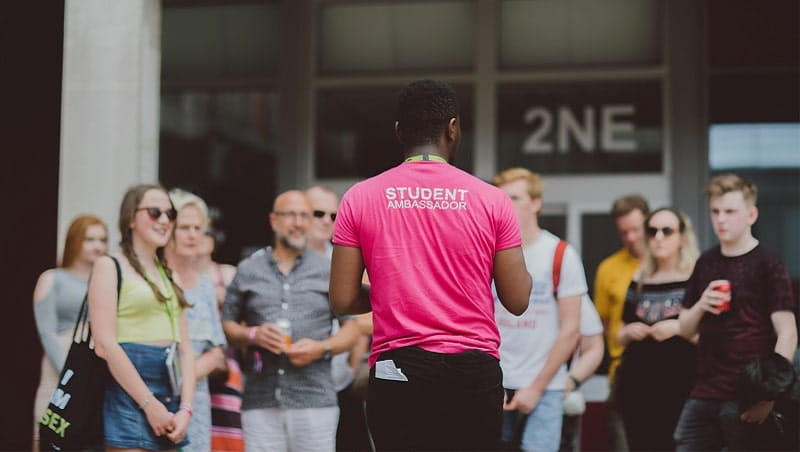
meet our students and staff
Check out our Visit Us pages to find out more information about booking onto one of our events. And if the dates aren’t suitable for you, feel free to book a campus tour here.
Our UK students, and some of our EU and international students, who are still at school or college, can apply through their school. Your school will be able to check and then submit your completed application to UCAS. Our other international applicants (EU or worldwide) or independent applicants in the UK can also apply online through UCAS Apply.
The UCAS code for our University of Essex is ESSEX E70. The individual campus codes for our Loughton and Southend Campuses are ‘L' and ‘S' respectively.
You can find further information on how to apply, including information on transferring from another university, applying if you are not currently at a school or college, and applying for readmission on our How to apply and entry requirements page.
If you receive an undergraduate offer to study with us in October 2026 and live in the UK, you will receive an email invitation to book onto one of our Open Days. These events provide the opportunity to meet your department, join interesting taster sessions, tour our campus and accommodation, and chat to current students. You can visit our Open Days event page for more information, including terms and conditions.
Interview
Undergraduate students who apply for our health-related courses are required to pass a compulsory interview before an offer can be made. If you are shortlisted for interview based on your application, you will be invited to interview with us via Microsoft Teams. We use the interview as an opportunity to get to know you, to find out about your ambitions, and assess how prepared you are for the course. It's important for us to be sure that you know what you're signing up for, so we'd expect you've done some research about the course and the associated careers it may lead to. We have some more information about how to demonstrate you have what it takes at the bottom of our undergraduate page
Visit Colchester Campus
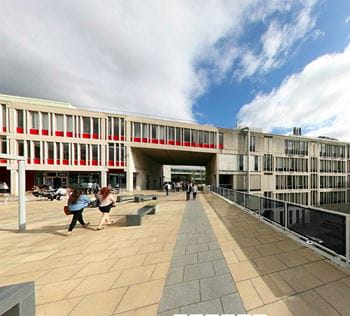
Set within 200 acres of award-winning parkland - Wivenhoe Park and located two miles from the historic city centre of Colchester – England's oldest recorded development. Our Colchester Campus is also easily reached from London and Stansted Airport in under one hour.
If you live too far away to come to Essex (or have a busy lifestyle), no problem. Our 360-degree virtual tour allows you to explore our University from the comfort of your home. Check out our Colchester virtual tour to see accommodation options, facilities and social spaces.
At Essex we pride ourselves on being a welcoming and inclusive student community. We offer a wide range of support to individuals and groups of student members who may have specific requirements, interests or responsibilities.
The University makes every effort to ensure that this information on its programme specification is accurate and up-to-date. Exceptionally it can be necessary to make changes, for example to courses, facilities or fees. Examples of such reasons might include, but are not limited to: strikes, other industrial action, staff illness, severe weather, fire, civil commotion, riot, invasion, terrorist attack or threat of terrorist attack (whether declared or not), natural disaster, restrictions imposed by government or public authorities, epidemic or pandemic disease, failure of public utilities or transport systems or the withdrawal/reduction of funding. Changes to courses may for example consist of variations to the content and method of delivery of programmes, courses and other services, to discontinue programmes, courses and other services and to merge or combine programmes or courses. The University will endeavour to keep such changes to a minimum, and will also keep students informed appropriately by updating our programme specifications. The University would inform and engage with you if your course was to be discontinued, and would provide you with options, where appropriate, in line with our Compensation and Refund Policy.
The full Procedures, Rules and Regulations of the University governing how it operates are set out in the Charter, Statutes and
Ordinances and in the University Regulations, Policy and Procedures.
Ask us a question
Want to quiz us about your course? Got a question that just needs answering? Get in touch with us on live chat!
3.png?mw=300)