Our course enables you to study philosophy, with a special focus on issues regarding religion and ethics, including momentous issues like the meaning of life, the relationship between faith and reason, arguments for and against the existence of God and the moral status of abortion and euthanasia. Study both classic texts and on-going debates in these fields, across a range of philosophical traditions. You will be equipped to engage with these discussions in an informed and critical way.
We are involved in many exciting and interdisciplinary research projects, and have active links with other areas including political science, law, sociology, psychoanalysis, and art history.
We've been ranked 21st for philosophy for overall positivity score (National Student Survey 2025).
Your education extends beyond the university campus. We support you in expanding your education through offering the opportunity to spend a year or a term studying abroad at one of our partner universities. The four-year version of our degree allows you to spend the third year abroad or employed on a placement abroad, while otherwise remaining identical to the three-year course.
Studying abroad allows you to experience other cultures and languages, to broaden your degree socially and academically, and to demonstrate to employers that you are mature, adaptable, and organised.
If you spend a full year abroad you'll only pay 15% of your usual tuition fee to Essex for that year. You won't pay any tuition fees to your host university
Our courses are taught by world-class academics and we are 7th in the UK for research impact in philosophy (Grade Point Average, REF2021).
Our open-minded and enthusiastic staff are known for our unique combination of Anglo-American and European philosophy, and as a leading centre for critical theory, phenomenology, German idealism and medical humanities. Some recent projects and publications include:
Take advantage of our extensive learning resources to assist you in your studies:
We know that the world of work is changing. Employers want graduates who can think laterally logically and creatively about practical problems and are effective communicators.
At Essex, we are serious about providing you with a teaching environment in which you develop the skills you need to flourish in the discipline, and to be prepared for the jobs you aspire to in the future.
A degree in Philosophy at Essex provides you with::
Philosophy graduates are therefore well-suited to a wide range of occupations, including law, PR, journalism and the media, the Civil Service, charity work, banking, and the NHS. Our recent graduates have gone on to work for a wide range of high-profile companies.
We also work with the university's Student Development Team to help you find out about further work experience, internships, placements, and voluntary opportunities.
We are committed to ensuring that all students with the merit and potential to benefit from an Essex education are supported to do so. We make Contextual Offers, of up to two A-level grades (or equivalent) below our standard conditional offer, to applicants from underrepresented groups residing in the UK. Our Contextual Offers policy outlines the full eligibility criteria.
For further information about what a Contextual Offer may look like for your specific qualification profile, email ugquery@essex.ac.uk.
If you haven't got the grades you hoped for, have a non-traditional academic background, are a mature student, or have any questions about eligibility for your course, more information can be found on our undergraduate application information page or get in touch with our Undergraduate Admissions Team at ugquery@essex.ac.uk.
We accept a wide range of qualifications from applicants studying in the EU and other countries. Get in touch with any questions you may have about the qualifications we accept. Remember to tell us about the qualifications you have already completed or are currently taking.
Sorry, the entry requirements for the country that you have selected are not available here. Please contact our Undergraduate Admissions team at ugquery@essex.ac.uk to request the entry requirements for this country.
English language requirements for applicants whose first language is not English: IELTS 6.0 overall, or specified score in another equivalent test that we accept.
Details of English language requirements, including component scores, and the tests we accept for applicants who require a Student visa (excluding Nationals of Majority English Speaking Countries) can be found here
If we accept the English component of an international qualification it will be included in the academic levels listed above for the relevant countries.
English language shelf-life
Most English language qualifications have a validity period of 5 years. The validity period of Pearson Test of English, TOEFL and CBSE or CISCE English is 2 years.If you require a Student visa to study in the UK please see our immigration webpages for the latest Home Office guidance on English language qualifications.
Pre-sessional English courses
If you do not meet our IELTS requirements then you may be able to complete a pre-sessional English pathway that enables you to start your course without retaking IELTS.
Pending English language qualifications
You don’t need to achieve the required level before making your application, but it will be one of the conditions of your offer.
If you cannot find the qualification that you have achieved or are pending, then please email ugquery@essex.ac.uk .
Requirements for second and final year entry
Different requirements apply for second and final year entry, and specified component grades are also required for applicants who require a visa to study in the UK. Details of English language requirements, including UK Visas and Immigration minimum component scores, and the tests we accept for applicants who require a Student visa (excluding Nationals of Majority English Speaking Countries) can be found here
If you’re an international student, but do not meet the English language or academic requirements for direct admission to this degree, you could prepare and gain entry through a pathway course. Find out more about opportunities available to you at the University of Essex International College
Our research-led teaching is continually evolving to address the latest challenges and breakthroughs in the field. The following modules are based on the current course structure and may change in response to new curriculum developments and innovation.
We understand that deciding where and what to study is a very important decision for you. We'll make all reasonable efforts to provide you with the courses, services and facilities as described on our website and in line with your contract with us. However, if we need to make material changes, for example due to significant disruption, we'll let our applicants and students know as soon as possible.
Components are the blocks of study that make up your course. A component may have a set module which you must study, or a number of modules from which you can choose.
Each component has a status and carries a certain number of credits towards your qualification.
| Status | What this means |
| Core |
You must take the set module for this component and you must pass. No failure can be permitted. |
| Core with Options |
You can choose which module to study from the available options for this component but you must pass. No failure can be permitted. |
| Compulsory |
You must take the set module for this component. There may be limited opportunities to continue on the course/be eligible for the qualification if you fail. |
| Compulsory with Options |
You can choose which module to study from the available options for this component. There may be limited opportunities to continue on the course/be eligible for the qualification if you fail. |
| Optional |
You can choose which module to study from the available options for this component. There may be limited opportunities to continue on the course/be eligible for the qualification if you fail. |
The modules that are available for you to choose for each component will depend on several factors, including which modules you have chosen for other components, which modules you have completed in previous years of your course, and which term the module is taught in.
Modules are the individual units of study for your course. Each module has its own set of learning outcomes and assessment criteria and also carries a certain number of credits.
In most cases you will study one module per component, but in some cases you may need to study more than one module. For example, a 30-credit component may comprise of either one 30-credit module, or two 15-credit modules, depending on the options available.
Modules may be taught at different times of the year and by a different department or school to the one your course is primarily based in. You can find this information from the module code. For example, the module code HR100-4-FY means:
| HR | 100 | 4 | FY |
|---|---|---|---|
|
The department or school the module will be taught by. In this example, the module would be taught by the Department of History. |
The module number. |
The UK academic level of the module. A standard undergraduate course will comprise of level 4, 5 and 6 modules - increasing as you progress through the course. A standard postgraduate taught course will comprise of level 7 modules. A postgraduate research degree is a level 8 qualification. |
The term the module will be taught in.
|
COMPONENT 01: COMPULSORY
Begin your study of philosophy with an exploration of epistemology (the theory of knowledge) and identity theory. What does it mean to say that we ‘know’ something? What if that something is ourselves? How do our modes of practical interaction with the world and each other shape our ability to know different kinds of objects? Are there vices of the mind that distort our reasoning and lead our practical deliberations astray? How important is trust in a functional knowledge community? What kind of creatures must we be in order to be capable of knowing things? What role does self-responsibility play in effective knowing? What is it to be a self? How does that differ from having an identity or identities? To what extent are our identities determined by others? Are they up to us? How can the study of philosophy help us with these questions?
COMPONENT 02: COMPULSORY
Ask life’s big questions: What, if anything, is the meaning of our lives? How can we become wise? Can we make sense of human suffering? How should we think about our own deaths? You take up these questions, first, by examining a series of ancient narratives, including The Myth of Sisyphus and Eden and the Fall; and then through the study of key works of modern thinkers including Nietzsche, Freud, Sartre, and Marx.
View Death, God and the Meaning of Life on our Module Directory
COMPONENT 05: COMPULSORY
This course introduces key academic, professional and personal skills to support a successful transition beyond undergraduate study. Students develop confidence in critical thinking, communication, teamwork and self reflection while exploring future study and career options.
View Beyond the BA: Skills for the Next Step on our Module Directory
COMPONENT 01: COMPULSORY
In this module, we shall take up a close study of the so-called problem of evil. Roughly, the 'problem of evil' is the objection to belief in God, as supremely wise, powerful and good, on the grounds of the existence of evil in our world. For how can there be such a God, given the appalling evils we suffer, both natural and human?
COMPONENT 02: COMPULSORY
This year, we will explore some of the things that worry people about morality. These are matters that may be thought of as challenges to morality and that seem either to make morality impossible or to undermine our commitment to it. For instance, if morality is just a matter of what we happen to like or dislike, or it is only relative to the standards of one's culture, the idea that we can ask and give moral reasons appears to be undermined, or significantly limited. Analogously, the fact that moral discussions (unlike arguments about matters of fact) often end up in irresolvable disagreements seems to threaten the rationality of moral arguments. The role that matters of luck play in our moral evaluations seems to involve holding people responsible for things that are not really under their control, thus compromising the idea that we can really assess the moral value of their actions. In the first term, we will look at these and other challenges to morality, and we will also explore some of the metaethical questions that these challenges raise: can we say that our moral judgements are capable of being true or false? If they are, does their truth depend on certain moral facts? Can we describe these facts as natural?
COMPONENT 03: COMPULSORY
COMPONENT 04: COMPULSORY
In this module we will intensively examine a classic philosophical text, treating it not only as a historical document, but principally with regard to its ongoing contribution to philosophical thinking.
View Reading texts from the history of philosophy on our Module Directory
COMPONENT 01: COMPULSORY
This module examines the relationships between faith and reason, religion and philosophy. We shall approach these topics, historically, by considering how they were discussed by some key figures in nineteenth-century European philosophy.
View Topics in the Philosophy of Religion on our Module Directory
COMPONENT 02: COMPULSORY
This module brings philosophical reflections to bear on questions to do with mental health and psychiatry, exploring key existential and social issues of our time. The exact content will vary from year to year, but questions that can be the focus include: What is mental health and its absence (various understood as distress or mental illness or mental disorder or as difficult experiences and troubled or troubling behaviour)? How do we best conceptualise them? What is it like to experience a disordered mind – what are the key structures and features of such experiences? And what can we learn from this about the functioning of our mind when it is not disordered? What is the ontology and epistemology underlying psychiatry? Have they changed over history and if so, why and how? What is the social context of distress and how can we address it? Does bio-medical psychiatry obscure that context? What are the ethical and political issues raised by our mental health system? Is it ever permissible to admit or treat people because of mental health issues against their will, and if so, under what conditions? What is ‘mad studies’? Who and what does it study? We will bring to bear different philosophical thinkers (such as Michel Foucault) or research traditions (such as Phenomenology) or ethical-political frameworks (like Republicanism) in exploring these and similar questions. In 2025-26, the focus will be on the crises inherent in our psychiatric present, informed by Foucault’s critical reflections about the beginning of psychiatry.
View Philosophy and Mental Health: The Psychiatric Present and its Crises on our Module Directory
COMPONENT 03: COMPULSORY
This is an intensive final-year module running over five weeks during the summer term. It involves a guided and structured approach to support you in completing a research project of your own.
On your year abroad, you have the opportunity to experience other cultures and languages, to broaden your degree socially and academically, and to demonstrate to employers that you are mature, adaptable, and organised. The rest of your course remains identical to the three-year degree.
Undergraduate students in the School of Philosophical, Historical and Interdisciplinary Studies typically attend a one-hour lecture and a one-hour seminar for each module every week (second and final year philosophy lectures are two-hours).
£9,790 per year
£21,500 per year
Fees will increase for each academic year of study.
If your course has the option to include a placement year or study abroad, and you choose to do so, you will pay the following:
20% of your standard tuition fee for that year
15% of your standard tuition fee for that year
Standard tuition fee
There may be scholarships, bursaries or discounts available to help with the cost of this course.
Our events are a great way to find out more about studying at Essex. We run a number of Open Days throughout the year which enable you to discover what our campus has to offer. You have the chance to:
Check out our Visit Us pages to find out more information about booking onto one of our events. And if the dates aren’t suitable for you, feel free to book a campus tour here.
Applications for our full-time undergraduate courses should be made through the Universities and Colleges Admissions Service (UCAS). Full details on how to apply can be found on the filling in your UCAS undergraduate application web page.
Our UK students, and some of our EU and international students, who are still at school or college, can apply through their school. Your school will be able to check and then submit your completed application to UCAS. Our other international applicants (EU or worldwide) or independent applicants in the UK can also apply online through UCAS Apply.
The UCAS code for our University of Essex is ESSEX E70. The individual campus codes for our Loughton and Southend Campuses are 'L' and 'S' respectively.
You can find further information on how to apply, including information on transferring from another university, applying if you are not currently at a school or college, and applying for readmission on our How to apply and entry requirements page.
If you receive an undergraduate offer to study with us in October 2026 and live in the UK, you will receive an email invitation to book onto one of our Open Days. These events provide the opportunity to meet your department, join interesting taster sessions, tour our campus and accommodation, and chat to current students. You can visit our Open Days event page for more information, including terms and conditions.
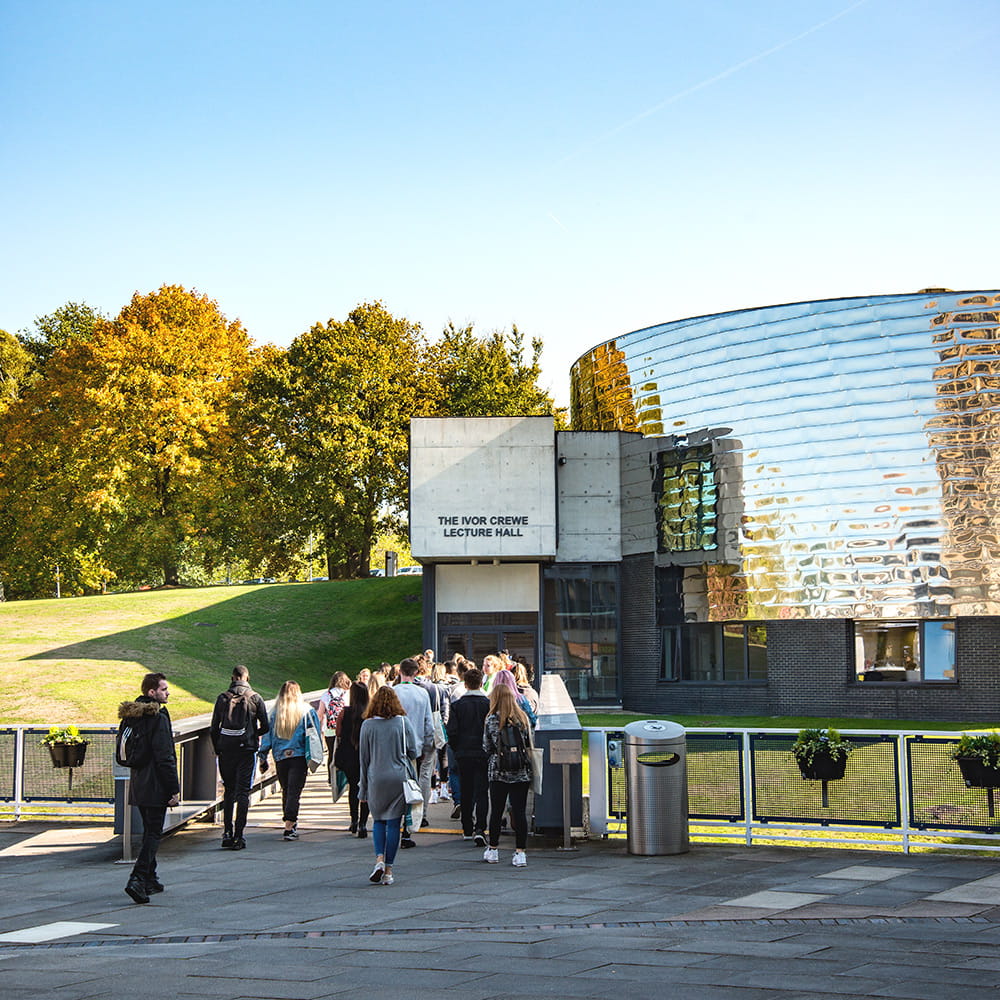
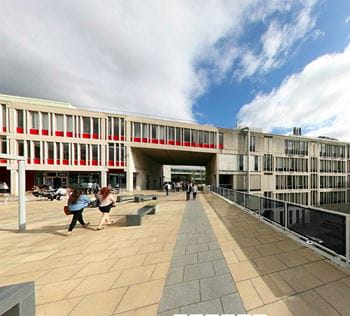
Set within 200 acres of award-winning parkland - Wivenhoe Park and located two miles from the historic city centre of Colchester – England's oldest recorded development. Our Colchester Campus is also easily reached from London and Stansted Airport in under one hour.
If you live too far away to come to Essex (or have a busy lifestyle), no problem. Our 360-degree virtual tour allows you to explore our University from the comfort of your home. Check out our Colchester virtual tour to see accommodation options, facilities and social spaces.
At Essex we pride ourselves on being a welcoming and inclusive student community. We offer a wide range of support to individuals and groups of student members who may have specific requirements, interests or responsibilities.
The University makes every effort to ensure that this information on its programme specification is accurate and up-to-date. Exceptionally it can be necessary to make changes, for example to courses, facilities or fees. Examples of such reasons might include, but are not limited to: strikes, other industrial action, staff illness, severe weather, fire, civil commotion, riot, invasion, terrorist attack or threat of terrorist attack (whether declared or not), natural disaster, restrictions imposed by government or public authorities, epidemic or pandemic disease, failure of public utilities or transport systems or the withdrawal/reduction of funding. Changes to courses may for example consist of variations to the content and method of delivery of programmes, courses and other services, to discontinue programmes, courses and other services and to merge or combine programmes or courses. The University will endeavour to keep such changes to a minimum, and will also keep students informed appropriately by updating our programme specifications. The University would inform and engage with you if your course was to be discontinued, and would provide you with options, where appropriate, in line with our Compensation and Refund Policy.
The full Procedures, Rules and Regulations of the University governing how it operates are set out in the Charter, Statutes and Ordinances and in the University Regulations, Policy and Procedures.
Want to quiz us about your course? Got a question that just needs answering? Get in touch with us on live chat!