Undergraduate Course

BA (Hons) Philosophy

BA (Hons)  Philosophy

Overview

The details
Philosophy
V500
October 2026
Full-time
3 years
Colchester Campus

What is BA Philosophy?

Our BA Philosophy challenges you to think critically about some of the most fundamental questions of human existence. You will explore topics such as knowledge, identity, ethics, freedom, religion, politics, and the meaning of life, while developing the analytical and reasoning skills that are valued across a wide range of careers.

At Essex, philosophy is connected to the real world. You will examine how philosophical ideas shape debates in areas such as public policy, law, medicine, politics, mental health, and social justice. Drawing on a diverse range of traditions and perspectives, you will learn to question assumptions, evaluate arguments, and engage thoughtfully with complex issues.

Taught by internationally recognised academics within the School of Philosophical, Historical and Interdisciplinary Studies, you will study in a research-led environment with particular strengths in ethics, political philosophy, philosophy of religion, and European philosophy. Through discussion, debate, and independent research, you will develop the intellectual confidence and transferable skills needed for success in a rapidly changing world.

Why this course

  • Explore life’s biggest questions: Investigate fundamental issues surrounding knowledge, identity, morality, freedom, religion, and the nature of reality.
  • Develop highly valued transferable skills: Build advanced abilities in critical thinking, problem-solving, communication, analysis, and reasoning that are sought after by employers across many sectors.
  • Learn in a discussion-led environment: Small seminars encourage debate, collaboration, and active engagement with philosophical ideas and arguments.
  • Study a wide range of philosophical traditions: Explore subjects ranging from ancient philosophy and the history of ideas to contemporary ethics, political philosophy, critical theory, existentialism, and phenomenology.
  • Research-led teaching with real-world relevance: Examine how philosophical thinking contributes to contemporary debates in law, politics, healthcare, social policy, and culture.

Who should apply

  • The Curious Thinker: Students who enjoy asking challenging questions and exploring different perspectives on important issues.
  • The Critical Analyst: Applicants looking to develop strong reasoning, argumentation, and problem-solving skills.
  • The Future Professional: Students seeking a versatile degree that provides excellent preparation for careers in law, journalism, public service, business, education, and beyond.

What you’ll learn

Our research-led teaching is continually evolving to address the latest challenges and developments within philosophy. The following modules are based on the current course structure and may change in response to new curriculum developments and innovation.

In your first year, you will explore key philosophical questions through modules such as Introduction to Philosophy, examining topics including knowledge, identity, selfhood, responsibility, and human understanding. As you progress, you will engage with major thinkers and traditions, studying areas such as rationalism, empiricism, ethics, political philosophy, philosophy of religion, and European thought.

In your final year, you will complete a Philosophy Capstone Project, allowing you to conduct independent research on a topic that reflects your own interests and intellectual ambitions.

We understand that deciding where and what to study is a very important decision for you. We'll make all reasonable efforts to provide you with the courses, services and facilities as described on our website and in line with your contract with us. However, if we need to make material changes, for example due to significant disruption, we'll let our applicants and students know as soon as possible.

Your learning experience

Undergraduate students in the School of Philosophical, Historical and Interdisciplinary Studies typically attend lectures and seminars each week, with additional contact hours introduced during the second and final years of study.

  • Taught through a combination of lectures and interactive seminar discussions.
  • Small class sizes encourage active participation, debate, and critical engagement with philosophical ideas.
  • Opportunities to explore both historical and contemporary philosophical debates across a range of traditions.
  • Research-led teaching informed by the latest developments in philosophical scholarship.
  • Additional modules in later years help develop specialist knowledge and independent research skills.

Philosophy at Essex places discussion at the centre of learning. Seminars provide opportunities to analyse arguments, challenge assumptions, and develop your own perspectives in a supportive academic environment.

Assessment methods are designed to develop a broad range of academic and professional skills. While first-year modules typically combine coursework and examinations, second and final-year assessments focus on essays, presentations, in-class assessments, group work, and other innovative forms of evaluation.

Our interdisciplinary approach means you can engage with ideas and research across related subjects including politics, law, sociology, psychoanalysis, art history, and cultural studies.

Careers and outcomes

A philosophy degree equips you with highly transferable skills that are valued across a wide range of professions. Essex Philosophy graduates develop the ability to analyse complex problems, evaluate evidence, communicate clearly, and think creatively and independently.

Graduates have gone on to careers in law, journalism, public relations, media, the Civil Service, charity and non-governmental organisations, banking, healthcare, education, and many other sectors.

Throughout your studies, you will have access to employability support, career development opportunities, and guidance from academic staff. We also work closely with the University's Student Development Team to help students explore internships, placements, voluntary work, and graduate career opportunities.

The intellectual flexibility, analytical rigour, and communication skills developed through philosophy provide an excellent foundation for both professional careers and further postgraduate study.

Why we're great.
  • We focus on the existential questions of human life, and provide a critical perspective on the social, political and economic challenges we are facing today.
  • Our courses can also be taken as a four-year option including a year of study abroad.
  • Top 20 for philosophy in the UK (The Times and Sunday Times Good University Guide 2026)

Course content

Course structure

Our research-led teaching is continually evolving to address the latest challenges and breakthroughs in the field. The following modules are based on the current course structure and may change in response to new curriculum developments and innovation.

We understand that deciding where and what to study is a very important decision for you. We'll make all reasonable efforts to provide you with the courses, services and facilities as described on our website and in line with your contract with us. However, if we need to make material changes, for example due to significant disruption, we'll let our applicants and students know as soon as possible.

Components and modules explained

Components

Components are the blocks of study that make up your course. A component may have a set module which you must study, or a number of modules from which you can choose.

Each component has a status and carries a certain number of credits towards your qualification.

Status What this means
Core
You must take the set module for this component and you must pass. No failure can be permitted.
Core with Options
You can choose which module to study from the available options for this component but you must pass. No failure can be permitted.
Compulsory
You must take the set module for this component. There may be limited opportunities to continue on the course/be eligible for the qualification if you fail.
Compulsory with Options
You can choose which module to study from the available options for this component. There may be limited opportunities to continue on the course/be eligible for the qualification if you fail.
Optional
You can choose which module to study from the available options for this component. There may be limited opportunities to continue on the course/be eligible for the qualification if you fail.

The modules that are available for you to choose for each component will depend on several factors, including which modules you have chosen for other components, which modules you have completed in previous years of your course, and which term the module is taught in.

Modules

Modules are the individual units of study for your course. Each module has its own set of learning outcomes and assessment criteria and also carries a certain number of credits.

In most cases you will study one module per component, but in some cases you may need to study more than one module. For example, a 30-credit component may comprise of either one 30-credit module, or two 15-credit modules, depending on the options available.

Modules may be taught at different times of the year and by a different department or school to the one your course is primarily based in. You can find this information from the module code. For example, the module code HR100-4-FY means:

HR 100  4  FY

The department or school the module will be taught by.

In this example, the module would be taught by the Department of History.

The module number. 

The UK academic level of the module.

A standard undergraduate course will comprise of level 4, 5 and 6 modules - increasing as you progress through the course.

A standard postgraduate taught course will comprise of level 7 modules.

A postgraduate research degree is a level 8 qualification.

The term the module will be taught in.

  • AU: Autumn term
  • SP: Spring term
  • SU: Summer term
  • FY: Full year 
  • AP: Autumn and Spring terms
  • PS: Spring and Summer terms
  • AS: Autumn and Summer terms

COMPONENT 01: COMPULSORY

Introduction to Philosophy
(30 CREDITS)

Begin your study of philosophy with an exploration of epistemology (the theory of knowledge) and identity theory. What does it mean to say that we ‘know’ something? What if that something is ourselves? How do our modes of practical interaction with the world and each other shape our ability to know different kinds of objects? Are there vices of the mind that distort our reasoning and lead our practical deliberations astray? How important is trust in a functional knowledge community? What kind of creatures must we be in order to be capable of knowing things? What role does self-responsibility play in effective knowing? What is it to be a self? How does that differ from having an identity or identities? To what extent are our identities determined by others? Are they up to us? How can the study of philosophy help us with these questions?

View Introduction to Philosophy on our Module Directory

COMPONENT 02: OPTIONAL

Humanities option(s) from list
(30 CREDITS)

COMPONENT 03: OPTIONAL

PY113-4-FY or outside option(s) from list
(30 CREDITS)

COMPONENT 04: OPTIONAL

PY114-4-FY or outside option(s) from list
(30 CREDITS)

COMPONENT 05: COMPULSORY

Beyond the BA: Skills for the Next Step
(0 CREDITS)

This course introduces key academic, professional and personal skills to support a successful transition beyond undergraduate study. Students develop confidence in critical thinking, communication, teamwork and self reflection while exploring future study and career options.

View Beyond the BA: Skills for the Next Step on our Module Directory

COMPONENT 01: COMPULSORY

Rationalists and Empiricists
(15 CREDITS)

What is the nature and limits of human knowledge? Does our common-sense view of the world have a philosophical foundation? Does sensory experience provide the only path to knowledge of the world or can we gain knowledge through the exercise of pure reason? What role, if any, does God play in knowledge? What is the relation between the body and the mind? Do we know that the sun will rise tomorrow? Study the philosophical texts of the modern era that helped lay the conceptual foundations for these questions and others. We will begin with a close reading of Descartes' Meditations before exploring both rationalist (Spinoza and Leibniz) and empiricist (Locke and Hume) responses.

View Rationalists and Empiricists on our Module Directory

COMPONENT 02: COMPULSORY

Ethics
(15 CREDITS)

This year, we will explore some of the things that worry people about morality. These are matters that may be thought of as challenges to morality and that seem either to make morality impossible or to undermine our commitment to it. For instance, if morality is just a matter of what we happen to like or dislike, or it is only relative to the standards of one's culture, the idea that we can ask and give moral reasons appears to be undermined, or significantly limited. Analogously, the fact that moral discussions (unlike arguments about matters of fact) often end up in irresolvable disagreements seems to threaten the rationality of moral arguments. The role that matters of luck play in our moral evaluations seems to involve holding people responsible for things that are not really under their control, thus compromising the idea that we can really assess the moral value of their actions. In the first term, we will look at these and other challenges to morality, and we will also explore some of the metaethical questions that these challenges raise: can we say that our moral judgements are capable of being true or false? If they are, does their truth depend on certain moral facts? Can we describe these facts as natural?

View Ethics on our Module Directory

COMPONENT 03: COMPULSORY

Reading Texts from the History of Philosophy
(30 CREDITS)

In this module we will intensively examine a classic philosophical text, treating it not only as a historical document, but principally with regard to its ongoing contribution to philosophical thinking.

View Reading Texts from the History of Philosophy on our Module Directory

COMPONENT 04: OPTIONAL

Philosophy option(s) from list or outside option(s)
(30 CREDITS)

COMPONENT 05: OPTIONAL

Philosophy option from list
(15 CREDITS)

COMPONENT 06: COMPULSORY WITH OPTIONS

CS200-5-SP or (CS207-5-AU and Philosophy option)
(15 CREDITS)

COMPONENT 01: OPTIONAL

Philosophy option(s) from list
(30 CREDITS)

COMPONENT 02: COMPULSORY

Philosophy Capstone Module
(30 CREDITS)

This is an intensive final-year module running over five weeks during the summer term. It involves a guided and structured approach to support you in completing a research project of your own.

View Philosophy Capstone Module on our Module Directory

COMPONENT 03: OPTIONAL

Philosophy option(s) from list
(30 CREDITS)

COMPONENT 04: OPTIONAL

CS307-6-AU and/or Philosophy option(s) from list
(30 CREDITS)

Year abroad

On your year abroad, you have the opportunity to experience other cultures and languages, to broaden your degree socially and academically, and to demonstrate to employers that you are mature, adaptable, and organised. The rest of your course remains identical to the three-year degree.

Teaching

Undergraduate students in the School of Philosophical, Historical and Interdisciplinary Studies typically attend a one-hour lecture and a one-hour seminar for each module every week (second and final year philosophy lectures are two-hours).

  • Teaching typically takes the form of lectures and seminar sessions
  • Seminars allow your lecturer to explain new arguments and ideas in more detail, while giving you sufficient time for questions, collective discussion and active engagement with the material
  • We believe that discussion is the lifeblood of philosophy, and we try to keep our classes as small as we can for this purpose
  • In the second and final-year of your degree, we add an additional contact hour to each module
  • In the Summer term of the second and final-year of your degree we offer additional modules which cover additional topics and develop your research skills

Assessment

  • In your first year, modules are typically assessed by essays and exams (with most modules weighted 50% coursework and 50% exams).
  • We are the first Philosophy Department in the UK that has scrapped all formal exams in the second and final-year of your degree
  • In place of exams, we have a whole range of innovative assessments (e.g. essays, in-class assessments, presentations, group work, reading summaries) designed to boost your transferable skills

Entry requirements

UK entry requirements

  • 120 - 112 UCAS tariff points from a minimum of 2 full A-levels.

  • IB: 30 - 29 points in the IB Diploma or 120 - 112 UCAS tariff points to include a minimum of 2 Higher Level subjects.

  • We accept A-levels, AAQs, BTECs, Access to HE Diploma, T-levels and most other qualifications that hold UCAS tariff points. Acceptability of some non A-level qualifications (such as BTECs) may depend on the subject studied and units taken.

You can calculate your UCAS tariff points on the UCAS website.

Whilst International A-levels and BTECs aren't on the UCAS tariff calculator, we assign them the same tariff points as their UK counterparts.

More information about our requirements and how to apply is on our undergraduate application information page

Contextual Offers:

We are committed to ensuring that all students with the merit and potential to benefit from an Essex education are supported to do so. We make Contextual Offers, of up to two A-level grades (or equivalent) below our standard conditional offer, to applicants from underrepresented groups residing in the UK. Our Contextual Offers policy outlines the full eligibility criteria.

If you haven't got the grades you hoped for, have a non-traditional academic background, are a mature student, or have any questions about eligibility for your course, more information can be found on our undergraduate application information page.

International & EU entry requirements

We accept a wide range of qualifications from applicants studying in the EU and other countries. Get in touch with any questions you may have about the qualifications we accept. Remember to tell us about the qualifications you have already completed or are currently taking.

Sorry, the entry requirements for the country that you have selected are not available here. Please contact our Undergraduate Admissions team at ugquery@essex.ac.uk to request the entry requirements for this country.

English language requirements

English language requirements for applicants whose first language is not English

IELTS 6.0 overall with a minimum of 5.5 in each component, or specified score in an equivalent test that we accept.

Details of English language requirements and the tests we accept for applicants who require a Student visa (excluding Nationals of Majority English Speaking Countries) can be found here

If we accept the English component of an international qualification it will be included in the academic levels listed above for the relevant countries.

Pre-sessional English courses

If you do not meet our IELTS requirements then you may be able to complete a pre-sessional English pathway that enables you to start your course without retaking IELTS.

Additional Notes

If you’re an international student, but do not meet the academic requirements for direct admission to this degree, you could prepare and gain entry through a pathway course. Find out more about opportunities available to you at the University of Essex International College

Fees and funding

Home/UK fee

£9,790 per year

International fee

£21,500 per year

Fees will increase for each academic year of study.

If your course has the option to include a placement year or study abroad, and you choose to do so, you will pay the following:

Placement year

20% of your standard tuition fee for that year

Study abroad

Full year abroad

15% of your standard tuition fee for that year

Single term abroad

Standard tuition fee

Scholarships and financial support

There may be scholarships, bursaries or discounts available to help with the cost of this course.

Fees and funding guide

Home/UK fees and funding information

What's next

Group of three female students walking along Southend Pier talking and looking at a booklet

Open Days

Our events are a great way to find out more about studying at Essex. We run a number of Open Days throughout the year which enable you to discover what our campus has to offer. You have the chance to:

  • tour our campus and accommodation
  • find out answers to your questions about our courses, student finance, graduate employability, student support and more
  • meet our students and staff

Check out our Visit Us pages to find out more information about booking onto one of our events. And if the dates aren’t suitable for you, feel free to book a campus tour here.

2026 Open Days (Colchester Campus)

  • Saturday 15 August 2026 - Clearing Open Day
  • Saturday 17 October 2026 - October Open Day
  • Saturday 7 November 2026 - November Open Day
Male applicant sitting at a desk in their bedroom writing on a notepad

Applying

Applications for our full-time undergraduate courses should be made through the Universities and Colleges Admissions Service (UCAS). Full details on how to apply can be found on the filling in your UCAS undergraduate application web page.

Our UK students, and some of our EU and international students, who are still at school or college, can apply through their school. Your school will be able to check and then submit your completed application to UCAS. Our other international applicants (EU or worldwide) or independent applicants in the UK can also apply online through UCAS Apply.

The UCAS code for our University of Essex is ESSEX E70. The individual campus codes for our Loughton and Southend Campuses are 'L' and 'S' respectively.

You can find further information on how to apply, including information on transferring from another university, applying if you are not currently at a school or college, and applying for readmission on our How to apply and entry requirements page.

If you receive an undergraduate offer to study with us in October 2026 and live in the UK, you will receive an email invitation to book onto one of our Open Days. These events provide the opportunity to meet your department, join interesting taster sessions, tour our campus and accommodation, and chat to current students. You can visit our Open Days event page for more information, including terms and conditions.

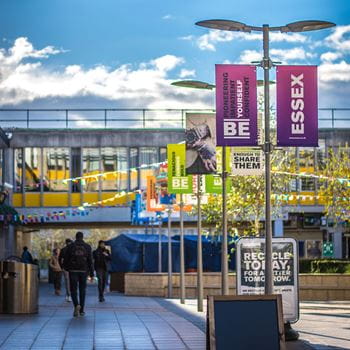
A sunny day with banners flying on Colchester Campus Square 4.

Visit Colchester Campus

Set within 200 acres of award-winning parkland - Wivenhoe Park and located two miles from the historic city centre of Colchester – England's oldest recorded development. Our Colchester Campus is also easily reached from London and Stansted Airport in under one hour.


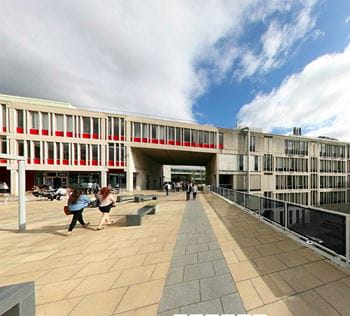
View from Square 2 outside the Rab Butler Building looking towards Square 3

Virtual tours

If you live too far away to come to Essex (or have a busy lifestyle), no problem. Our 360-degree virtual tour allows you to explore our University from the comfort of your home. Check out our Colchester virtual tour to see accommodation options, facilities and social spaces.

At Essex we pride ourselves on being a welcoming and inclusive student community. We offer a wide range of support to individuals and groups of student members who may have specific requirements, interests or responsibilities.

The University makes every effort to ensure that this information on its programme specification is accurate and up-to-date. Exceptionally it can be necessary to make changes, for example to courses, facilities or fees. Examples of such reasons might include, but are not limited to: strikes, other industrial action, staff illness, severe weather, fire, civil commotion, riot, invasion, terrorist attack or threat of terrorist attack (whether declared or not), natural disaster, restrictions imposed by government or public authorities, epidemic or pandemic disease, failure of public utilities or transport systems or the withdrawal/reduction of funding. Changes to courses may for example consist of variations to the content and method of delivery of programmes, courses and other services, to discontinue programmes, courses and other services and to merge or combine programmes or courses. The University will endeavour to keep such changes to a minimum, and will also keep students informed appropriately by updating our programme specifications. The University would inform and engage with you if your course was to be discontinued, and would provide you with options, where appropriate, in line with our Compensation and Refund Policy.

The full Procedures, Rules and Regulations of the University governing how it operates are set out in the Charter, Statutes and Ordinances and in the University Regulations, Policy and Procedures.

Related courses

Ask us a question
Ask us a question

Want to quiz us about your course? Got a question that just needs answering? Get in touch with us on live chat!

login