Our BA Art History (including Foundation Year) could be suitable for you if your academic qualifications do not yet meet our entry requirements for a three-year version of our arts and humanities courses and you want a programme that improves your skills to support your academic performance.
Open to UK and EU applicants, this four-year course includes a Foundation Year. From the start of your journey at Essex, you’ll be integrated as a student within the School of Philosophical, Historical and Interdisciplinary Studies for the entire duration of your degree, helping you to feel connected to your subject, lecturers and future classmates from day one. At least 25% of the teaching during your Foundation Year will be delivered directly by the School. You’ll also study academic skills modules designed to help you build confidence and prepare for university-level study. Your Foundation Year won’t just prepare you for university - it’ll help you feel part of your academic community right from the beginning.
At Essex, you will acquire a broad foundation in the history of visual culture: both by learning about canonical forms of art and architecture and by discovering what has been overlooked or marginalised, such as medical photography, tattoos or objects from political protests. You will also develop the skills you need to make exciting new connections between the forms of visual culture you study, developments in other disciplines, and broader social and political forces.
You will develop the skills you need to transform your excitement about art, architecture and visual culture into the ability to uncover new insights about the material you study. You will also develop a solid grounding in the history of art and other forms of visual culture, including the ideas and forces that shaped their production, distribution and reception.
For students with a particular interest in pursuing careers in curating and museumship, we also provide modules every year that explore the histories, theories and practices of museums, exhibitions and galleries, as well as more nuts-and-bolts issues, such as installing and marketing artwork.
You will be taught by our expert staff from your first year, a rarity in UK art history courses. We also house a collection of over 750 pieces of art from Latin America, ESCALA.
Why we're great.
We equip you with the necessary knowledge and skills to succeed at Essex and beyond.
Guarantee your place on your chosen course if you successfully complete your foundation year at Essex.
Small class sizes allow you to work closely with your teachers and classmates.
Study abroad
Our BA Art History programme offers you a variety of study abroad options. The five-year version of our degree allows you to spend the fourth year studying abroad, while otherwise remaining identical to the four-year course.
Studying abroad allows you to experience other cultures and languages, to broaden your degree socially and academically, and to demonstrate to employers that you are mature, adaptable and organised. We have established partnerships across Europe, the United States, Latin America and Asia, including with world-renowned institutions such as:
École du Louvre in France
University of Freiburg in Germany
University of Bologna in Italy
Many of our partnerships are subject to language requirements and are recommended for students on joint degrees with languages, but there are also plenty of Anglophone destinations if you don't want to pursue a second language.
If you spend a full year abroad you'll only pay 15% of your usual tuition fee to Essex for that year. You won't pay any tuition fees to your host university
Our expert staff
We are a dynamic group of art historians who investigate the production and reception of images and built environment, across cultures and media, from the late medieval period to the present day.
Our staff's research interests include activist art, modernist art and totalitarianism, the relationship between art and science, the artistic status of body modification, art and the environment, critical heritage, and the visual culture of social problems. We also have significant experience in curation and public engagement. Recent projects include:
Paola Di Giuseppantonio Di Franco's UKRI Future Leaders-funded research project, REPLACE
Matt Lodder's Painted People: Humanity in 21 Tattoos (HarperCollins, 2022)
Diana Bullen Presciutti's Saints, Miracles, and Social Problems in Italian Renaissance Art (Cambridge, 2023)
Specialist facilities
Our School of Philosophical, Historical and Interdisciplinary Studies also offers excellent on-campus facilities:
Our Essex Collection of Art from Latin America (ESCALA) is the most comprehensive Latin American art research resource in the UK and has a state-of-the-art teaching and research space. Many of our students gain work and research experience through our collection
Our onsite gallery Art Exchange runs an ongoing programme of contemporary art exhibitions, talks by curators and artists, and exhibitions organised by our curatorial students
Enjoy regular visits to London galleries, including Tate Modern, Tate Britain, the National Gallery and the Royal Academy of Arts, as well as many independent and alternative spaces
Access our lively common room and departmental film collection
Colchester's iconic Firstsite gallery runs an exciting programme of art exhibitions, film screenings and talks
Your future
The visual arts and culture industries have become an increasingly significant part of the national and international economy, and our art history graduates leave Essex with the skills to take advantage of this growing opportunity.
Some of the sectors with jobs well suited for our graduates include: museums and galleries, auction houses, education (e.g., in schools, universities and cultural institutions), marketing and advertising, and new media. Our degree also prepares students to run their own galleries, to work as specialist arts lawyers and PR agents, and for positions in charities, fashion and publishing.
To help our students acquire the particular skills they need to gain employment in the museum and gallery sector – arguably the single-most important area in which our students seek jobs – we offer several modules every year dedicated to the histories, theories and practices of museums, exhibitions and galleries. We also give our students the opportunity to think creatively and proactively about life after university in our curatorial employability module.
Our recent graduates have gone on to work for a wide range of high-profile companies including:
National Portrait Gallery
Victoria and Albert Museum
Sotheby's New York
Momart Ltd
John Lewis
We also work with the university's Student Development Team to help you find out about further work experience, internships, placements, and voluntary opportunities.
Course content
Components and modules explained
Components
Components are the blocks of study that make up your course. A component may have a set module which you must study, or a number of modules from which you can choose.
Each component has a status and carries a certain number of credits towards your qualification.
Status
What this means
Core
You must take the set module for this component and you must pass. No failure can be permitted.
Core with Options
You can choose which module to study from the available options for this component but you must pass. No failure can be permitted.
Compulsory
You must take the set module for this component. There may be limited opportunities to continue on the course/be eligible for the qualification if you fail.
Compulsory with Options
You can choose which module to study from the available options for this component. There may be limited opportunities to continue on the course/be eligible for the qualification if you fail.
Optional
You can choose which module to study from the available options for this component. There may be limited opportunities to continue on the course/be eligible for the qualification if you fail.
The modules that are available for you to choose for each component will depend on several factors, including which modules you have chosen for other components, which modules you have completed in previous years of your course, and which term the module is taught in.
Modules
Modules are the individual units of study for your course. Each module has its own set of learning outcomes and assessment criteria and also carries a certain number of credits.
In most cases you will study one module per component, but in some cases you may need to study more than one module. For example, a 30-credit component may comprise of either one 30-credit module, or two 15-credit modules, depending on the options available.
Modules may be taught at different times of the year and by a different department or school to the one your course is primarily based in. You can find this information from the module code. For example, the module code HR100-4-FY means:
HR
100
4
FY
The department or school the module will be taught by.
In this example, the module would be taught by the Department of History.
This module is designed to support students in their academic subject disciplines and to strengthen their confidence in key skills areas such as: academic writing, research, academic integrity, collaborative and reflective practices.
The students are supported through the use of subject-specific materials tailored to their chosen degrees with alignment of assessments between academic subject modules and the skills module.
The module aims to establish a theoretical foundation for students pursuing degrees in Social Science through the introduction of some key theories and concepts associated with the fields of Sociology, Criminology and Psychoanalysis and Psychosocial studies. The relevance of these theories will be demonstrated through opportunities to consider their role in specific contemporary social issues. As such the Autumn Term focuses on criminological theory and its application to contemporary society whilst also encouraging the development of a Sociological Imagination through debating current social issues based on the work of key social theorists. In Spring term building upon the learning in Autumn Term, students will use the lens of psychoanalysis to explore how people interact within society. They will consider the way individuals affect one another and how institutions affect the people who work in them and vice versa. Throughout the module, expert guest speakers are periodically invited to contribute to lectures and seminars.
This module is intended as a skills-building course for first year art history students, to develop writing skills across a range of assessed and non-assessed writing types (essay, critical review, reading summary, label text, catalogue essay etc). The module will also present an introduction to research methods in art history, and a historical overview of art historical writing.
This module tackles some of the biggest questions surrounding the history of art. You will explore some key theoretical issues in the history of art, such as the nature of representation, by engaging critically with seminal texts and artworks. In this module, you will develop your analytical and interpretive skills, and leave with a solid foundation for the study of the history of art.
This introductory module asks you to consider how art historians look (and have looked) at art and visual culture across history. In so doing, it seeks to train you to see and think like an art historian.
This course introduces key academic, professional and personal skills to support a successful transition beyond undergraduate study. Students develop confidence in critical thinking, communication, teamwork and self reflection while exploring future study and career options.
Art and Ideas II: More Art, More Ideas - Critique and Historiography in the History of Art
(15 CREDITS)
How did our society decide what counts as ‘art’ and what is ‘culture’? Is there really such a thing as high vs low culture? What are the political stakes of these divisions? This module looks at the shift in ideas from ‘art history’ to visual and material cultural studies. This module will engage with these debates and teach you new methods for seeing, interpreting and understanding art, design, craft, performance, fashion, film and videogames. These new ways of seeing are often driven by new theoretical ideas , and allow us to look at culture to draw out new perspectives on social and political issues of activism and social change, sex, technology, police violence, migration, austerity and crisis, state surveillance, and our relation to animals and the environment.
This third art and ideas module deepens your existing thematic and historiographical knowledge building on Art and Ideas II. In this module, we will familiarise ourselves with some of the most influential and insightful theoretical approaches to art in the 20th and 21st Century.
In this module you will produce a capstone project, taking the form of either of an 8,000-word written dissertation, or a curatorial project or heritage project of equivalent scope. The finished capstone project should show an all-round grasp of your subject and the ability to present your material clearly, succinctly and in the most appropriate sequence. It should also demonstrate evidence of a serious engagement with your topic, a mastery of the information currently available, and the inclusion of your own reasoned, critical judgements. A supervisor will help guide you as you begin to develop a research question, start researching the topic and write the dissertation or develop the curating or heritage project. This is a capstone module, available to final-year students on Art History, Curating, or Heritage courses with permission only.
Mature applicants and non-traditional academic backgrounds:
We welcome applications from mature students (over 21) and students with non-traditional academic backgrounds (might not have gone on from school to take level 3 qualifications). We will consider your educational and employment history, along with your personal statement and reference, to gain a rounded view of your suitability for the course.
International applicants:
We are unable to accept applications from international students for our foundation year courses. Foundation pathways for international students are available at the University of Essex International College and are delivered and awarded by Kaplan, in partnership with the University of Essex. Successful completion will enable you to progress to the relevant degree course at the University of Essex.
International & EU entry requirements
We accept a wide range of qualifications from applicants studying in the EU and other countries. Get in touch with any questions you may have about the qualifications we accept. Remember to tell us about the qualifications you have already completed or are currently taking.
Sorry, the entry requirements for the country that you have selected are not available here. Please contact our Undergraduate Admissions team at ugquery@essex.ac.uk to request the entry requirements for this country.
English language requirements
English language requirements for applicants whose first language is not English
IELTS 5.5 overall with a minimum of 5.5 in each component, or specified score in an equivalent test that we accept.
If we accept the English component of an international qualification it will be included in the academic levels listed above for the relevant countries.
Pre-sessional English courses
If you do not meet our IELTS requirements then you may be able to complete a pre-sessional English pathway that enables you to start your course without retaking IELTS.
Additional Notes
If you’re an international student, but do not meet the requirements for direct admission to this degree or the first year of a degree at Essex, you could prepare and gain entry through a pathway course. Find out more about opportunities available to you at the University of Essex International College
Our events are a great way to find out more about studying at Essex. We run a number of Open Days throughout the year which enable you to discover what our campus has to offer.
You have the chance to:
tour our campus and accommodation
find out answers to your questions about our courses, student finance, graduate employability, student support and more
meet our students and staff
Check out our Visit Us pages to find out more information about booking onto one of our events. And if the dates aren’t suitable for you, feel free to book a campus tour here.
Our UK students, and some of our EU students, who are still at school or college, can apply through their school. Your school will be able to check and then submit your completed application to UCAS. Independent applicants in the UK or EU can also apply online through UCAS Apply.
The UCAS code for our University of Essex is ESSEX E70. The individual campus codes for our Loughton and Southend Campuses are 'L' and 'S' respectively.
You can find further information on how to apply, including information on transferring from another university, applying if you are not currently at a school or college, and applying for readmission on our How to apply and entry requirements page.
If you receive an undergraduate offer to study with us in October 2026 and live in the UK, you will receive an email invitation to book onto one of our Open Days. These events provide the opportunity to meet your department, join interesting taster sessions, tour our campus and accommodation, and chat to current students. You can visit our Open Days event page for more information, including terms and conditions.
Please note that this course is not open to international applicants
Visit Colchester Campus
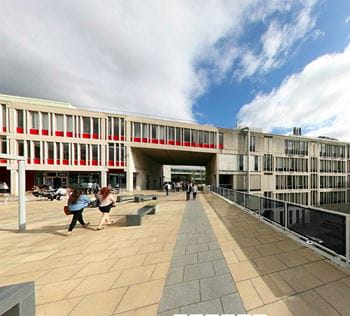
Set within 200 acres of award-winning parkland - Wivenhoe Park and located two miles from the historic city centre of Colchester – England's oldest recorded development. Our Colchester Campus is also easily reached from London and Stansted Airport in under one hour.
If you live too far away to come to Essex (or have a busy lifestyle), no problem. Our 360-degree virtual tour allows you to explore our University from the comfort of your home. Check out our Colchester virtual tour to see accommodation options, facilities and social spaces.
At Essex we pride ourselves on being a welcoming and inclusive student community. We offer a wide range of support to individuals and groups of student members who may have specific requirements, interests or responsibilities.
The University makes every effort to ensure that this information on its programme specification is accurate and up-to-date. Exceptionally it can be necessary to make changes, for example to courses, facilities or fees. Examples of such reasons might include, but are not limited to: strikes, other industrial action, staff illness, severe weather, fire, civil commotion, riot, invasion, terrorist attack or threat of terrorist attack (whether declared or not), natural disaster, restrictions imposed by government or public authorities, epidemic or pandemic disease, failure of public utilities or transport systems or the withdrawal/reduction of funding. Changes to courses may for example consist of variations to the content and method of delivery of programmes, courses and other services, to discontinue programmes, courses and other services and to merge or combine programmes or courses. The University will endeavour to keep such changes to a minimum, and will also keep students informed appropriately by updating our programme specifications. The University would inform and engage with you if your course was to be discontinued, and would provide you with options, where appropriate, in line with our Compensation and Refund Policy.
The full Procedures, Rules and Regulations of the University governing how it operates are set out in the Charter, Statutes and
Ordinances and in the University Regulations, Policy and Procedures.
3.png?mw=300)