The deadline to apply for this course starting October 2026 has now passed (15 December 2025). Due to the course's popularity, offers are made on a first-come, first-served basis until places are filled, after which offers will be made for a place on the waiting list. Please see our how to apply webpages for more information.
Our MSc Physiotherapy (Pre-Registration) is a two-year, full-time postgraduate degree delivered at our Colchester Campus.
It provides the integrated clinical training, scientific knowledge and professional skills required to become a safe, effective and autonomous physiotherapist.
You’ll examine how physiotherapists assess, treat and rehabilitate people across the lifespan, and you’ll develop the clinical reasoning, hands-on skills and evidence-based practice needed to work confidently in modern healthcare settings. You’ll also build the reflective, problem-solving and leadership capabilities essential for a long-term career in physiotherapy.
The MSc Physiotherapy (Pre-Registration) at Essex is highly competitive and attracts applicants who want a fast-track route into a respected, in-demand healthcare profession.
Key benefits include:
By graduation, you’ll have the clinical competence, professional confidence and evidence-based reasoning required to begin your career as a registered physiotherapist.
If you’re driven, compassionate and ready for a challenging, hands-on route into healthcare, this programme is designed for you.
You’ll develop the clinical, scientific and professional skills required for safe and effective physiotherapy practice and long-term professional development.
Key learning areas include:
This MSc combines research-informed teaching with extensive clinical practice and placement experience.
How you'll learn
Specialist facilities
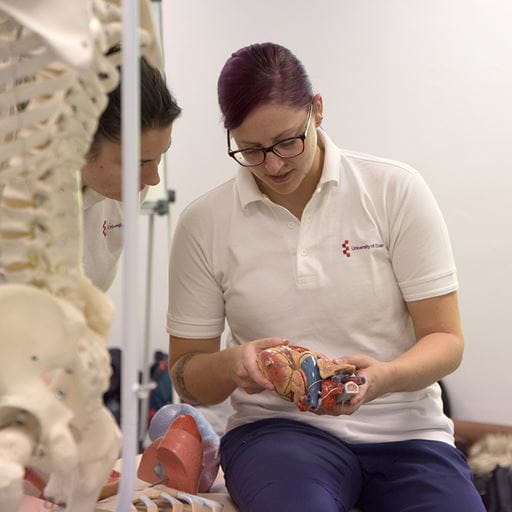
You'll train in environments that mirror real clinical settings, helping you build confidence before entering practice:
Clinical placements
You’ll complete multiple placements across NHS and community settings, working directly with patients and qualified physiotherapists, gaining experience in:
Essex maintains strong links with regional clinical partners, ensuring high-quality placement experiences.
Physiotherapy is a high-demand profession with excellent career prospects in the UK and internationally.
Roles may include:
You’ll graduate ready to apply for HCPC registration and begin your career as an autonomous practitioner.
You’ll also have access to career support, placement networks and professional development opportunities to help you transition into qualified practice.
Our MSc Physiotherapy (Pre-Registration) graduates secure roles across leading NHS trusts, international health services and elite professional sport organisations.
Accredited by the Chartered Society of Physiotherapy (CSP).
Approved by the Health and Care Professions Council (HCPC) for the purpose of providing eligibility to apply for registration with the HCPC as a physiotherapist.
"I could not have asked for a better foundation to my career than the course at Essex, which is founded on encouraging students to be autonomous in gaining their skills and knowledge through the support of experienced teaching staff. We were always challenged to be critical of our knowledge and how it could be applied to individuals in our care. Patients being at the centre of our care underpinned all modules, which is an attitude that was invaluable in seeking and gaining employment."
Emily Linney, MSc Physiotherapy
Please note that our MSc Physiotherapy (Pre-Registration) is an intensive two-year course based at our Colchester Campus.
Postgraduate study is the chance to take your education to the next level. These carefully selected modules will give you the chance to explore, question, and create powerful ideas. Picked to give you an extensive and in-depth education, they'll equip you with the specialist knowledge, vital transferrable skills, and the confidence to make a genuine difference to the world around you.
There are 44 weeks of teaching per year. The structure of the programme adopts a developmental approach to the mastering of physiotherapy skills. You will be introduced to physiotherapy through observing and working with physiotherapists practising in a variety of settings (primary and secondary care, public and private sectors, adult and the elderly, acute care setting and specialist mental health/learning disability services), and adopt a critical stand in the discussion of contemporary physiotherapy practice in the context of the environment of practice.
We're reactive, we're pioneering, we never stand still, so modules might change from year to year in response to new developments and innovation. Those listed below show how a typical course might look, but more detail on course structure, including details of all optional modules, is available on our Programme Specification.
We understand that deciding where and what to study is a very important decision for you. We'll make all reasonable efforts to provide you with the courses, services and facilities as described on our website and in line with your contract with us. However, if we need to make material changes, for example due to significant disruption, we'll let our applicants and students know as soon as possible.
Components are the blocks of study that make up your course. A component may have a set module which you must study, or a number of modules from which you can choose.
Each component has a status and carries a certain number of credits towards your qualification.
| Status | What this means |
| Core |
You must take the set module for this component and you must pass. No failure can be permitted. |
| Core with Options |
You can choose which module to study from the available options for this component but you must pass. No failure can be permitted. |
| Compulsory |
You must take the set module for this component. There may be limited opportunities to continue on the course/be eligible for the qualification if you fail. |
| Compulsory with Options |
You can choose which module to study from the available options for this component. There may be limited opportunities to continue on the course/be eligible for the qualification if you fail. |
| Optional |
You can choose which module to study from the available options for this component. There may be limited opportunities to continue on the course/be eligible for the qualification if you fail. |
The modules that are available for you to choose for each component will depend on several factors, including which modules you have chosen for other components, which modules you have completed in previous years of your course, and which term the module is taught in.
Modules are the individual units of study for your course. Each module has its own set of learning outcomes and assessment criteria and also carries a certain number of credits.
In most cases you will study one module per component, but in some cases you may need to study more than one module. For example, a 30-credit component may comprise of either one 30-credit module, or two 15-credit modules, depending on the options available.
Modules may be taught at different times of the year and by a different department or school to the one your course is primarily based in. You can find this information from the module code. For example, the module code HR100-4-FY means:
| HR | 100 | 4 | FY |
|---|---|---|---|
|
The department or school the module will be taught by. In this example, the module would be taught by the Department of History. |
The module number. |
The UK academic level of the module. A standard undergraduate course will comprise of level 4, 5 and 6 modules - increasing as you progress through the course. A standard postgraduate taught course will comprise of level 7 modules. A postgraduate research degree is a level 8 qualification. |
The term the module will be taught in.
|
COMPONENT 01: CORE
This module explores the lived experience of the self and others through the contexts in which they live. You will examine and develop your understanding of being a physiotherapist in contemporary and evolving UK practice, and consider your own development as a student healthcare professional.
View Understanding and Developing Self and Others on our Module Directory
COMPONENT 02: CORE
This module facilitates your knowledge and understanding of critical thinking and academic skills such as searching, retrieving, appraising and reporting evidence to allow to you to begin to engage with evidence-based practice and life-long learning.
COMPONENT 03: CORE
This module develops your knowledge and understanding of the pathophysiology and anatomy of the human body and its impact on structure, function and wellbeing of the individual.
View Applied Anatomy and Pathophysiology on our Module Directory
COMPONENT 04: CORE
This module introduces you to core concepts of physiotherapy assessment and treatment, allowing you to explore the role of Physiotherapy in the assessment/treatment of patients with different clinical conditions from different age groups and populations, both in the acute and non-acute settings.
View Physiotherapy Led Assessment & Treatment on our Module Directory
COMPONENT 01: CORE
This module will provide you with the experience of how social researchers go about applying their skills and knowledge in an empirical investigation of a topic you find interesting. It will allow you to plan the organisation and timing of your work with a high degree of independence and self-motivation.
COMPONENT 02: CORE
This module considers your develop as a future leader, recognising the evolving contexts in which you will practice. You will learn about the concept of leadership and begin to develop skills to enable you to lead your own development and that of others.
COMPONENT 03: CORE
This module sets out to explore the expanding role of physiotherapy in the wider context, by promoting healthy choices and activity throughout the lifespan (infancy, childhood, adolescence, adulthood, old age, end of life). You will explore the links between lifestyle choices and the effects on well-being, and learn to promote the use of activity and healthy behaviours to improve the physical, mental and social health of individuals, families, communities and societies. This module has been designed to enable students to integrate their subject knowledge with an understanding of sustainable development, acquiring the skills and competencies essential for addressing the urgent sustainability challenges of the 21st century.
COMPONENT 04: CORE
This module provides you with the opportunity to be proactive in identifying your current scope of practice. Reflecting this, you will develop strategies to expand knowledge and skills in your own chosen areas. Based upon these areas, you will be able to select sessions to attend in order to proactively develop your current scope of practice.
View Preparation for Professional Practice on our Module Directory
You are assessed through:
Please note, this programme is not suitable for those already holding a diploma or degree in physiotherapy.
This is because our degree is a pre-registration programme. For those who have already completed a pre-registration physiotherapy degree in their home country and would like to work in the UK, they should apply to the HCPC for registration:Our applicants are required to:
You must also submit one recent reference which clearly demonstrates how you are a suitable applicant for the course.
Don't worry if you cannot provide your reference when you make your application, as if we make you an offer you will be able to provide this at a later stage.
References should be recent and verifiable, on official institution paper, signed and dated by the referee. If a referee wishes to provide an email reference, it must be sent from the referee’s email account.
The following documents should be submitted with your online application:
Your personal statement should include and explain:
You must also have a satisfactory enhanced Disclosure and Barring Service (DBS) Check (including child and adult barred list check) and a Occupational Health Check. Both of these are organised by the University.
A satisfactory Overseas Criminal Record Check/Local Police Certificate is also required, in addition to a DBS check, where you have lived outside of the UK in the last 5 years for 6 months or more. Where it is not possible to obtain an Overseas Check a relevant professional reference may be accepted
For the October 2025 intake, interviews commence in January 2025. Interviews and offers are made on a first-come-first-served basis until the available number of places are filled. After this offers will be made for a place on the waiting list.
If you are already a registered physiotherapist, please see our Continuing Professional Development webpage.
We accept a wide range of qualifications from applicants studying in the EU and other countries. Get in touch with any questions you may have about the qualifications we accept. Remember to tell us about the qualifications you have already completed or are currently taking.
Sorry, the entry requirements for the country that you have selected are not available here. Please contact our Graduate Admissions team at pgquery@essex.ac.uk to request the entry requirements for this country.
An overall IELTS score of 7.0, with 6.5 in all components.
£9,790 per year
For more information about fees and funding for our pre-registration postgraduate courses, please visit our department pages.
£23,875 per year
For more information about fees and funding for our pre-registration postgraduate courses, please visit our department pages.
Fees will increase for each academic year of study.
There may be scholarships, bursaries or discounts available to help with the cost of this course.
We hold Open Days for all our applicants throughout the year. Our Colchester Campus events are a great way to find out more about studying at Essex, and give you the chance to:
If the dates of our organised events aren’t suitable for you, feel free to get in touch by emailing tours@essex.ac.uk and we’ll arrange an individual campus tour for you.
Interviews and offers are made on a first-come-first-served basis until the available number of places are filled. After this, offers will be made for a place on the waiting list.
You can apply for this postgraduate course online. Before you apply, please check our information about necessary documents that we'll ask you to provide as part of your application.
We aim to respond to applications within two weeks. If we are able to offer you a place, you will be contacted via email.
For information on our deadline to apply for this course, please see our ‘how to apply' information.
Official transcript(s), in English or a certified translation of your academic results to date, showing marks or grades, must be provided at the time you make your application. (Transcripts are not required from current or previous University of Essex students, or from students who have previously completed a degree at Colchester Institute awarded by the University of Essex).
A personal statement with a 500 word limit to support your application saying why you wish to undertake the course and what you hope to achieve from it. If you require a Tier 4 visa to study with us, your personal statement should refer specifically to your reasons for wishing to study in the UK, and why you have chosen your area of study.
An up to date CV (no longer than 2 sides of A4) must also be provided with your application.
We will also require two references during the application process; one verifiable academic reference, dated, signed and on official institution paper. The second reference must be work-based and this will be dependent on which course you are applying for, it could be for example, from a registered nurse or equivalent outlining the care duties that you perform and to what standard.
For information about funding, references and supporting documents, it is essential that you read our 2 year accelerated programme application notes.
Don't worry if you cannot provide references when you make your application, as if we make you an offer you will be able to provide these at a later stage.
You'll notice that many of our physiotherapy pre-registration courses are underpinned by the NHS Constitution, as well as our own Essex values. The NHS Constitution is an important document which establishes the principles and values of the NHS in England.
This document very clearly explains that the patient is at the heart of everything the NHS does. We take this commitment seriously, and so are looking for people who have the potential to be future healthcare superstars. You may wish to consider this in your written application.
Our courses are a blend of both theory and practice, so we also need to hear from you about both your academic and practical skills. Think carefully about how your experiences have prepared you for some of the challenges of the course, and how they can make you stand out from the crowd. For example, if you've worked in retail, you're likely to have developed your communication skills, so you may be able to talk about this.
For many people, the idea of being interviewed is quite daunting. There's no need to panic. We're on your side. We aim to use the interview process to get to know you and to find out your plans for the future.
Our interview panels are made up from current staff and students, service users/experts by experience, and local placement partners. Many of the panel will have been through a similar process at some point in their career, so they'll appreciate you'll probably be feeling nervous. Try to relax (as best as you can) and think of it more as a discussion with colleagues about why you'd like to join us.
Set within 200 acres of award-winning parkland - Wivenhoe Park and located two miles from the historic city centre of Colchester – England's oldest recorded development. Our Colchester Campus is also easily reached from London and Stansted Airport in under one hour.
If you live too far away to come to Essex (or have a busy lifestyle), no problem. Our 360-degree virtual tour allows you to explore our University from the comfort of your home. Check out our Colchester virtual tour to see accommodation options, facilities and social spaces.
Got a question about this course? Chat with Aleksandra Birn-Jeffery from the School of Sport, Rehabilitation and Exercise Sciences.
At Essex we pride ourselves on being a welcoming and inclusive student community. We offer a wide range of support to individuals and groups of student members who may have specific requirements, interests or responsibilities.
The University makes every effort to ensure that this information on its programme specification is accurate and up-to-date. Exceptionally it can be necessary to make changes, for example to courses, facilities or fees. Examples of such reasons might include, but are not limited to: strikes, other industrial action, staff illness, severe weather, fire, civil commotion, riot, invasion, terrorist attack or threat of terrorist attack (whether declared or not), natural disaster, restrictions imposed by government or public authorities, epidemic or pandemic disease, failure of public utilities or transport systems or the withdrawal/reduction of funding. Changes to courses may for example consist of variations to the content and method of delivery of programmes, courses and other services, to discontinue programmes, courses and other services and to merge or combine programmes or courses. The University will endeavour to keep such changes to a minimum, and will also keep students informed appropriately by updating our programme specifications. The University would inform and engage with you if your course was to be discontinued, and would provide you with options, where appropriate, in line with our Compensation and Refund Policy.
The full Procedures, Rules and Regulations of the University governing how it operates are set out in the Charter, Statutes and Ordinances and in the University Regulations, Policy and Procedures.