How are marketing campaigns planned and managed? How does marketing to other businesses differ from promoting products and services to consumers?
The global economy is undergoing unprecedented integration. Today's marketers must thrive in crowded and rapidly changing markets. They must identify and respond to emerging customer trends in order to compete.
This highly practical marketing course combines marketing theory with interactive projects, group work and business simulation games to explore the major issues facing marketers today. We develop your creativity, analytical and strategic decision-making skills so you can maximise business performance in fast-moving, digitally connected and international markets.
You study topics such as:
Your first year provides an introduction to essential business topics such as entrepreneurship, accounting, finance, management and marketing. Upon graduation, you have the flexibility to continue your career in marketing, or pursue roles in other areas of business.
You undertake an independent research project in your final year, where you explore an area of marketing of your choice to build your marketing portfolio before you enter this fast-paced sector.
The University of Essex is one of just three UK universities to have received Q-Step Affiliate status, including for our BSc Marketing, to support the way we develop the quantitative skills of our graduates.
This means we can provide work placement bursaries to develop your skills in evaluating numerical evidence, analysing data and designing research. We also offer the opportunity to follow a specialised degree path, where you graduate with enhanced quantitative skills. These are evidenced on your degree transcript, to help give you the competitive edge in the graduate job market.
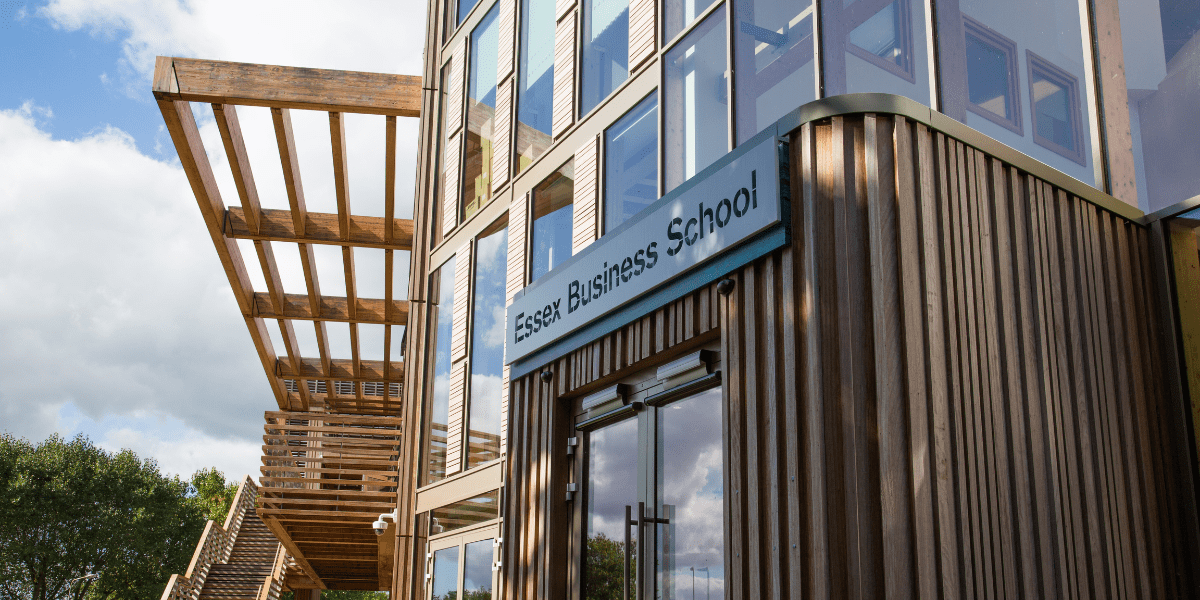
Essex Business School is located in Colchester, Essex, one of the most entrepreneurial counties in the UK. On our Campus you'll find the Knowledge Gateway, where many start-up businesses call home. Our research-led teaching ensures you learn about the latest academic thinking on issues affecting today's business world. We're focused on responsible management and sustainable business, with our students and staff joining us from all over the world.
BSc Marketing can also be taken with an optional study abroad or placement year.
Accredited by The Chartered Institute of Marketing (CIM) for the purpose of gaining CIM qualifications through the Graduate Gateway.
The four-year version of this course enables you to study abroad during your third year. In all other areas, this version of the course remains identical to the standard three-year variant.
You can study abroad with one of our exchange partners in the United States, Europe, Canada, Australia, New Zealand, Latin America, the Middle East, Hong Kong and Japan. In doing so, you experience other cultures and languages, meet new people, and gain intercultural skills that are sought-after by employers.
A placement year provides an alternative option, enabling you to develop your practical business skills by working for an external organisation. During your time away from study, you can build key industry contacts that will be invaluable as you progress in your career.
The Student Development Team can offer bespoke support throughout the process of researching, applying and interviewing for placements. However, it is your responsibility to apply, prepare for and secure your own role. In recent years, our students have gained placements with organisations such as BMW, Samsung and Greater Anglia.
Our academics have a global understanding of business, specialising in both established and developing markets. They are at the forefront of entrepreneurship research and challenges effecting Small and Medium-Sized Enterprises (SMEs) and use this knowledge in their teaching to ensure your education is at the cutting-edge of real-world business issues.
Our staff specialise in areas including:
You'll be guided by our expert staff for your studies in Marketing. Dr Kholoud Mohsen, lectures in marketing and international business and her research focuses on: the international marketing strategies of emerging market firms, emerging markets MNEs and intra-firm integration mechanisms and their influence on marketing performance (effectiveness, adaptiveness, efficiency and creativity).
You'll be studying at Essex Business School, home to the first zero carbon business school in the UK – demonstrating our sustainable approach to business first-hand. Set around a lush winter garden, with shared spaces to encourage collaborative working, you'll find a wealth of inspiring teaching and study zones:
You'll also benefit from fantastic University facilities located close by, including our state-of-the-art Silberrad Student Centre, complete with an open-access 24-hour Learning Hub and a cutting-edge media centre. You benefit from access to a wide range of specialised banking and finance databases, textbooks and e-books and can book appointments with our subject librarian.
Essex Business School students also have access to quantitative analysis software, such as MatLab, Stata and Eviews which can be accessed remotely and from all university computer labs.
Our building is located on the Knowledge Gateway, home to some of the region's most exciting enterprises in the science, technology and creative sectors. The Knowledge Gateway provides potential networking and career opportunities for students directly on campus.
Skilled marketers are in high demand in the graduate labour market, therefore, we embed a series of core and specific skills into our undergraduate curriculum for BSc Marketing to ensure that our graduates are suited to careers in marketing, management and leadership roles.
All of our taught modules embed elements of our skills map which emulate the skills which are required by employers of marketing graduates, these generally include:
We embed a structured approach to student development and skills support throughout the curriculum and through additional support from the Essex Business School Learning Team.
Our students have gone on to become business analysts, marketing managers, account managers and management trainees, with recent graduate destinations including:
Our marketing graduates enjoy successful careers in their fields.
Additional to the skills development offered by Essex Business School, BSc Marketing students can also take advantage of the University of Essex Careers Service which focuses in particular on supporting the development of undergraduate employability, including careers fairs, career mentoring, skills development, careers advice and guidance, placement year support, job opportunities, start-up support and more.
“Before university, I spent 20 years working as a singer/songwriter. I was self-employed, so I had some marketing experience, but I wanted to enhance my skills and learn more about the wider areas of business. Coming to Essex as a mature student, I found the support from students and staff really encouraging. I gained a placement as a Frontrunner, managing social media and marketing for the School of Health and Human Sciences.”
Claire Parry-Witchell, BSc Marketing
We are committed to ensuring that all students with the merit and potential to benefit from an Essex education are supported to do so. We make Contextual Offers, of up to two A-level grades (or equivalent) below our standard conditional offer, to applicants from underrepresented groups residing in the UK. Our Contextual Offers policy outlines the full eligibility criteria.
For further information about what a Contextual Offer may look like for your specific qualification profile, email ugquery@essex.ac.uk.
If you haven't got the grades you hoped for, have a non-traditional academic background, are a mature student, or have any questions about eligibility for your course, more information can be found on our undergraduate application information page or get in touch with our Undergraduate Admissions Team at ugquery@essex.ac.uk.
We accept a wide range of qualifications from applicants studying in the EU and other countries. Get in touch with any questions you may have about the qualifications we accept. Remember to tell us about the qualifications you have already completed or are currently taking.
Sorry, the entry requirements for the country that you have selected are not available here. Please contact our Undergraduate Admissions team at ugquery@essex.ac.uk to request the entry requirements for this country.
English language requirements for applicants whose first language is not English: IELTS 6.0 overall, or specified score in another equivalent test that we accept.
Details of English language requirements, including component scores, and the tests we accept for applicants who require a Student visa (excluding Nationals of Majority English Speaking Countries) can be found here
If we accept the English component of an international qualification it will be included in the academic levels listed above for the relevant countries.
English language shelf-life
Most English language qualifications have a validity period of 5 years. The validity period of Pearson Test of English, TOEFL and CBSE or CISCE English is 2 years.If you require a Student visa to study in the UK please see our immigration webpages for the latest Home Office guidance on English language qualifications.
Pre-sessional English courses
If you do not meet our IELTS requirements then you may be able to complete a pre-sessional English pathway that enables you to start your course without retaking IELTS.
Pending English language qualifications
You don’t need to achieve the required level before making your application, but it will be one of the conditions of your offer.
If you cannot find the qualification that you have achieved or are pending, then please email ugquery@essex.ac.uk .
Requirements for second and final year entry
Different requirements apply for second and final year entry, and specified component grades are also required for applicants who require a visa to study in the UK. Details of English language requirements, including UK Visas and Immigration minimum component scores, and the tests we accept for applicants who require a Student visa (excluding Nationals of Majority English Speaking Countries) can be found here
If you’re an international student, but do not meet the English language or academic requirements for direct admission to this degree, you could prepare and gain entry through a pathway course. Find out more about opportunities available to you at the University of Essex International College

The course structure is designed to balance a practical and in depth experience of marketing with a broader look at key business and management topics. In the first year you will cover the fundamentals that every business manager needs to know including topics such as entrepreneurship, economics, accounting, finance, management and an introduction to marketing. Then in second and final year you'll get hands-on with marketing with a mixture of compulsory and optional modules to make the degree your own.
We offer a flexible course structure with a mixture of core/compulsory modules, and optional modules chosen from lists. Please be aware that we are planning changes to our first year to make it more relevant to your chosen course.
Our research-led teaching is continually evolving to address the latest challenges and breakthroughs in the field. The following modules are based on the current course structure and may change in response to new curriculum developments and innovation.
We understand that deciding where and what to study is a very important decision for you. We'll make all reasonable efforts to provide you with the courses, services and facilities as described on our website and in line with your contract with us. However, if we need to make material changes, for example due to significant disruption, we'll let our applicants and students know as soon as possible.
Components are the blocks of study that make up your course. A component may have a set module which you must study, or a number of modules from which you can choose.
Each component has a status and carries a certain number of credits towards your qualification.
| Status | What this means |
| Core |
You must take the set module for this component and you must pass. No failure can be permitted. |
| Core with Options |
You can choose which module to study from the available options for this component but you must pass. No failure can be permitted. |
| Compulsory |
You must take the set module for this component. There may be limited opportunities to continue on the course/be eligible for the qualification if you fail. |
| Compulsory with Options |
You can choose which module to study from the available options for this component. There may be limited opportunities to continue on the course/be eligible for the qualification if you fail. |
| Optional |
You can choose which module to study from the available options for this component. There may be limited opportunities to continue on the course/be eligible for the qualification if you fail. |
The modules that are available for you to choose for each component will depend on several factors, including which modules you have chosen for other components, which modules you have completed in previous years of your course, and which term the module is taught in.
Modules are the individual units of study for your course. Each module has its own set of learning outcomes and assessment criteria and also carries a certain number of credits.
In most cases you will study one module per component, but in some cases you may need to study more than one module. For example, a 30-credit component may comprise of either one 30-credit module, or two 15-credit modules, depending on the options available.
Modules may be taught at different times of the year and by a different department or school to the one your course is primarily based in. You can find this information from the module code. For example, the module code HR100-4-FY means:
| HR | 100 | 4 | FY |
|---|---|---|---|
|
The department or school the module will be taught by. In this example, the module would be taught by the Department of History. |
The module number. |
The UK academic level of the module. A standard undergraduate course will comprise of level 4, 5 and 6 modules - increasing as you progress through the course. A standard postgraduate taught course will comprise of level 7 modules. A postgraduate research degree is a level 8 qualification. |
The term the module will be taught in.
|
COMPONENT 01: COMPULSORY
If you’re looking to start your own business, or to help an existing business to grow, then this module provides the essential knowledge you’ll need. You develop a greater understanding of the various aspects involved in new venture creation and growth, from opportunity identification, evaluation and implementation through to continued growth and management. Using practical exercises, case studies and videos, you learn about the business life cycle from start-up to growth and maturity and explore business development from economic and behavioural perspectives.
COMPONENT 02: COMPULSORY
This module introduces you to key economic theories and concepts, covering highly topical issues affecting the business world. Using real-life case studies, you explore the key microeconomics principles and concepts that can help to explain why economic activities occur and explore whether it is possible to improve economic situations for society.
COMPONENT 03: COMPULSORY
It’s essential that every aspiring entrepreneur, manager and leader understands the basics of accounting and finance. In this introductory module you’ll explore the principles of financial and management accounting; the recording of transactions; the preparation of financial statements and their analysis; the principles of cost accumulation and decision making in businesses; techniques of cost control; the management of working capital; the sources of funding and investment appraisal. You’ll explore the key theories, carry out problem-solving exercises and learn how to apply these within companies.
View Introduction to Accounting and Finance on our Module Directory
COMPONENT 04: COMPULSORY
Discover the fundamentals of marketing and how they shape today’s business world. This module introduces core marketing principles such as value creation, consumer behaviour, segmentation and the marketing mix, while exploring how digital transformation, emerging technologies and artificial intelligence are redefining modern marketing practice. Using real-world case studies and ethical perspectives, you’ll develop a strong foundation and the confidence to understand and engage with marketing in contemporary organisations.
View Foundations of Modern Marketing on our Module Directory
COMPONENT 05: COMPULSORY
Introduction to Business Analytics will allow you to develop core knowledge and skills in the domain of business analytics and data science. You’ll focus on different tools and approaches to support data analysis and decision making in business environment. The module is designed to enhance your ability of data analysis to uncover embedded information useful for decision making.Learn how to valuate the potential of data analytics in supporting complex decision making in real-world business environment.
View Introduction to Business Analytics on our Module Directory
COMPONENT 06: COMPULSORY
At Essex Business School we’re proud of our international community, bringing international expertise into the classroom. In this module you are introduced to the global business environment and how this impacts upon corporations and their decision to operate internationally. You explore the different strategies organisations can adopt when entering international markets and examine aspects of managing multinational corporations, such as marketing, human resource management and global supply chain management.
View Introduction to International Business on our Module Directory
COMPONENT 07: COMPULSORY
The Professional and Academic Development module helps you build a foundation in core academic skill requirements to help you improve the standard of your academic work across all of your first year modules. This module also introduces you to the themes of career planning and employability skills and establishing a career path.
View Professional and Academic Development on our Module Directory
COMPONENT 08: COMPULSORY
COMPONENT 01: COMPULSORY
This module will provide you with an overview of applications of business analytics for real world business problems.Business examples and case studies will be used to explain the variety of decision-making issues that can be solved using analytics to gain business intelligence. Useful business analytics software (like R, Python or similar) will be discussed in this module. With this understanding you can learn how to select one or more business analytics tools and appropriate software for solving specific real-world problems.
View Applied Business Analytics and Decision Making on our Module Directory
COMPONENT 02: COMPULSORY
Examine the various determinants of consumer behaviour, the theories of consumer behaviour and their application to managerial decision-making. You also gain an appreciation of understanding consumer behaviour in areas of new product testing, and advertising, distribution and pricing research.
COMPONENT 03: COMPULSORY
Discover the importance of studying and understanding buyer behaviour in the business to business market, and distinguish the marketing strategy, planning and implementation for the same from buyer behaviour in consumer markets. You build an awareness of multiple stakeholder groups in business markets and the notion of managing networks, alliances and partnerships across the diverse stakeholder groups.
COMPONENT 04: COMPULSORY
This module introduces a number of business and management research methods, with a particular focus on entrepreneurship and small business. You explore philosophical research issues, such as selecting appropriate research methods and judging the quality and value of findings. You learn how to write a research proposal and design and plan quantitative and qualitative research. This includes collecting data, analysing findings and presenting results.
COMPONENT 05: COMPULSORY
This module will give you a clear understanding of feedback, Dweck`s concept of a `growth mindset`, and how you can use these to improve your studies and career. We want you to have a passion for learning, a willingness to challenge yourself, and an eagerness to learn from mistakes, so this module will help you to understand group work and presentations and to acquire the relevant skills to successfully undertake both. The module also serves as a bridge for your final year, so that students should be able to understand the expectations of the final year and the possible career paths you can take after you graduate, and how you can use summer vacations to get ahead.
View Professional and Academic Development 2 on our Module Directory
COMPONENT 01: COMPULSORY
Enhance your understanding of the concepts and nature of strategy and its interactions with the macro environment, industries/sectors and business operations. You develop your skills analysing opportunities and threats, managing strategic capability and resources, understanding competitive advantage, competition and collaboration, directions and methods of business development, as well as managing strategic change.
COMPONENT 02: COMPULSORY
This module gives you the opportunity to draw upon the knowledge acquired throughout your course to produce an independent marketing research project. Your project must be approximately 4,000-5,000 words and can draw upon a range of research methods, including surveys, questionnaires, interviews and content analysis. You review appropriate literature to construct a research framework, develop a research methodology, collect data and draw upon relevant empirical findings.
COMPONENT 03: COMPULSORY
This module introduces the role of communications in marketing. You explore communication theories and models and learn how to produce a marketing communications plan. You examine the marketing communications mix, including tools such as advertising, sales promotion, direct marketing, public relations and sponsorship. You learn how packaging and merchandising contribute towards corporate and brand identity, as well as the impact of word of mouth. You examine the impact of rapid technological change on marketing communications and the challenges of changing market conditions and public perceptions.
COMPONENT 04: COMPULSORY
This module introduces key concepts, issues and trends in services marketing and explores the differences between promoting products and services. You learn how consumer behaviour is central to effective service design and examine how customer relationships are developed and maintained. You gain an understanding of how services are distributed online and through traditional channels and examine how service quality and productivity can be improved. You also look at complaint handling and how marketing communications channels can be employed to recover a service in the event of issues.
COMPONENT 05: COMPULSORY
This module focuses on the impact of 'digital' on the world of Marketing. You explore the changing nature of business and consumer behaviour, communication, and market research. You will investigate current practical and theoretical issues within Digital Marketing and Social Media. You will study the academic field concerned with marketing and digital media and the challenges and opportunities it affords to marketers, consumers, organisations and society at large. Marketing practices have dramatically changed with the rise of social media, mobile apps and new technological developments in devices, platforms, and applications. We will explore together the rapid evolution of the digital environment presents new opportunities and challenges for marketers.
View Digital Marketing and Social Media on our Module Directory
COMPONENT 07: COMPULSORY
This module will help you to understand the interests, skills and competencies which are relevant to your future career choices. You will learn how to find the graduate-level roles and career paths available to business students and you will learn about the skills necessary to successfully compete in the graduate labour market after you graduate.
On a placement year you gain relevant work experience within an external business or organisation, giving you a competitive edge in the graduate job market and providing you with key contacts within the industry. The rest of your course remains identical to the three-year degree.
On your year abroad, you have the opportunity to experience other cultures and languages, to broaden your degree socially and academically, and to demonstrate to employers that you are mature, adaptable, and organised. The rest of your course remains identical to the three-year degree.
£9,790 per year
£22,600 per year
Fees will increase for each academic year of study.
If your course has the option to include a placement year or study abroad, and you choose to do so, you will pay the following:
20% of your standard tuition fee for that year
15% of your standard tuition fee for that year
Standard tuition fee
There may be scholarships, bursaries or discounts available to help with the cost of this course.
Our events are a great way to find out more about studying at Essex. We run a number of Open Days throughout the year which enable you to discover what our campus has to offer. You have the chance to:
Check out our Visit Us pages to find out more information about booking onto one of our events. And if the dates aren’t suitable for you, feel free to book a campus tour here.
Applications for our full-time undergraduate courses should be made through the Universities and Colleges Admissions Service (UCAS). Full details on how to apply can be found on the filling in your UCAS undergraduate application web page.
Our UK students, and some of our EU and international students, who are still at school or college, can apply through their school. Your school will be able to check and then submit your completed application to UCAS. Our other international applicants (EU or worldwide) or independent applicants in the UK can also apply online through UCAS Apply.
The UCAS code for our University of Essex is ESSEX E70. The individual campus codes for our Loughton and Southend Campuses are 'L' and 'S' respectively.
For information on transferring from another university, applying when you are not at school or college, and applying for readmission, please see How to apply and entry requirements
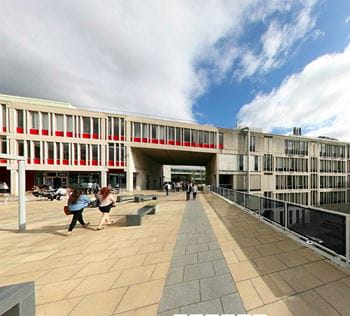
Set within 200 acres of award-winning parkland - Wivenhoe Park and located two miles from the historic city centre of Colchester – England's oldest recorded development. Our Colchester Campus is also easily reached from London and Stansted Airport in under one hour.
If you live too far away to come to Essex (or have a busy lifestyle), no problem. Our 360-degree virtual tour allows you to explore our University from the comfort of your home. Check out our Colchester virtual tour to see accommodation options, facilities and social spaces.
At Essex we pride ourselves on being a welcoming and inclusive student community. We offer a wide range of support to individuals and groups of student members who may have specific requirements, interests or responsibilities.
The University makes every effort to ensure that this information on its programme specification is accurate and up-to-date. Exceptionally it can be necessary to make changes, for example to courses, facilities or fees. Examples of such reasons might include, but are not limited to: strikes, other industrial action, staff illness, severe weather, fire, civil commotion, riot, invasion, terrorist attack or threat of terrorist attack (whether declared or not), natural disaster, restrictions imposed by government or public authorities, epidemic or pandemic disease, failure of public utilities or transport systems or the withdrawal/reduction of funding. Changes to courses may for example consist of variations to the content and method of delivery of programmes, courses and other services, to discontinue programmes, courses and other services and to merge or combine programmes or courses. The University will endeavour to keep such changes to a minimum, and will also keep students informed appropriately by updating our programme specifications. The University would inform and engage with you if your course was to be discontinued, and would provide you with options, where appropriate, in line with our Compensation and Refund Policy.
The full Procedures, Rules and Regulations of the University governing how it operates are set out in the Charter, Statutes and Ordinances and in the University Regulations, Policy and Procedures.
Want to quiz us about your course? Got a question that just needs answering? Get in touch with us on live chat!