BA (Hons) Events Management with Hospitality

Overview
What is BA Events Management with Hospitality?
BA Events Management with Hospitality is an accelerated top-up degree that builds on prior study in events, hospitality, business or related subjects to prepare you for professional roles in events and hospitality management.
This degree combines academic study with practical experience in real hospitality and events environments. You’ll develop the skills, knowledge and competencies needed to design, plan and manage events while also understanding core hospitality operations such as service, food and beverage, guest relations and venue management.
Why this course
The events and hospitality industries are dynamic global sectors with a wide range of career opportunities. This course is designed to help you refine your professional capabilities through a mix of theoretical insight and practical experience.
You’ll study key areas such as event planning and operations, hospitality service delivery, budget and resource management, business strategy and entrepreneurship. These subjects equip you with a strong understanding of both the creative and commercial sides of managing events and hospitality offerings.
Practical experience is embedded in the programme, allowing you to work in real event and hospitality settings and apply your learning in a professional context. This hands-on exposure enhances your readiness to enter the workforce in roles that demand both operational skill and business awareness.
The course also emphasises industry engagement, career readiness and professional development, helping you build confidence and networks before you graduate.
Who should apply
- Students who have completed a relevant Level?5 qualification and want to complete a full honours degree
- Those aiming for a career in event management, hospitality operations or related sectors
- Learners who enjoy practical work experience alongside academic study
- Individuals looking to strengthen professional skills in planning, service delivery and business strategy
What you’ll learn
- Event design and planning: How to develop proposals, brief clients and manage event logistics
- Hospitality operations: Insight into service delivery, guest experience and venue management
- Business strategy and entrepreneurship: Understanding strategic thinking, innovation and business models in events and hospitality
- Resource and budget management: Skills to manage people, materials and finances effectively
- Professional communication: Building persuasive communication and presentation skills for client and stakeholder engagement
- Research and analysis: Capability to carry out independent research in a hospitality or events context
Your learning experience
- Integrated real-world experience: Apply practical learning in hospitality and events settings as part of your studies
- Industry-relevant teaching: Learn from educators with professional backgrounds in events and hospitality
- Professional development focus: Build employability skills such as communication, teamwork and problem solving
- Live event and hospitality projects: Work on real initiatives that reflect current industry practice
- Industry engagement opportunities: Connect with professionals through sessions, talks or networking activities
Careers and outcomes
This degree prepares you for a variety of roles in the events and hospitality sectors, including:
- Event management: Planning and delivering corporate, private and public events
- Hospitality operations management: Overseeing service and guest experience
- Venue or conference management: Managing event spaces and facilities
- Food and beverage operations: Supporting service delivery and business operations
- Marketing, sales and client relations: Promoting services and building client engagement
Employers of graduates from this course
Graduates go on to work with a wide range of organisations in the global events, hospitality, leisure and service industries, including event agencies, venue teams, corporate event departments, hospitality groups, festivals and visitor attractions.
- The first hotel school of its kind in the UK offering experience in a fully-commercial 4* hotel.
- Academic teaching that reflects the movements and innovations of the events industry.
- Outstanding preparation for employment through innovative combination of professional experience and academic learning
Course content
Components
Components are the blocks of study that make up your course. A component may have a set module which you must study, or a number of modules from which you can choose.
Each component has a status and carries a certain number of credits towards your qualification.
| Status | What this means |
| Core |
You must take the set module for this component and you must pass. No failure can be permitted. |
| Core with Options |
You can choose which module to study from the available options for this component but you must pass. No failure can be permitted. |
| Compulsory |
You must take the set module for this component. There may be limited opportunities to continue on the course/be eligible for the qualification if you fail. |
| Compulsory with Options |
You can choose which module to study from the available options for this component. There may be limited opportunities to continue on the course/be eligible for the qualification if you fail. |
| Optional |
You can choose which module to study from the available options for this component. There may be limited opportunities to continue on the course/be eligible for the qualification if you fail. |
The modules that are available for you to choose for each component will depend on several factors, including which modules you have chosen for other components, which modules you have completed in previous years of your course, and which term the module is taught in.
Modules
Modules are the individual units of study for your course. Each module has its own set of learning outcomes and assessment criteria and also carries a certain number of credits.
In most cases you will study one module per component, but in some cases you may need to study more than one module. For example, a 30-credit component may comprise of either one 30-credit module, or two 15-credit modules, depending on the options available.
Modules may be taught at different times of the year and by a different department or school to the one your course is primarily based in. You can find this information from the module code. For example, the module code HR100-4-FY means:
| HR | 100 | 4 | FY |
|---|---|---|---|
|
The department or school the module will be taught by. In this example, the module would be taught by the Department of History. |
The module number. |
The UK academic level of the module. A standard undergraduate course will comprise of level 4, 5 and 6 modules - increasing as you progress through the course. A standard postgraduate taught course will comprise of level 7 modules. A postgraduate research degree is a level 8 qualification. |
The term the module will be taught in.
|
COMPONENT 01: COMPULSORY
COMPONENT 02: COMPULSORY
COMPONENT 03: COMPULSORY
COMPONENT 04: COMPULSORY
COMPONENT 05: COMPULSORY
COMPONENT 06: COMPULSORY WITH OPTIONS
Entry requirements
UK entry requirements
- GCSE: Mathematics and English C/4, or equivalent. We can consider OFQUAL regulated Level 2 Functional Skills in Numeracy as equivalent to GCSE Maths C/4. We are able to consider a range of equivalent English language qualifications, including OFQUAL regulated level 2 Functional Skills, Key Skills level 2, literacy units taken as part of the Access to HE Diploma, or a demonstration of the use of English through essay-based subjects at either GCSE or A-level equivalent. Advice on acceptability can be provided, please contact Undergraduate Admissions for more information.
In addition to meeting the English and Maths requirements, applicants for final year entry should hold a Level 5 qualification in a relevant subject area (e.g. business, hospitality, tourism or events)
Additional requirements
All applicants must be aged 18 or over by 31 October 2026 for October 2026 entry.
International & EU entry requirements
We accept a wide range of qualifications from applicants studying in the EU and other countries. Get in touch with any questions you may have about the qualifications we accept. Remember to tell us about the qualifications you have already completed or are currently taking.
Sorry, the entry requirements for the country that you have selected are not available here. Please contact our Undergraduate Admissions team at ugquery@essex.ac.uk to request the entry requirements for this country.
English language requirements
English language requirements for applicants whose first language is not English
IELTS 6.0 overall with a minimum of 5.5 in each component, or specified score in an equivalent test that we accept.
Details of English language requirements and the tests we accept for applicants who require a Student visa (excluding Nationals of Majority English Speaking Countries) can be found here
If we accept the English component of an international qualification it will be included in the academic levels listed above for the relevant countries.
Pre-sessional English courses
If you do not meet our IELTS requirements then you may be able to complete a pre-sessional English pathway that enables you to start your course without retaking IELTS.
Fees and funding
Home/UK fee
£9,790
International fee
£21,500
If your course has the option to include a placement year or study abroad, and you choose to do so, you will pay the following:
Placement year
20% of your standard tuition fee for that year
Study abroad
Full year abroad
15% of your standard tuition fee for that year
Single term abroad
Standard tuition fee
Scholarships and financial support
There may be scholarships, bursaries or discounts available to help with the cost of this course.
Fees and funding guide
What's next

Open Days
Our events are a great way to find out more about studying at Essex. We run a number of Open Days throughout the year which enable you to discover what our campus has to offer. You have the chance to:
- tour our campus and accommodation
- find out answers to your questions about our courses, student finance, graduate employability, student support and more
- meet our students and staff
Check out our Visit Us pages to find out more information about booking onto one of our events. And if the dates aren’t suitable for you, feel free to book a campus tour here.
2026 Open Days (Colchester Campus)

Applying
Applications for our undergraduate top-up courses should be made through the University of Essex Direct Application form.
You can find further information on how to apply, including information on transferring from another university, applying if you are not currently at a school or college, and applying for readmission on our How to apply and entry requirements page.
Offer Holder Days
If you are an undergraduate student residing in the UK who has received an offer to study with us in January 2025, you will receive an email invitation soon to book onto one of our Offer Holder Days. Our Colchester Campus Offer Holder Days run from February to May 2024 on various Wednesdays and Saturdays, and our Southend Campus Offer Holder Days run in April and May 2024 on various Wednesdays and Saturdays. Offer Holder Days provide the opportunity to meet your department, tour our campus and accommodation, and chat to current students. We appreciate that travelling to university events can be expensive, so we are offering an Offer Holder Day Travel Bursary, allowing you to claim up to £150 as reimbursement for travel expenses. For further information about Offer Holder Days, including terms and conditions and eligibility criteria for our Travel Bursary, please visit our Offer Holder Days webpage.
If you are an overseas offer-holder, you will be invited to attend one of our virtual events. However, you are more than welcome to join us at one of our in-person Offer Holder Days if you are able to - we will let you know in your invite email how you can do this.
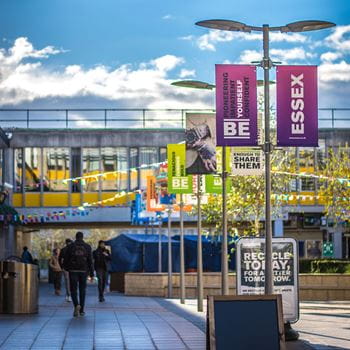
Visit Colchester Campus
Set within 200 acres of award-winning parkland - Wivenhoe Park and located two miles from the historic city centre of Colchester – England's oldest recorded development. Our Colchester Campus is also easily reached from London and Stansted Airport in under one hour.
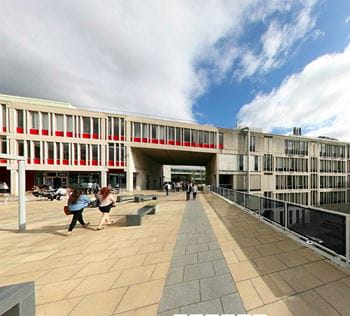
Virtual tours
If you live too far away to come to Essex (or have a busy lifestyle), no problem. Our 360-degree virtual tour allows you to explore our University from the comfort of your home. Check out our Colchester virtual tour to see accommodation options, facilities and social spaces.
At Essex we pride ourselves on being a welcoming and inclusive student community. We offer a wide range of support to individuals and groups of student members who may have specific requirements, interests or responsibilities.
The University makes every effort to ensure that this information on its programme specification is accurate and up-to-date. Exceptionally it can be necessary to make changes, for example to courses, facilities or fees. Examples of such reasons might include, but are not limited to: strikes, other industrial action, staff illness, severe weather, fire, civil commotion, riot, invasion, terrorist attack or threat of terrorist attack (whether declared or not), natural disaster, restrictions imposed by government or public authorities, epidemic or pandemic disease, failure of public utilities or transport systems or the withdrawal/reduction of funding. Changes to courses may for example consist of variations to the content and method of delivery of programmes, courses and other services, to discontinue programmes, courses and other services and to merge or combine programmes or courses. The University will endeavour to keep such changes to a minimum, and will also keep students informed appropriately by updating our programme specifications. The University would inform and engage with you if your course was to be discontinued, and would provide you with options, where appropriate, in line with our Compensation and Refund Policy.
The full Procedures, Rules and Regulations of the University governing how it operates are set out in the Charter, Statutes and Ordinances and in the University Regulations, Policy and Procedures.

Want to quiz us about your course? Got a question that just needs answering? Get in touch with us on live chat!