Postgraduate Course

MSc Corporate Sustainability

MSc Corporate Sustainability

Overview

The details
Corporate Sustainability
October 2026
Full-time
1 year
Colchester Campus

What is the MSc Corporate Sustainability degree?

The MSc Corporate Sustainability is a one-year, 12-month full-time degree that explores the relationship between accounting, finance and sustainability.

Corporate sustainability considers how organisations respond to environmental, social and governance (ESG) issues and incorporate sustainability into financial and business decisions. You'll explore how financial markets, organisations, regulators and other stakeholders are responding to the transition towards more sustainable business practices.

You'll develop your understanding of sustainability accounting and finance, sustainable investing, ESG principles and sustainability reporting, while considering how these areas influence financial decision-making and corporate practice.

Why this course

Develop knowledge across accounting, finance and sustainability and explore how these areas increasingly influence financial markets and corporate decision-making.

You'll examine how organisations and the financial industry are responding to sustainable development, including the growth of ESG investing, green investment products and sustainability reporting.

You'll also consider the perspectives of different stakeholders, including businesses, banks and regulators, and engage with sustainability debates in real-world contexts.

Who should apply

  • Those interested in the relationship between sustainability, accounting and finance
  • Those looking to understand ESG and sustainable investment
  • Those interested in how organisations manage and report on sustainability
  • Those considering careers in corporate sustainability, ESG, accounting or finance
  • Those considering further study at PhD level

What you'll learn

  • Sustainability accounting: Explore how sustainability and accountability are incorporated into organisational management and decision-making
  • Sustainability reporting: Understand how organisations communicate and report their sustainability performance
  • Sustainable and green finance: Explore sustainable investment, green financial products and the role of finance in sustainable development
  • Corporate finance: Develop your understanding of financial decision-making within organisations
  • ESG: Examine environmental, social and governance principles and their role in finance and investment

Choose your area of focus

You can tailor your studies through one of two qualifiers, allowing you to focus further on green finance or accounting and governance.

Green Finance develops your understanding of financial research and gives you the opportunity to complete a dissertation focused on finance.

Accounting and Governance develops your understanding of accounting research, corporate governance and sustainability, alongside a dissertation focused on accounting.

Your learning experience

  • Accounting and finance: Develop knowledge across two areas that play an important role in corporate sustainability
  • Real-world sustainability: Engage with contemporary sustainability debates and consider how they affect organisations and financial markets
  • Financial decision-making: Develop your commercial awareness and consider how sustainability influences financial decisions
  • Research skills: Develop your ability to investigate contemporary issues in accounting, finance and sustainability
  • Ethical awareness: Consider the wider environmental, social and governance implications of business and financial decisions

Careers and outcomes

The MSc Corporate Sustainability develops knowledge across sustainability, accounting and finance, preparing you for roles where organisations need to understand and respond to ESG and sustainability challenges.

Career opportunities can include:

  • Corporate Sustainability Manager
  • Auditor
  • ESG Analyst
  • Business Analyst
  • Renewable Energy Accountant

The course can also provide a foundation for further study at PhD level.

Career support

Our Student Support team works closely with the University's Employability and Careers service to provide careers information, advice and CV support.

They can help you find work experience, internships, placements and voluntary opportunities, as well as providing access to employer talks on campus.

We also work closely with the Essex Startups team to support students looking to develop their own business ideas.


Why we're great.
  • Develop a critical understanding of advanced concepts in accounting, green finance and corporate sustainability reporting, including current theories, frameworks, and policy implications.
  • Apply analytical and critical thinking skills to evaluate sustainability and financial data within the context of organisational decision-making and reporting.
  • Study in the UK's first zero carbon business school building. The design reflects the business school's commitment to responsible business practice both in teaching and research. You will have access to our state-of-the-art Bloomberg Trading Floor which gives you access to the same tools used by traders and business analysts worldwide.

Course content

Course structure

We offer a flexible course structure with a mixture of core/compulsory modules, and optional modules chosen from lists. Please be aware that we are planning changes to our first year to make it more relevant to your chosen course.

Our research-led teaching is continually evolving to address the latest challenges and breakthroughs in the field. The following modules are based on the current course structure and may change in response to new curriculum developments and innovation.

We understand that deciding where and what to study is a very important decision for you. We'll make all reasonable efforts to provide you with the courses, services and facilities as described on our website and in line with your contract with us. However, if we need to make material changes, for example due to significant disruption, we'll let our applicants and students know as soon as possible.

Components and modules explained

Components

Components are the blocks of study that make up your course. A component may have a set module which you must study, or a number of modules from which you can choose.

Each component has a status and carries a certain number of credits towards your qualification.

Status What this means
Core
You must take the set module for this component and you must pass. No failure can be permitted.
Core with Options
You can choose which module to study from the available options for this component but you must pass. No failure can be permitted.
Compulsory
You must take the set module for this component. There may be limited opportunities to continue on the course/be eligible for the qualification if you fail.
Compulsory with Options
You can choose which module to study from the available options for this component. There may be limited opportunities to continue on the course/be eligible for the qualification if you fail.
Optional
You can choose which module to study from the available options for this component. There may be limited opportunities to continue on the course/be eligible for the qualification if you fail.

The modules that are available for you to choose for each component will depend on several factors, including which modules you have chosen for other components, which modules you have completed in previous years of your course, and which term the module is taught in.

Modules

Modules are the individual units of study for your course. Each module has its own set of learning outcomes and assessment criteria and also carries a certain number of credits.

In most cases you will study one module per component, but in some cases you may need to study more than one module. For example, a 30-credit component may comprise of either one 30-credit module, or two 15-credit modules, depending on the options available.

Modules may be taught at different times of the year and by a different department or school to the one your course is primarily based in. You can find this information from the module code. For example, the module code HR100-4-FY means:

HR 100  4  FY

The department or school the module will be taught by.

In this example, the module would be taught by the Department of History.

The module number. 

The UK academic level of the module.

A standard undergraduate course will comprise of level 4, 5 and 6 modules - increasing as you progress through the course.

A standard postgraduate taught course will comprise of level 7 modules.

A postgraduate research degree is a level 8 qualification.

The term the module will be taught in.

  • AU: Autumn term
  • SP: Spring term
  • SU: Summer term
  • FY: Full year 
  • AP: Autumn and Spring terms
  • PS: Spring and Summer terms
  • AS: Autumn and Summer terms

COMPONENT 01: CORE WITH OPTIONS

BE980-7-FY or BE989-7-FY
(60 CREDITS)

COMPONENT 02: COMPULSORY

Sustainability Accounting, Accountability and Management
(20 CREDITS)

For far too long, sustainability has been left at the background of decision-making in businesses, resulting in a huge impact on the planet. As the world begins to place a higher priority on sustainable practices, it becomes increasingly important that you as a student are aware of the different existing and emerging models of sustainable accounting, accountability, and management. This module will provide you with an understanding of these emerging practices and how they are working to impact the unfolding global crisis.

View Sustainability Accounting, Accountability and Management on our Module Directory

COMPONENT 03: COMPULSORY

Corporate Finance
(20 CREDITS)

This module offers you a standard introduction of the field of corporate finance at postgraduate level. You consider the classical areas of Modigliani-Miller irrelevance, Taxes and capital structure, Trade-off theory and Pecking order theory of capital structure, before exploring the more modern areas, which are essentially based on contract theory.

View Corporate Finance on our Module Directory

COMPONENT 04: COMPULSORY

Sustainability Reporting
(20 CREDITS)

Understand how sustainability reporting is shaping modern business and investment decisions. This module introduces the accounting principles and reporting practices used to measure and communicate organisations’ environmental and social impacts. You’ll explore current regulatory requirements and key sustainability issues such as climate change, biodiversity, water and workforce management, while examining how investors and other stakeholders use sustainability information to support decision-making and long-term sustainable development.

View Sustainability Reporting on our Module Directory

COMPONENT 05: COMPULSORY

Principles of Finance
(20 CREDITS)

What is the stock market? How do you make a good investment decision? Our Principles of Finance module aims to provide students with no prior background in finance a core understanding of topics including economics, corporate finance, and asset pricing.

View Principles of Finance on our Module Directory

COMPONENT 06: CORE WITH OPTIONS

BE951-7-AU or BE953-7-AU
(20 CREDITS)

COMPONENT 07: OPTIONAL

EBS (Colchester Campus) option from list
(20 CREDITS)

COMPONENT 08: COMPULSORY

Postgraduate Mathematics Preparation
(0 CREDITS)

This module covers topics in mathematics that are required in Masters-level finance courses at the University of Essex. You focus on the basics of linear algebra, differential calculus including optimisation and dynamics.

View Postgraduate Mathematics Preparation on our Module Directory

Teaching

  • Tailor the content of your course to more closely fit your interests and aspirations
  • Courses focus on practical applications and links with industry
  • We run an open seminar series, which our Masters students are welcome to attend
  • learn in an international environment; our Masters students join us from more than 40 countries

Assessment

  • Regular assessment is by coursework, presentations, case studies, group work, tests and examinations

Dissertation

  • You submit a 15,000 word dissertation.

Entry requirements

UK entry requirements

A 2:2 degree, or international equivalent, in any discipline.

International & EU entry requirements

We accept a wide range of qualifications from applicants studying in the EU and other countries. Get in touch with any questions you may have about the qualifications we accept. Remember to tell us about the qualifications you have already completed or are currently taking.

Sorry, the entry requirements for the country that you have selected are not available here. Please contact our Graduate Admissions team at pgquery@essex.ac.uk to request the entry requirements for this country.

English language requirements

If English is not your first language, we require IELTS 6.5 overall with a minimum score of 5.5 in all components. If you do not meet our IELTS requirements then you may be able to complete a pre-sessional English pathway that enables you to start your course without retaking IELTS. Additional Notes The University uses academic selection criteria to determine an applicant’s ability to successfully complete a course at the University of Essex. Where appropriate, we may ask for specific information relating to previous modules studied or work experience.

Fees and funding

Home/UK fee

£15,750

International fee

£24,675

Scholarships and financial support

There may be scholarships, bursaries or discounts available to help with the cost of this course.

Fees and funding guide

Masters fees and funding information

Research (e.g. PhD) fees and funding information

What's next

Group of three female students walking along Southend Pier talking and looking at a booklet

Open Days

We hold Open Days for all our applicants throughout the year. Our Colchester Campus events are a great way to find out more about studying at Essex, and give you the chance to:

  • tour our campus and accommodation
  • find out answers to your questions about our courses, student finance, graduate employability, student support and more
  • meet our students and staff

If the dates of our organised events aren’t suitable for you, feel free to get in touch by emailing tours@essex.ac.uk and we’ll arrange an individual campus tour for you.

2026 Open Days (Colchester Campus)

  • Saturday 17 October 2026 - October Open Day
  • Saturday 7 November 2026 - November Open Day
Male applicant sitting at a desk in their bedroom writing on a notepad

Applying

You can apply for this postgraduate course online. Before you apply, please check our information about necessary documents that we'll ask you to provide as part of your application.

We aim to respond to applications within two weeks. If we are able to offer you a place, you will be contacted via email.

For information on our deadline to apply for this course, please see our ‘how to apply' information.

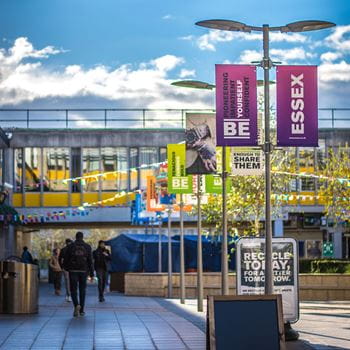
A sunny day with banners flying on Colchester Campus Square 4.

Visit Colchester Campus

Set within 200 acres of award-winning parkland - Wivenhoe Park and located two miles from the historic city centre of Colchester – England's oldest recorded development. Our Colchester Campus is also easily reached from London and Stansted Airport in under one hour.


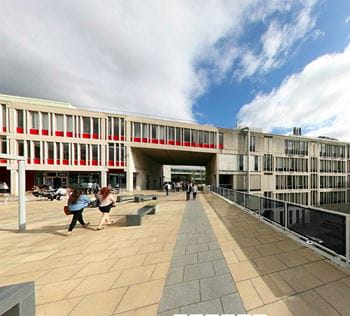
View from Square 2 outside the Rab Butler Building looking towards Square 3

Virtual tours

If you live too far away to come to Essex (or have a busy lifestyle), no problem. Our 360-degree virtual tour allows you to explore our University from the comfort of your home. Check out our Colchester virtual tour to see accommodation options, facilities and social spaces.

At Essex we pride ourselves on being a welcoming and inclusive student community. We offer a wide range of support to individuals and groups of student members who may have specific requirements, interests or responsibilities.

The University makes every effort to ensure that this information on its programme specification is accurate and up-to-date. Exceptionally it can be necessary to make changes, for example to courses, facilities or fees. Examples of such reasons might include, but are not limited to: strikes, other industrial action, staff illness, severe weather, fire, civil commotion, riot, invasion, terrorist attack or threat of terrorist attack (whether declared or not), natural disaster, restrictions imposed by government or public authorities, epidemic or pandemic disease, failure of public utilities or transport systems or the withdrawal/reduction of funding. Changes to courses may for example consist of variations to the content and method of delivery of programmes, courses and other services, to discontinue programmes, courses and other services and to merge or combine programmes or courses. The University will endeavour to keep such changes to a minimum, and will also keep students informed appropriately by updating our programme specifications. The University would inform and engage with you if your course was to be discontinued, and would provide you with options, where appropriate, in line with our Compensation and Refund Policy.

The full Procedures, Rules and Regulations of the University governing how it operates are set out in the Charter, Statutes and Ordinances and in the University Regulations, Policy and Procedures.

Ask us a question
Ask us a question

Want to quiz us about your course? Got a question that just needs answering? Get in touch with us on live chat!

login