The BSc Economics is a three-year degree, or four years with an optional placement or study abroad year.
You’ll study how economies work, how people and institutions respond to incentives, and how economic evidence is used to explain real-world outcomes. With an emphasis on analysis, data, and economic reasoning, you’ll build the confidence to interpret evidence, and apply quantitative insight to complex economic questions.
The BSc Economics gives you the opportunity to analyse how people, markets, and governments behave - and the quantitative tools to make sense of a world defined by uncertainty, incentives, and change. If you want a degree that explores not just what is happening in the economy but why - and what to do about it - this programme gives you that foundation.
You’ll explore how economic decisions shape wellbeing, inequality, opportunity, and how societies function. You’ll learn how policy choices affect real lives, and how economists use data to create better outcomes. You’ll study micro and macroeconomics, econometrics, behavioural economics, development, labour markets, and public policy.
You’ll be taught within a department whose research informs decision-making on labour markets, behavioural change, financial regulation, and development, illustrating how economic theory connects to real policy challenges. Throughout your degree, you’ll learn to think like an economist; breaking down problems, analysing evidence, interpreting data, predicting outcomes, and communicating insights clearly and confidently.
You can also add an optional placement or study abroad year, applying your skills in industry or international settings and strengthening both your CV and your global perspective.
By graduation, you’ll have the foundational skills to pursue early careers in government, business, finance - any sector that values sharp analysis - or progress to postgraduate study.
A BSc Economics degree prepares you for careers in:
Graduates from this course have progressed to roles in organisations such as:
We are committed to ensuring that all students with the merit and potential to benefit from an Essex education are supported to do so. We make Contextual Offers, of up to two A-level grades (or equivalent) below our standard conditional offer, to applicants from underrepresented groups residing in the UK. Our Contextual Offers policy outlines the full eligibility criteria.
For further information about what a Contextual Offer may look like for your specific qualification profile, email ugquery@essex.ac.uk.
If you haven't got the grades you hoped for, have a non-traditional academic background, are a mature student, or have any questions about eligibility for your course, more information can be found on our undergraduate application information page or get in touch with our Undergraduate Admissions Team at ugquery@essex.ac.uk.
We accept a wide range of qualifications from applicants studying in the EU and other countries. Get in touch with any questions you may have about the qualifications we accept. Remember to tell us about the qualifications you have already completed or are currently taking.
Sorry, the entry requirements for the country that you have selected are not available here. Please contact our Undergraduate Admissions team at ugquery@essex.ac.uk to request the entry requirements for this country.
Our research-led teaching is continually evolving to address the latest challenges and breakthroughs in the field. The following modules are based on the current course structure and may change in response to new curriculum developments and innovation.
We understand that deciding where and what to study is a very important decision for you. We'll make all reasonable efforts to provide you with the courses, services and facilities as described on our website and in line with your contract with us. However, if we need to make material changes, for example due to significant disruption, we'll let our applicants and students know as soon as possible.
Components are the blocks of study that make up your course. A component may have a set module which you must study, or a number of modules from which you can choose.
Each component has a status and carries a certain number of credits towards your qualification.
| Status | What this means |
| Core |
You must take the set module for this component and you must pass. No failure can be permitted. |
| Core with Options |
You can choose which module to study from the available options for this component but you must pass. No failure can be permitted. |
| Compulsory |
You must take the set module for this component. There may be limited opportunities to continue on the course/be eligible for the qualification if you fail. |
| Compulsory with Options |
You can choose which module to study from the available options for this component. There may be limited opportunities to continue on the course/be eligible for the qualification if you fail. |
| Optional |
You can choose which module to study from the available options for this component. There may be limited opportunities to continue on the course/be eligible for the qualification if you fail. |
The modules that are available for you to choose for each component will depend on several factors, including which modules you have chosen for other components, which modules you have completed in previous years of your course, and which term the module is taught in.
Modules are the individual units of study for your course. Each module has its own set of learning outcomes and assessment criteria and also carries a certain number of credits.
In most cases you will study one module per component, but in some cases you may need to study more than one module. For example, a 30-credit component may comprise of either one 30-credit module, or two 15-credit modules, depending on the options available.
Modules may be taught at different times of the year and by a different department or school to the one your course is primarily based in. You can find this information from the module code. For example, the module code HR100-4-FY means:
| HR | 100 | 4 | FY |
|---|---|---|---|
|
The department or school the module will be taught by. In this example, the module would be taught by the Department of History. |
The module number. |
The UK academic level of the module. A standard undergraduate course will comprise of level 4, 5 and 6 modules - increasing as you progress through the course. A standard postgraduate taught course will comprise of level 7 modules. A postgraduate research degree is a level 8 qualification. |
The term the module will be taught in.
|
COMPONENT 01: CORE
How do consumers make decisions? Or firms conduct different market strategies? What impact does government policy have on inflation? Or unemployment? Develop your knowledge of economics in relation to a range of contemporary issues. Learn how to apply both micro and macroeconomic principles to the analysis of such problems.
COMPONENT 05: COMPULSORY
Are you ready for graduate employment? Like to improve your core skills? Need to know more about the working world? Attend workshops, events and activities to build your knowledge, abilities and experience with this compulsory, zero credit module that runs during your three years of undergraduate study.
COMPONENT 01: COMPULSORY
What tools can you use for macroeconomic analysis? And how can these then be applied to macro-policy issues? Learn how to build alternative macroeconomic models and apply analytical reasoning. Examine real-life macroeconomic questions, on topics such as government budgets or wage-price flexibility, and critically evaluate macroeconomic policies.
COMPONENT 02: COMPULSORY
How do consumers behave in a competitive market? And what about producers? How do various imperfections affect the outcome of decentralised markets? Study the fundamental concepts and methods in microeconomics. Understand the tools and methods of analysis for economic reasoning, and develop your critical approach to economic issues and policies.
COMPONENT 03: COMPULSORY
What mathematical methods can analyse economic problems? And what mathematical tools are needed to understand economic models? Gain an introduction to the mathematical methods commonly used in economics, build your knowledge of mathematical tools for work in economics and develop your understanding of the mathematical language used in economic literature.
View Mathematical Methods in Economics on our Module Directory
COMPONENT 04: COMPULSORY
Which econometric methods can analyse economic data? How do you critically assess applied economic literature? Learn how to carry out statistical and econometric calculations, plus gain experience of using the Stata software package. Demonstrate your subsequent understanding of the linear regression model with your own investigation on an empirical issue.
View Introduction to Econometric Methods on our Module Directory
COMPONENT 06: COMPULSORY
Are you ready for graduate employment? Like to improve your core skills? Need to know more about the working world? Attend workshops, events and activities to build your knowledge, abilities and experience with this compulsory, zero credit module that runs during your three years of undergraduate study.
COMPONENT 01: COMPULSORY
What interests you? Design and implement your own research project, under the guidance and supervision of our world-leading academic staff. Demonstrate your knowledge of economic ideas in greater depth, building your professional research skills and developing further understanding of a topic that fascinates you.
COMPONENT 03: OPTIONAL
Option(s) from list or outside option(s) if not already taken in 2nd yearCOMPONENT 04: COMPULSORY
Are you ready for graduate employment? Like to improve your core skills? Need to know more about the working world? Attend workshops, events and activities to build your knowledge, abilities and experience with this compulsory, zero credit module that runs during your three years of undergraduate study.
On a placement year you gain relevant work experience within an external business or organisation, giving you a competitive edge in the graduate job market and providing you with key contacts within the industry. The rest of your course remains identical to the three-year degree.
On your year abroad, you have the opportunity to experience other cultures and languages, to broaden your degree socially and academically, and to demonstrate to employers that you are mature, adaptable, and organised. The rest of your course remains identical to the three-year degree.
£9,790 per year
£22,600 per year
Fees will increase for each academic year of study.
If your course has the option to include a placement year or study abroad, and you choose to do so, you will pay the following:
20% of your standard tuition fee for that year
15% of your standard tuition fee for that year
Standard tuition fee
There may be scholarships, bursaries or discounts available to help with the cost of this course.
Our events are a great way to find out more about studying at Essex. We run a number of Open Days throughout the year which enable you to discover what our campus has to offer. You have the chance to:
Check out our Visit Us pages to find out more information about booking onto one of our events. And if the dates aren’t suitable for you, feel free to book a campus tour here.
Applications for our full-time undergraduate courses should be made through the Universities and Colleges Admissions Service (UCAS). Full details on how to apply can be found on the filling in your UCAS undergraduate application web page.
Our UK students, and some of our EU and international students, who are still at school or college, can apply through their school. Your school will be able to check and then submit your completed application to UCAS. Our other international applicants (EU or worldwide) or independent applicants in the UK can also apply online through UCAS Apply.
The UCAS code for our University of Essex is ESSEX E70. The individual campus codes for our Loughton and Southend Campuses are 'L' and 'S' respectively.
You can find further information on how to apply, including information on transferring from another university, applying if you are not currently at a school or college, and applying for readmission on our How to apply and entry requirements page.
If you receive an undergraduate offer to study with us in October 2026 and live in the UK, you will receive an email invitation to book onto one of our Open Days. These events provide the opportunity to meet your department, join interesting taster sessions, tour our campus and accommodation, and chat to current students. You can visit our Open Days event page for more information, including terms and conditions.
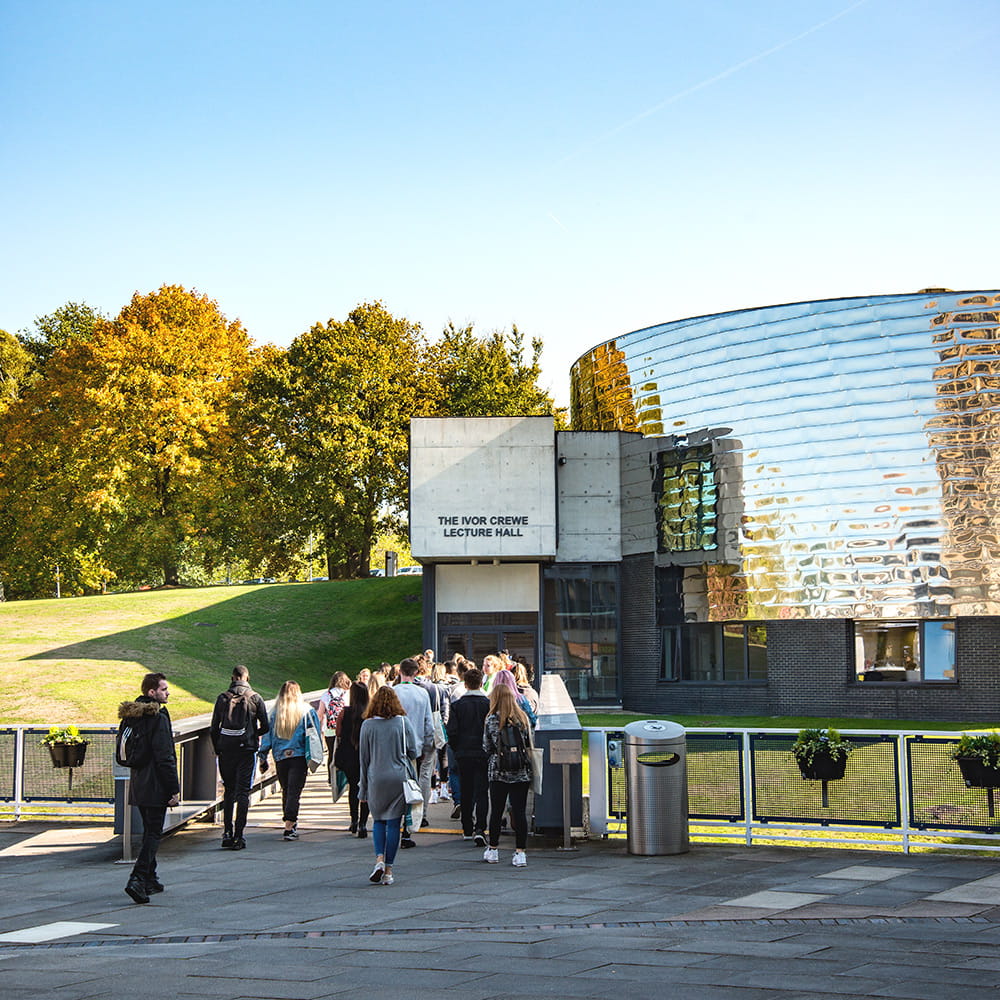
Set within 200 acres of award-winning parkland - Wivenhoe Park and located two miles from the historic city centre of Colchester – England's oldest recorded development. Our Colchester Campus is also easily reached from London and Stansted Airport in under one hour.
If you live too far away to come to Essex (or have a busy lifestyle), no problem. Our 360-degree virtual tour allows you to explore our University from the comfort of your home. Check out our Colchester virtual tour to see accommodation options, facilities and social spaces.
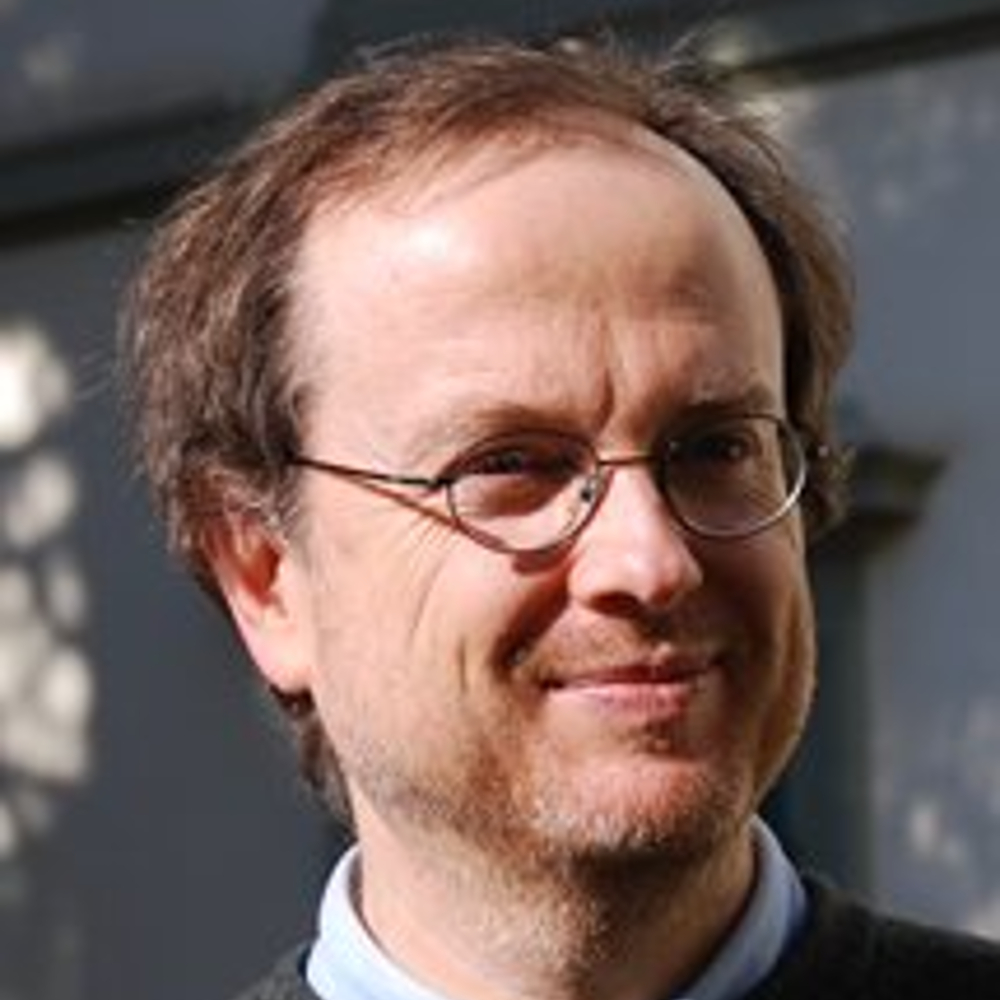
Got a question about this course? Chat with Professor Eric Smith from the Department of Economics.
At Essex we pride ourselves on being a welcoming and inclusive student community. We offer a wide range of support to individuals and groups of student members who may have specific requirements, interests or responsibilities.
The University makes every effort to ensure that this information on its programme specification is accurate and up-to-date. Exceptionally it can be necessary to make changes, for example to courses, facilities or fees. Examples of such reasons might include, but are not limited to: strikes, other industrial action, staff illness, severe weather, fire, civil commotion, riot, invasion, terrorist attack or threat of terrorist attack (whether declared or not), natural disaster, restrictions imposed by government or public authorities, epidemic or pandemic disease, failure of public utilities or transport systems or the withdrawal/reduction of funding. Changes to courses may for example consist of variations to the content and method of delivery of programmes, courses and other services, to discontinue programmes, courses and other services and to merge or combine programmes or courses. The University will endeavour to keep such changes to a minimum, and will also keep students informed appropriately by updating our programme specifications. The University would inform and engage with you if your course was to be discontinued, and would provide you with options, where appropriate, in line with our Compensation and Refund Policy.
The full Procedures, Rules and Regulations of the University governing how it operates are set out in the Charter, Statutes and Ordinances and in the University Regulations, Policy and Procedures.