Essex Sociology and Criminology Research Newsletter Spring 2026
Here is the latest edition of the Department of Sociology and Criminology’s research newsletter. It highlights the outstanding research achievements and contributions of our colleagues over the past months. We hope you enjoy reading about our work, with our best wishes for the end of the academic year.
Colin Samson
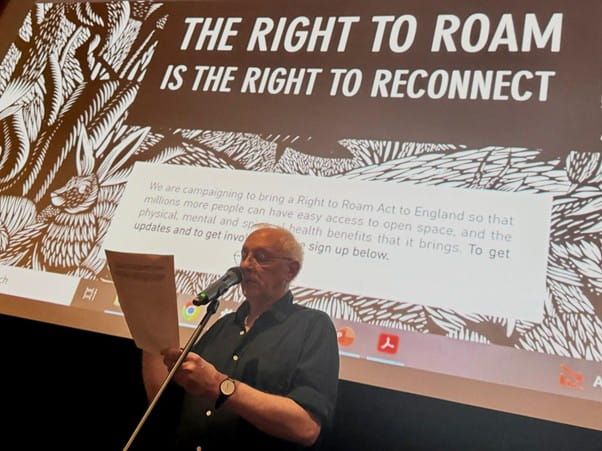
On 4 May Colin Samson spoke at the Curzon cinema to a sell out crowd of 120 ahead of the Colchester premiere of the film 'Our Land' about the Right to Roam movement. Colin’s talk was on the links between the enclosure movement, colonialism and the privatisation of land in England and included some family history from the Norfolk Fens. This talk was based on Colin’s recent research on the drainage and enclosure of the Fens.
Alejandra Díaz de León
Alejandra Díaz de León gave a guest talk in the Justice Studies Speaker Series at the University of Tennessee where she discussed her research on migration, solidarity, and trust.
She also published a new co-authored article "Health, migration, and the climate crisis: an exploratory qualitative study in an informal settlement in Santiago, Chile". The article explores how the climate crisis is affecting the health of migrants living in an informal settlement in Santiago de Chile.
Sean Nixon
Sean Nixon has two new articles published and forthcoming:
- Protecting Wild Spain: The Coto Donana, International Conservation and Avian Landscapes, in Rural History, 2025
- Wild Feelings: Love and Violence in Human-Avian Relations, in Society & Animals, 2026
Sean also has an article appearing in History Extra magazine (formerly BBC History Magazine) in May 2026 called 'Advertising, Domestic Modernity and the New Housewife' and a review in the journal Ibis of Ian Wallace's 'Beguiled by Birds', 2026.
Isabel Crowhurst
Isabel Crowhurst has been awarded a Leverhulme Research Fellowship for her project: Just taxes? Comparing and reimagining fiscal approaches to sex work. Isabel will be exploring the understudied relationship between taxation and sex work, examining how fiscal policies influence interactions between the state and sex workers. While legal regulation of sex work is well documented, little is known about the taxation of earnings from commercial sexual activities. The project will map and compare taxation approaches across jurisdictions with different legal frameworks for sex work, identifying barriers sex workers face and potential best practices. Isabel's aim is to improve understanding of how tax systems can support or undermine sex workers' rights, ultimately informing efforts to create fairer tax regimes for sex workers.
In April 2026, Isabel presented a paper at the 'Ordinary Intimacies' symposium organised by the Contemporary Intimacies, Sexualities and Genders (CISG) research group at Manchester Metropolitan University. Entitled "Bonds that matter: friendship in the lives of urban sex workers in Brazil", her co-authored paper drew from a GCRF Networking Grant that explored the challenges faced by sex workers in three Brazilian cities, for which Isabel was a co-investigator.
Phoebe Kisubi Mbasalaki
The Feminist Centre for Racial Justice (FCRJ) at SOAS will be holding a public screening of Ondas: Waves on the 29th May 2026, a documentary produced by Phoebe Kisubi Mbasalaki. Set in Maputo, Mozambique and Rio de Janeiro, Brazil, Ondas: Waves follows five trans protagonists navigating exile, belonging, kinship, and survival amid rising authoritarianism and anti-gender politics.
Jason Sumich
Jason Sumich’s article, with Sandra Manuel ‘Para Viver Bem: Distinction from Above and Below’ is forthcoming in the Journal ‘Africa’.
Tara Mahfoud
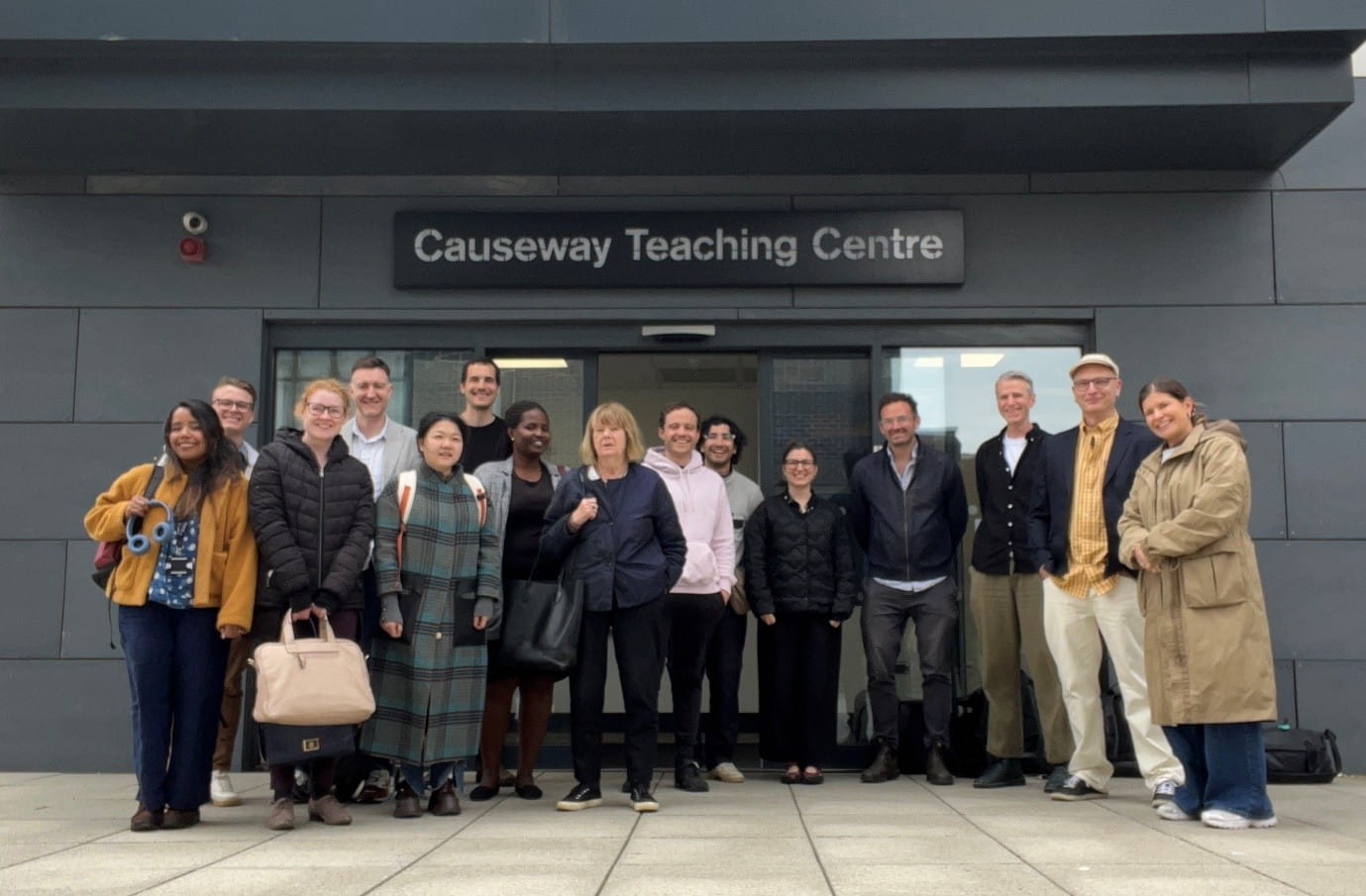
On 5 May 2026, the University of Essex hosted the workshop “Towards a Sociology of Neurology: Imbrications with the Sociologies of Ageing, Disability, Science and Mental Health” organised by Dr Tara Mahfoud (Essex), Dr Greg Hollin (Sheffield) and Professor Martyn Pickersgill (Edinburgh). The workshop was supported by funding from the Foundation for the Sociology of Health and Illness, the Wellcome Trust and ARIA.
Neurological conditions affect 43% of the world’s population – from stroke and brain injury, to migraine, dementia, epilepsy, and nerve damage (Steinmetz et al. 2024). Despite medical and technological advances, neurological conditions remain the leading cause of illness and disability (ibid.). However, the engagement of Sociology of Health and Illness (SHI) with neurological conditions is disproportionate to the personal and social suffering these conditions bring. The workshop, therefore, explored how SHI can focus sociological attention on neurology - propelling scholarship while also aiming to generate insights that enhance health.
Maitrayee Deka
Maitrayee Deka launched her novel, The Octogenarian and poetry collection Boiled or Cracked, at the Marx Memorial Library on the 20 March. She was a speaker at the Poetry in the Margins event at Porta Garibaldi, Naples, in April. Maitrayee will be presenting her ongoing work on young people's social media in the Social Media &Society Conference in Glasgow in July 2026.
Katy Wheeler
Katy Wheeler has published two articles this year; the paper "Bringing the sociology of sustainable consumption into conversation with education for sustainable development" was over 5-years in the writing! It was informed by research she did for a BA small grant on sustainability education which looked at how young people are taught about environmental issues in schools. Overwhelmingly consumer choice is framed as a ‘solution’ yet so often a sociological account of how consumption is socially shaped by political-economic systems and cultural practices was missing. The paper is aimed at environmental educators and uses sociological frameworks to suggest alternative ways of teaching about these issues.
The second paper - "Technological reflexivity in practice: how MAXQDA, NVivo, and ChatGPT shape qualitative survey analysis" – details her reflections on using technology and generative AI in the analysis of qualitative survey data. It was fun to write and she continues to reflect on the polarising debates that are currently been played out in the journal ‘Qualitative Inquiry’ about the affordances and constraints of qualitative GenAI analysis. The survey data came from the SEEd Youth Listening Project – an organisation she has been working with for several years, and whose survey data on young people’s understandings of sustainability and climate change is used to inform their Young Changemakers programme.
Katy has also starting working on a project on circular economy of Internet of Things devices, funded by the EPSRC with colleagues from CSEE, and Universities of Glasgow and Oxford.
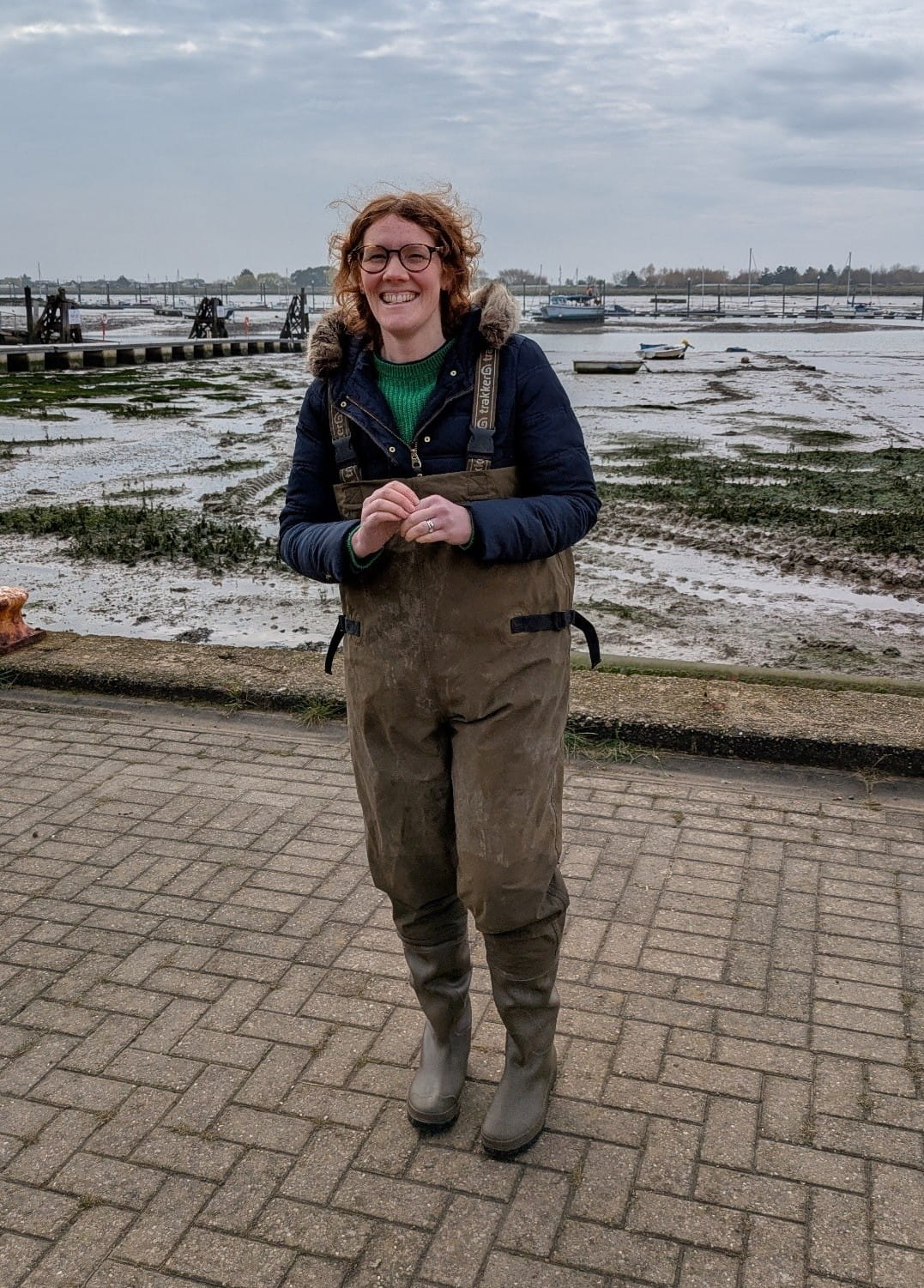
Finally, Katy has enjoyed working with two new PhD students who are based in Life Sciences (co-supervised with Dr Michael Steinke) and she is incorporating sociological perspectives into her studies of pacific oysters as a nature-based solution to mitigate against coastal erosion. Kristina Chilver and James Goodfellow, along with the other Sustainable Transitions students from the 2025 cohort have also been meeting with Katy fortnightly at a sociology reading group where we have read foundational texts in environmental sociology together to help prepare them for their interdisciplinary research projects. Katy joined Kristina and James recently on a trip to Brightlingsea harbour in search of oysters!
EJ-Francis Caris-Hamer
EJ-Francis Caris-Hamer was invited as a keynote speaker for Hounslow Council’s LGBTQ+ History Month 2026 programme, presenting insights from their journal article, “Lessons in Lockdown: Rethinking LGBTQ+ Inclusion in Post-Pandemic English Secondary Schools.” Drawing on empirical social science research with teachers in English secondary schools, the keynote explored how the COVID-19 pandemic exposed the fragility and often symbolic nature of LGBTQ+ inclusion within education.
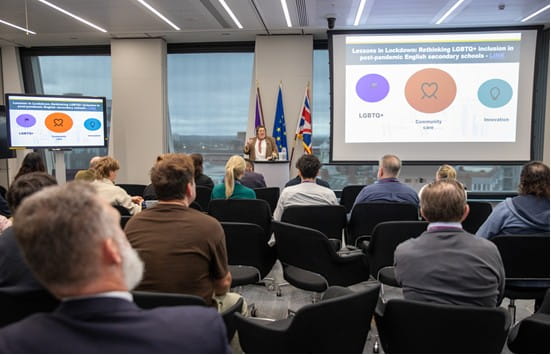
The presentation highlighted the limitations of relying on individual teacher goodwill and argued for more structurally embedded approaches to inclusion. EJ discussed how school governance, curricula, safeguarding practices, and digital learning spaces can be reconfigured to better support LGBTQ+ students and staff. The keynote invited attendees to think critically about what meaningful inclusion requires beyond visibility alone, particularly in post-pandemic educational contexts where inequalities have been intensified and made more visible.
Linsey McGoey
In February, Linsey McGoey gave an invited talk jointly organised by Warwick Sociology and the Centre for Interdisciplinary Methodologies (CIM) on her current research on political polarisation in western nations. In May 2026, she’s giving an invited talk for Bayreuth University’s seminar series on 'Perspectives on multiple forms of knowledge and realities'. Linsey’s talk is titled "Oracular Power beyond Left vs Right." Her recent review article for Economy & Society on racial capitalism is one of the journal’s 'most-read articles'; The weaponry of racial capitalism: Gargi Bhattacharyya (2024) The futures of racial capitalism (Polity). She was a recent panellist for the Oxford Union Debate society, and her speech can be viewed on Youtube.
Sobia Kaker
On 6 May, Sobia Kaker participated in a roundtable organised by the Strategic Insight Unit (SIU) at the Metropolitan Police Service. Drawing on preliminary findings from her research on 'patchworked policing' in Karachi, she shared insights on differential perceptions of trust and confidence in communities dependant on identity (ethnic, sectarian, gender) in an environment characterised by plural policing. Sobie contributed to interdisciplinary discussions with researchers and officers at the Metropolitan Police, alongside Katerina Hadjimatheou and other colleagues from the Departments of Government and Economics at Essex.
Earlier in April, Security Dialogue published Sobie’s article on "Fortified Enclaves as Process". This is based on her longstanding research on gated communities, urban security, and everyday policing in Karachi. Drawing on ethnographic research, the article examines how urban security is constituted through routine interactions at enclave gates, checkpoints, and across classed boundaries. Her findings highlight the unequal and negotiated nature of protection in highly stratified cities.
Michael Halewood
Michael Halewood has recently published two articles. One asks, and partially answers, the question, "Is Sociology a Moral Science?" This piece, in The Journal of Classical Sociology, revisits the work of Hume, Mill and Durkheim and suggests that the relation between systematic knowledge and what ought to be done is core to the project of what Sociology is, or could be.
Along with Michael Thomas of the University of Amsterdam, he has also published "Du Bois on sociology, double consciousness and imagination" in Ethnic and Racial Studies. This article traces how Du Bois deploys a process of reimagining which is grounded in his experience of racialized modernity. It explores how Du Bois uses sociological narratives to redirect the imaginations of his audiences by teaching them to see what they have been trained to ignore.
Both articles are Open Access and published Online First.
John Preston
John Preston’s article ‘Rethinking race theory in education: Racial Value Theory (RVT)’ appeared in the journal ‘Power and Education’. The article intervenes in recent debates on racial theory in education, to argue that existing theories are locked into a mode of critique that accepts conventional categories of political economy and essentialises race and education as timeless. RVT, as a metatheory, aims to explain how methods of ‘racial organisation’, racial categorisations and racial theories in education become archaic. He is speaking at the 19th Subversive Festival in Zagreb, Croatia at the end of May. The theme of this year’s festival is ‘Algorithmic Capital’ and John will be presenting on ‘Artificial Intelligence in the Capitalist University’.
Farid Adilov
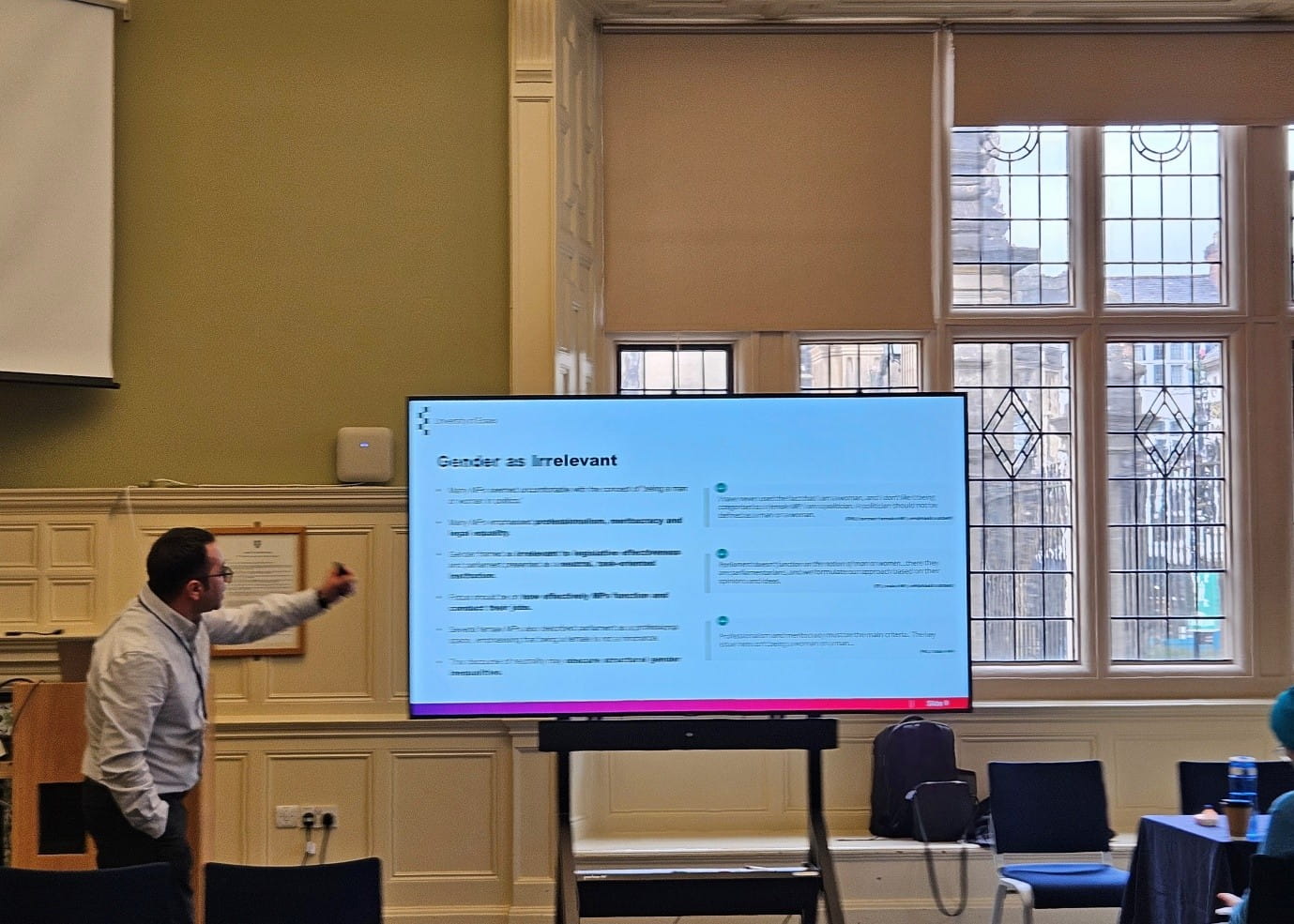
Farid Adilov presented his work ‘Gender and Political Effectiveness in the Azerbaijani Parliament: Neutrality, Difference and Solidarity’ at the 76th Political Studies Association Annual International Conference on 1 April 2026 in Oxford.