Elena Sherstoboeva: Q and A on her Open Access publication


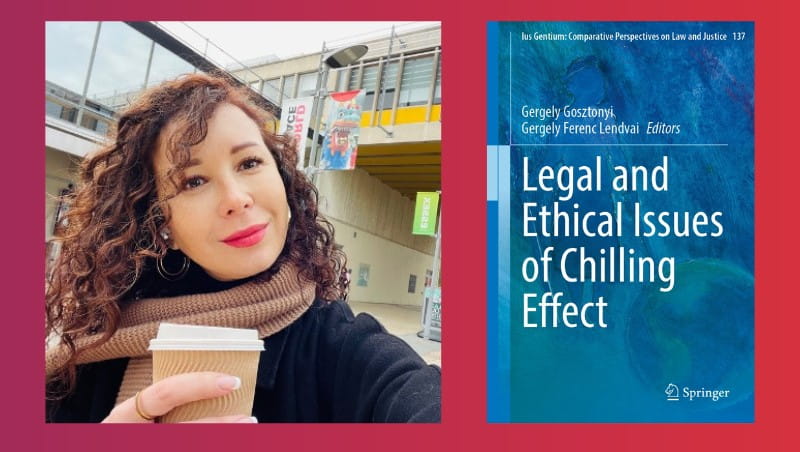
Dr Elena Sherstoboeva, Lecturer at the Essex Law School, is the author of Chilling Effect and Fake News Laws: Lessons from East and Southeast Asia, co-authored with Valentina Pavlenko, an Open Access (OA) chapter in Legal and Ethical Issues of Chilling Effect, a new collection published by Springer. The chapter can be downloaded free of charge here.
Congratulations, Dr Sherstoboeva! How does it feel to see your work in print and freely available online?
It is genuinely rewarding to see the chapter in print, particularly because it is available Open Access. The idea of open knowledge resonates strongly with me, and it feels especially important in the context in which this chapter was written. Together with my co-author, Valentina Pavlenko, I examine chilling effects in legal and regulatory settings beyond the usual Western focus, with particular attention to how legal uncertainty shapes speech.
The concept of the chilling effect is frequently invoked in legal and policy debates, yet sustained doctrinal analysis is not always easy to access or engage with. Making the chapter Open Access therefore matters not only in principle, but also in practice: it allows the analysis to circulate more freely and to be used in contexts where questions of legal uncertainty, indirect deterrence and freedom of expression are especially salient.
How did you get involved with this collection?
I became involved with the volume through earlier scholarly exchanges around the regulation of ‘fake news’ and its chilling effects on freedom of expression. In my previous work, I examined how emergency-driven speech regulation can produce indirect deterrence, particularly in contexts of heightened political pressure.
When the editors circulated a call for chapters, the conceptual focus of the collection immediately resonated with my research trajectory. At the time, my co-author and I were working with a comparative dataset on fake news laws in East and Southeast Asia, and the concept of the chilling effect provided precisely that analytical lens, enabling us to develop a set of criteria for assessing the potential chilling impact of such laws based on their legal design, rather than on enforcement alone. I am also very grateful to the editors for their engagement and support throughout the process, which made the collaboration both intellectually rewarding and enjoyable.
The term ‘chilling effect’ seems to be one that’s heard more often recently. What is it describing?
In legal terms, the chilling effect describes a form of indirect deterrence: people refrain from lawful expression not because it is explicitly prohibited, but because the law is unclear, overly broad or unpredictably enforced. The fear of legal consequences leads to precautionary self-censorship. What the chapter seeks to emphasise is that chilling effects are not only a by-product of enforcement or implementation. They can be built into the law itself.
In the chapter, we develop a set of analytical criteria that make it possible to assess the potential intensity of chilling effects generated by fake news laws as a function of their design, including factors such as definitional vagueness, the scope of discretion and the severity of sanctions. This approach allows chilling effects to be examined as a structural flaw in legal design, rather than merely as a consequence of overzealous enforcement. I am particularly grateful to Professor Lorna Woods OBE, Emeritus Professor of Internet Law at the University of Essex, for her insightful comments and rigorous feedback at various stages of the project, which greatly helped to sharpen the analysis.
How – if at all – can a person or an institution withstand the force of this chilling effect?
At an individual level, it is extremely difficult. Chilling effects are structural rather than merely psychological. They arise from legal design choices such as vague definitions, broad discretion and disproportionate penalties.
What the chapter seeks to highlight is that these effects are, in principle, preventable. Careful legal design can reduce or even avoid chilling effects at the drafting stage, before laws are implemented. Where problematic provisions already exist, institutional safeguards, such as clear interpretative guidance, meaningful judicial oversight and proportional sanctions, can help correct their impact in practice. That said, such corrective mechanisms are far more difficult to rely on in contexts where judicial independence is weak or where oversight is limited, which makes preventative design all the more important.
How did you come to focus on the Asia-Pacific region?
The focus on the Asia-Pacific region grew out of my previous position as an Assistant Professor at the City University of Hong Kong, where I was struck by the region’s legal and institutional diversity. East and Southeast Asia are often treated as a single regulatory space, yet in practice they encompass very different legal traditions, political systems and models of judicial oversight.
That diversity makes the region particularly valuable for comparative analysis. It allows us to examine how similar regulatory tools, such as ‘fake news’ laws, operate very differently depending on legal design and institutional context, and to resist overly simplified or monolithic accounts of speech regulation in the Asia-Pacific region.
And – before we all read the chapter for free – tell us something about the fake news laws of your title?
The chapter looks at laws that regulate what are framed as socially harmful falsehoods. While these laws are often justified by reference to public order, health or national security, they frequently rely on vague concepts such as ‘false information’, ‘rumours’ or ‘distortion of facts’. This lack of precision allows governments to act as arbiters of truth and creates significant legal uncertainty. Our analysis shows that it is often this uncertainty, rather than the mere existence of regulation, that drives chilling effects.
Does the chapter represent your main area of research?
Yes, it represents a core strand of my research, while also laying the conceptual groundwork for its next stage. My work has consistently focused on how law responds to emerging technologies and contested forms of expression, particularly where regulatory uncertainty produces indirect constraints on speech.
Much of my earlier research examined disinformation and ‘fake news’ laws in non-Western and crisis-driven contexts. That work was never solely about false information as such, but about how legal frameworks recalibrate expressive freedoms through ambiguity, discretion and risk. This chapter crystallises that concern by treating the chilling effect not as a context-specific outcome, but as a transferable analytical concept rooted in legal design.
What made you decide to publish Open Access and how did you find the process?
Open Access was a natural choice for this chapter. The topic speaks to audiences well beyond academia, and making the research freely available felt consistent with a broader commitment to openness in scholarship. Through my role in law research visibility at the Essex Law School, I collaborate closely with the University’s Open Access team and have seen first-hand how supportive and effective their work is.
The process itself was very straightforward. The guidance and practical support provided by the Open Access team made OA publishing easy to navigate, and the experience was genuinely positive throughout.
You chose to publish under a CC BY licence. Can you tell us what that means and why you opted for it?
A CC BY licence allows others to share, reuse and build upon the work, provided proper attribution is given. I chose it because it maximises the potential reach and impact of the research. For work dealing with freedom of expression and regulatory models, enabling reuse in teaching, policy discussions and comparative research felt particularly appropriate.
What advice would you give to any colleagues thinking about publishing OA?
I would encourage colleagues to think about who they want their research to reach. If a piece has relevance beyond a narrow academic audience, Open Access can significantly extend its life and impact. It is also worth speaking to library teams early on — they are an invaluable source of guidance and support.
How do you plan to take advantage of OA to share your work?
I plan to share the chapter through academic networks, conferences and teaching, and to use it as a reference point in discussions with policymakers and practitioners working on media regulation. Open Access makes these conversations much easier, as it removes the practical barriers to engagement.
And finally, what is next for you?
My current research is increasingly focused on the regulation of creative industries and the protection of performers in the context of emerging technologies. In particular, I am developing work on performers’ rights and vocal identity in the age of AI, including the challenges posed by voice cloning and synthetic reproduction. This shift reflects both my academic background in media and entertainment law and my earlier professional experience within the creative industries.
Conceptually, there is a strong continuity with my previous work around legal uncertainty, which re-emerges in a new setting, where technological innovation risks eroding creative identity and agency. My aim is to explore how law can respond to these challenges in a way that safeguards performers’ rights and creative labour, while still allowing technological development to flourish. Much of this work is now grounded in the UK context, reflecting both my institutional position and the regulatory debates currently unfolding here.
Chilling Effect and Fake News Laws: Lessons from East and Southeast Asia can be downloaded free of charge here.