About
More than 350,000 people in the UK have aphasia, a complex language and communication disability usually caused by stroke.
Research has found that Speech and Language Therapy for aphasia can improve reading, writing and speaking skills, but it is challenging to generalise these benefits to everyday life. The National Institute for Clinical Excellence recommends that assistive technologies should be considered as a method to improve communication in people with aphasia, but there is currently a lack of evidence-based treatments.
The HARP Aphasia Study ran from April 2024 to September 2025. It was funded by a National Institute for Health and Care Research Research for Patient Benefit Grant. The project was based at North East London NHS Foundation Trust and was led by Dr Anna Caute of the University of Essex. The study began with a scoping review of the literature about the use of portable smart-camera technology in communication disabilities and rehabilitation, which will soon be published in the journal Disability & Rehabilitation: Assistive Technology. We then carried out a market survey of commercially available apps suitable for use in healthcare. We identified three apps that had a range of useful smart-camera features.
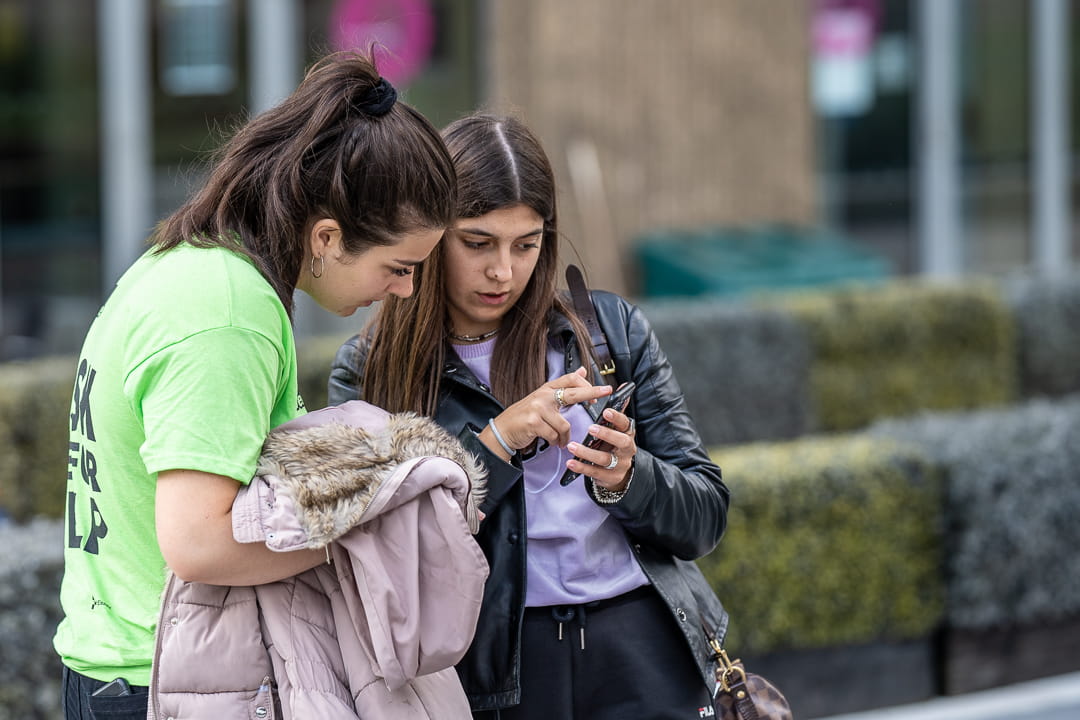
In the second phase of the study, we worked with people with aphasia and Speech and Language Therapists to develop a novel intervention. We conducted a series of focus groups and workshops with people with aphasia and Speech and Language Therapists. People with aphasia discussed ways that portable smart-camera technology could address communication difficulties and explored existing apps. They were also interviewed about their communication experiences. People with aphasia trialled three apps and chose their preferred one, Seeing AI. They also found Google Lens to be very useful because it can be used in a wide range of different languages and can translate between languages.
We collaborated with people with aphasia and Speech and Language Therapists to develop a new intervention, which uses existing portable smart-camera technology to enhance the communication skills of people with aphasia, targeting spoken language and reading comprehension. We developed a therapy manual and videos demonstrating how to use the apps. In the final stage of the study, people with aphasia and Speech and Language Therapists attended workshops where they gave feedback on the manual and made suggestions for improving it.
We are now preparing a grant application to explore the feasibility of carrying out a trial of the new interventions.
Contact
If you would like to find out more about the project, please contact Anna Caute (anna.caute@essex.ac.uk).
3.png?mw=300)