At the Essex Babylab, we are committed to making our research accessible and relevant to families and the wider community. Alongside our research studies, we organise events and create resources designed to share developmental science in practical, engaging, and meaningful ways.

Free online course

Understanding Your Baby: From Research to Real Life

Developed by researchers at the Essex Babylab, this free online course translates research into practical insights for parents and caregivers. Through short videos, interactive animations, and reflective activities you’ll explore what research tells us about:

  • How babies learn about their bodies and senses
  • How they communicate internal needs like hunger and tiredness
  • How babies learn to imitate others
  • Why caregiver wellbeing matters for child development

Along the way, you’ll be encouraged to reflect on your own experiences and consider simple, research-informed ideas you can try at home.

No prior knowledge is needed, and while many examples focus on young babies, the ideas are relevant whatever your child’s age.

How to access the course

Getting started takes just a couple of minutes:

  • Step 1 — Create an account: If you're new to Open Essex, you'll first need to register for a free account at open.essex.ac.uk.
  • Step 2 — Enrol in the course: Once you're logged in, visit the course enrolment page to self-enrol and get started straight away.

If you already have an Open Essex account, you can go directly to the course enrolment page and sign in to begin.

The course is based on Essex Babylab research and developed in collaboration with parenting experts from BabyBrains, with support from the Instructional Design Team within Organisational Development at the University of Essex.

The development of the course was supported by the University of Essex QR Impact Fund, funded through Research England QR IF (FN02400).

Coffee mornings

Essex Babylab hosts regular coffee mornings for parents with babies, parents-to-be, and anyone interested in how babies learn and develop. These informal, friendly sessions are a chance to learn about current research in child development while connecting with others over a cup of tea or coffee.

Many parents feel pressure to follow parenting books or “rules” in order to be good parents. Our aim is to challenge this idea by helping parents recognise that they already have the most important expertise: an understanding of their own baby. By sharing science-based insights and the latest research findings, we show that there is no single manual for parenthood and that responsive, attentive caregiving can take many forms.

Each coffee morning focuses on a different topic, such as prenatal development and maternal health, emotional development, feeding and eating behaviour, language, and imitation. We combine up-to-date research with practical, everyday tips that parents can reflect on and apply in ways that feel right for their own family.

Past events and topics

  • 7 May 2026 – Transition to Parenting Dr Silvia Rigato, Jaime Tung (PANDAS Wivenhoe).
  • 2 April 2026 – Follow my steps: how babies learn to copy movements Dr Carina de Klerk, Jade Robinson (Tiny Toes Ballet Colchester).
  • 29 January 2026 – Motherhood rewired: Brain & body changes in pregnancy (and beyond) Dr Jess Leov; Emma Shaw (StartStrong Fitness)
  • 4 December 2025 – Sing together, feel closer: The power of music for parent-child connection Dr Zehra Karademir (Goldsmiths, University of London); Kate Pavey (Singing Mamas)
  • 6 November 2025 – The world of the womb: Exploring the prenatal period Dr Jess Leov
  • 27 June 2025 – Heads, shoulders, Knees & Toes: How babies discover their bodies Dr Carina De Klerk; Liz Archer (Liz Archer Yoga)
  • 14 February 2025 – Emotions and eating: Building healthy habits in the early years Dr Maria Laura Filippetti; Lucy Wood (Early Years Nutritionist)
  • 22 November 2024 – “I like to move it, move it” – Everything you need to know to promote your little one’s motor development Dr Anna Gui; Emma Blowers
  • 2 July 2024 – Early communication skills: How to enhance social and language development Amanda Morris; Alix Willmore
  • 4 June 2024 – Supporting every child’s neurodevelopment Dr Anna Gui; Andrea Hattrell Caney
  • 21 March 2024 – Sensory wonders: The science of baby sensory development Hayley Grimmett (Baby Sensory)
  • 21 August 2023 – Early language Dr Clare Delle Luche; Mariam Malik
  • 17 July 2023 - Feeding and eating Dr Liam Chawner; Lucy Wood (Early Years Nutritionist)
  • 19 June 2023 - Baby sleep Karina Luz Moore; Samantha Evans
  • 25 February 2023 - Sensory Wonders: The science of infant sensory play Dr Carina De Klerk; Baby Sensory Colchester
  • 20 January 2023 - Little Drummers: Musicality in Babies Dr Sinead Rocha; Baby Rhythm Time
  • 10 December 2022 - Healthy eating in the early years Dr Rana Conway; Dr Florence Sheen; Your Family Nutritionist
  • 29 October 2022 - Baby Talk: from signs to words Dr Clare Delle Luche; TinyTalk MidEssex
  • 17 September 2022 - Caring Dads: Navigating fatherhood Dr Pascal Vritcka; Nigel Clarke (Dadvengers)
  • 27 August 2022 - The Power of Touch Dr Charlotte Krahé; Beautiful Bonds
  • 24 July 2022 -  Learn, Sleep, Repeat! Dr Teodora Gliga; Calm Sleep
  • 28 May 2022 - What makes babies happy? Dr Caspar Addyman
  • 23 April 2022 - Preparing to parenthood Dr Silvia Rigato; Babybrains
  • 26 March 2022 - Fourth trimester: why are babies so needy? Dr Maria Laura Filippetti; UK Babies

From the Womb to the World

From the Womb to the World (WoW) is a multidisciplinary group founded by the Essex Babylab researchers in collaboration with a team of independent practitioners interested in supporting child development.

We all share a strong interest in studying how parental behaviour and interactions with babies (inside and outside the womb) develop during the first year of life.

We want to promote ideas exchange and a better understanding of the real needs of the community, through the use of online platforms and events and workshops for parents and families. Our group aims  to promote:

  • Support: give families the support they need to facilitate and promote their relationship with their babies.
  • Empowerment: by providing the tools to learn and use the latest scientific discoveries, we want to facilitate the communication of evidence-based research in the community.
  • Continuity: from pregnancy to childbirth, new parents receive a variety of advice and information from different sources, with very little continuity throughout their journey. We want to offer a platform where new parents can be accompanied from the beginning of their pregnancy throughout the first years of life of their babies.

If you are a practitioner, professional, or researcher who shares our interests and would like to connect, collaborate, or learn more, we’d love to hear from you.

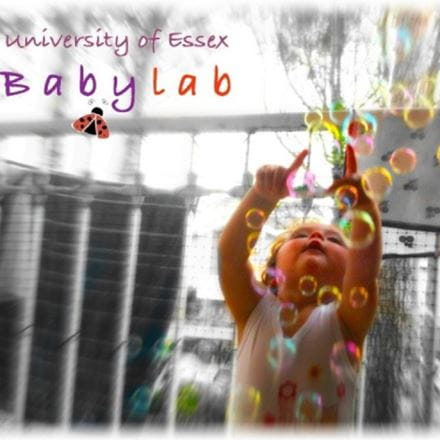
A photo of a baby standing up and reaching for some bubbles floating in front of it, with "University of Essex Babylab" in red and purple text on the left.
Take part in our research

We are always looking for parents interested in taking part in our studies with their babies! If you are pregnant, or have a baby or a child under 3 years old, and you are interested in taking part in our research, please sign-up today.

Take part
Hands holding a mobile phone
Get in touch
Essex Babylab Department of Psychology