The MRes Management Research is a postgraduate taught programme that can be studied for one year full-time or two years part-time.
MRes stands for 'Masters by Research', but this is a taught programme rather than a research degree. You'll develop qualitative and quantitative research skills while deepening your understanding of management, organisations and the people within them.
Why this course
Develop the research skills and management knowledge needed to explore organisations from a social science perspective.
You'll deepen your understanding of management and organisations, considering the changing role and contemporary perceptions of management.
Develop the skills to design and manage your own research, from constructing research questions and hypotheses to selecting appropriate research approaches.
Who should apply
Those looking to develop advanced research skills in management and organisational studies
Those considering progressing to PhD study
Those interested in qualitative and quantitative approaches to management research
Those interested in organisational behaviour and human resource management
Those looking to develop research skills that can be applied in employment
What you'll learn
Management research: Explore different approaches to research within management and organisational studies
Research methods: Develop your understanding of qualitative and quantitative research approaches
Research design: Learn how to develop research questions, hypotheses and research proposals
Research management: Develop the skills needed to plan and manage a research project
Management theory: Deepen your understanding of management and organisational theories
People and organisations: Explore organisational behaviour and human resource management
Your learning experience
Independent research: Develop the skills to plan and manage your own research
Research approaches: Explore the theoretical perspectives that underpin different approaches to research
Qualitative and quantitative research: Develop experience of different methods used to investigate management and organisations
Critical thinking: Explore management and organisational theories within a wider social science context
Information for international students
Please be aware that MRes courses are taught programmes rather than research degrees. This means studying this MRes does not meet the Student visa requirements relating to dependant applications.
Students studying an MRes at Essex will not normally be eligible to make a dependant application for their family unless they are also in receipt of a scholarship or financial sponsorship from a government.
They can help you find work experience, internships, placements and voluntary opportunities, as well as providing access to employer talks on campus.
We also work closely with the Essex Startups team to support students looking to develop their own business ideas.
Why we're great.
Become a member of our thriving Centre for Work, Organisation and Society (CWOS) that supports the research of our world-leading academics.
This course is the ideal first step for a research qualification in management, such as a PhD.
Choose from a number of optional modules to prepare the perfect foundation for further PhD research.
Course content
Course structure
We offer a flexible course structure with a mixture of core/compulsory modules, and optional modules chosen from lists. Please be aware that we are planning changes to our first year to make it more relevant to your chosen course.
Our research-led teaching is continually evolving to address the latest challenges and breakthroughs in the field. The following modules are based on the current course structure and may change in response to new curriculum developments and innovation.
We understand that deciding where and what to study is a very important decision for you. We'll make all reasonable efforts to provide you with the courses, services and facilities as described on our website and in line with your contract with us. However, if we need to make material changes, for example due to significant disruption, we'll let our applicants and students know as soon as possible.
Components and modules explained
Components
Components are the blocks of study that make up your course. A component may have a set module which you must study, or a number of modules from which you can choose.
Each component has a status and carries a certain number of credits towards your qualification.
Status
What this means
Core
You must take the set module for this component and you must pass. No failure can be permitted.
Core with Options
You can choose which module to study from the available options for this component but you must pass. No failure can be permitted.
Compulsory
You must take the set module for this component. There may be limited opportunities to continue on the course/be eligible for the qualification if you fail.
Compulsory with Options
You can choose which module to study from the available options for this component. There may be limited opportunities to continue on the course/be eligible for the qualification if you fail.
Optional
You can choose which module to study from the available options for this component. There may be limited opportunities to continue on the course/be eligible for the qualification if you fail.
The modules that are available for you to choose for each component will depend on several factors, including which modules you have chosen for other components, which modules you have completed in previous years of your course, and which term the module is taught in.
Modules
Modules are the individual units of study for your course. Each module has its own set of learning outcomes and assessment criteria and also carries a certain number of credits.
In most cases you will study one module per component, but in some cases you may need to study more than one module. For example, a 30-credit component may comprise of either one 30-credit module, or two 15-credit modules, depending on the options available.
Modules may be taught at different times of the year and by a different department or school to the one your course is primarily based in. You can find this information from the module code. For example, the module code HR100-4-FY means:
HR
100
4
FY
The department or school the module will be taught by.
In this example, the module would be taught by the Department of History.
Your dissertation is the culmination of your course, where you apply knowledge gained to produce an extended independent piece of work. You generate an original idea, analyse literature and current knowledge and produce a coherent argument that shows your ability to relate theory to practice. Your dissertation/research project will help you develop vital skills for the workplace, as well as the ability to analyse real problems through an academic lens. You are assigned a supervisor for the duration of your project.
Philosophies of Research and Advanced Qualitative Research Methods
(20 CREDITS)
This module is designed to build on your knowledge and understanding of research in management, marketing, accounting and organisation studies and to develop your skills in studying organisational life. Its aim is to draw together insights from the philosophy of the social sciences, methodology and advanced qualitative research methods in order to develop an informed and reflexive understanding of research design and practice.
A key part of your learning process on this module will develop your ability to connect an informed understanding of the philosophical underpinnings of organisational research with your planned methodological approach and methods of data collection and analysis.
Underpinning the module is an understanding of the research process not as a unidirectional, linear trajectory but as a complex and multi-dimensional back and forth process through which ideas evolve that coalesce into a research design that is specific to particular research projects and researchers and which enables those projects to proceed ethically and credibly.
Develop the skills needed to produce a rigorous and critical literature review at postgraduate level. This module explores key theoretical, philosophical and methodological approaches to research, with a strong focus on literature searching, evaluation and synthesis. You’ll strengthen your ability to critically analyse academic texts and build methodological and epistemological insight to support advanced research projects and dissertations.
This module introduces the methods of research in the fields of marketing. You explore a variety of quantitative and qualitative methods, using examples and case studies to determine the suitability of different types of research in particular situations. You gain understanding of research ethics and acquire the skills to organise and undertake a research project.
This module is designed to encourage students to reflect on a variety of issues relating to management and business strategy. It will introduce students to the basics of management such as dealing with teams, culture and organisational management structures. It will then introduce students to managing strategically, covering topics that involve the analysis of the external and internal environments of the business as well as avenues for implementation.
Consequently, the module offers an insight into a range of current business issues, management dilemmas, ethical considerations, and general governance issues relating to the strategic direction of organisations. Overall, the module provides an introduction to management and strategy and a critical examination of its application in practice.
Organisational Behaviour and Human Resource Management
(20 CREDITS)
This module is designed to encourage students to think and reflect upon the nature of managing people and organisations. In particular, it encourages students to consider the main topics of Organisational Behaviour and Human Resource Management. Throughout the sessions, the core issues affecting organisational behaviour and outcomes will be discussed and critically analysed. Therefore, it invites participants to consider the tensions emerging from competing views and perspectives. In so doing, the module challenges many of the taken-for-granted assumptions about people management, and provides tools to analyse organisations and to explore the realities of organisational life.
Tailor the content of your course to more closely fit your interests and aspirations
Modules focus on applied skills and links with industry
We run an open seminar series focused on key contemporary Organisational Studies and Human Resource Management issues
Assessment
You will be assessed through a combination of coursework assignments, which may take a number of forms, such as essays, case studies, theoretical and empirical studies
Dissertation
You submit a 15,000 word dissertation designed to enable you to demonstrate the knowledge, understanding, and skills gained from the programme by integrating and applying your learning to a current issue your choice
Entry requirements
UK entry requirements
A 2:2 degree, or international equivalent, in a MBA, management, commerce or related social science discipline.
You should also hold at least two years' of graduate work experience.
International & EU entry requirements
We accept a wide range of qualifications from applicants studying in the EU and other countries. Get in touch with any questions you may have about the qualifications we accept. Remember to tell us about the qualifications you have already completed or are currently taking.
Sorry, the entry requirements for the country that you have selected are not available here. Please contact our Graduate Admissions team at pgquery@essex.ac.uk to request the entry requirements for this country.
English language requirements
If English isn’t your first language, we require IELTS 6.5 overall with a minimum component score of 5.5 except for 6.0 in writing.
If you do not meet our IELTS requirements then you may be able to complete a pre-sessional English pathway that enables you to start your course without retaking IELTS.
Additional Notes
The University uses academic selection criteria to determine an applicant’s ability to successfully complete a course at the University of Essex. Where appropriate, we may ask for specific information relating to previous modules studied or work experience.
We hold Open Days for all our applicants throughout the year. Our Colchester Campus events are a great way to find out more about studying at Essex, and give you the chance to:
tour our campus and accommodation
find out answers to your questions about our courses, student finance, graduate employability, student support and more
meet our students and staff
If the dates of our organised events aren’t suitable for you, feel free to get in touch by emailing tours@essex.ac.uk and we’ll arrange an individual campus tour for you.
We aim to respond to applications within two weeks. If we are able to offer you a place, you will be contacted via email.
For information on our deadline to apply for this course, please see our ‘how to apply' information.
Visit Colchester Campus
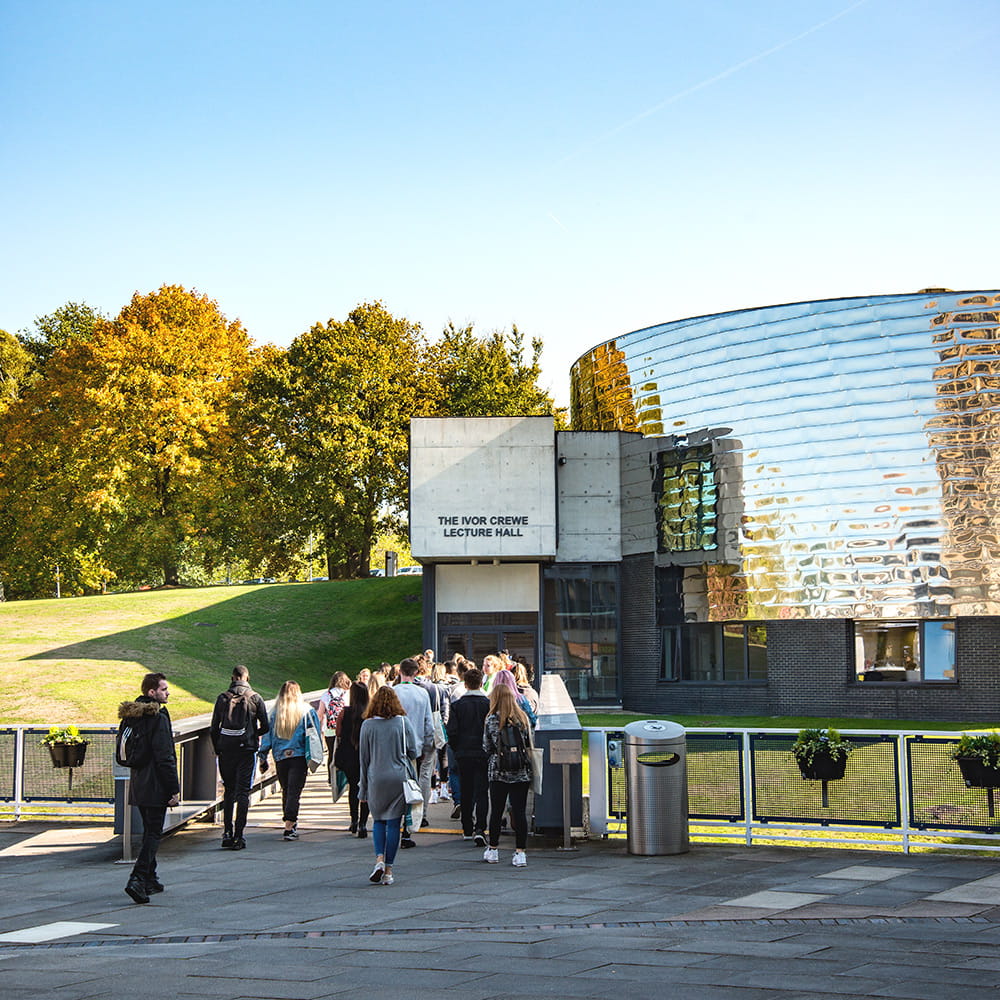
Set within 200 acres of award-winning parkland - Wivenhoe Park and located two miles from the historic city centre of Colchester – England's oldest recorded development. Our Colchester Campus is also easily reached from London and Stansted Airport in under one hour.
If you live too far away to come to Essex (or have a busy lifestyle), no problem. Our 360-degree virtual tour allows you to explore our University from the comfort of your home. Check out our Colchester virtual tour to see accommodation options, facilities and social spaces.
At Essex we pride ourselves on being a welcoming and inclusive student community. We offer a wide range of support to individuals and groups of student members who may have specific requirements, interests or responsibilities.
The University makes every effort to ensure that this information on its programme specification is accurate and up-to-date. Exceptionally it can be necessary to make changes, for example to courses, facilities or fees. Examples of such reasons might include, but are not limited to: strikes, other industrial action, staff illness, severe weather, fire, civil commotion, riot, invasion, terrorist attack or threat of terrorist attack (whether declared or not), natural disaster, restrictions imposed by government or public authorities, epidemic or pandemic disease, failure of public utilities or transport systems or the withdrawal/reduction of funding. Changes to courses may for example consist of variations to the content and method of delivery of programmes, courses and other services, to discontinue programmes, courses and other services and to merge or combine programmes or courses. The University will endeavour to keep such changes to a minimum, and will also keep students informed appropriately by updating our programme specifications. The University would inform and engage with you if your course was to be discontinued, and would provide you with options, where appropriate, in line with our Compensation and Refund Policy.
The full Procedures, Rules and Regulations of the University governing how it operates are set out in the Charter, Statutes and
Ordinances and in the University Regulations, Policy and Procedures.
Ask us a question
Want to quiz us about your course? Got a question that just needs answering? Get in touch with us on live chat!
3.png?mw=300)

/regius-lecture-for-webpage/regius-lecture-for-webpage.jpg?mw=300)