Xintong Jia: Q and A on her new Open Access book
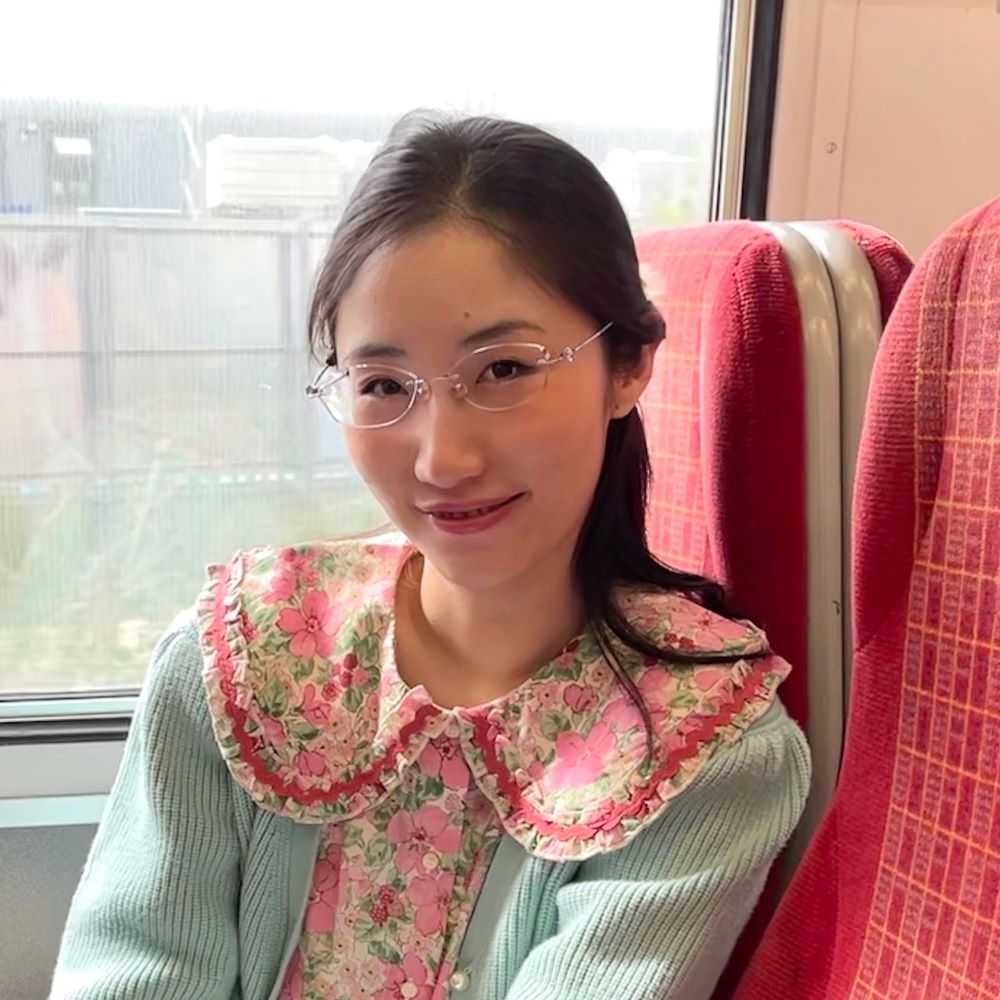

The Open Access Team spoke to Dr Xintong Jia, lecturer in the Department of Sociology and Criminology, about her new monograph, Gender and Postfeminism in Chinese Reality Dating Shows (Palgrave Macmillan). As well as a hardcover, it’s available as an Open Access (OA) digital edition, which was supported by the University’s OA fund and which can be downloaded free of charge here.
We spoke to Dr Jia about her work, what dating shows reveal about the female self in contemporary Chinese society, and why she opted for an OA edition.
Congratulations! How does it feel to see your book in print and freely available online?
Thank you, Sean! Thank you for arranging this Q&A for my book. It feels like another dream come true — and also incomplete in the nicest way, because I haven’t actually held the hard copy yet. I’m still waiting for it to arrive. I’ve always wanted a book of my own with an Eau de Nil jacket, and now there is one. I feel blessed!
The online side of things happened very quickly — I have to thank the production office for their astonishing efficiency. In fact, ORCID notified me that the book was live before my editor had a chance to share the good news. I’m especially glad it’s open access: it means my book can reach readers anywhere with an internet connection.
When did you begin working on it and what inspired you to research this topic?
The book developed from my doctoral thesis, which I started working on in 2018. But the questions and reflections at its heart — about female subjectivity, feminism, and mediated intimacy — have occupied my mind since my teenage years, long before I had the vocabulary to name them. In this sense, the book has been quietly forming for much longer than its formal timeline suggests.
Please tell us more about these dating shows? Are there many of them and are they very popular?
The book examines a dating show genre I call Chinese Dating with the Parents, focusing on its defining format: bringing contestants’ parents onto the set and incorporating parental advice and evaluation into the dating process. The contestants are predominantly young, heterosexual, and urban. This genre of televised dating shows took off in China around the mid-2010s — following the waning popularity of the earlier hit If You Are the One (fei cheng wu rao). What’s striking about Chinese Dating with the Parents is the entanglement between this seemingly new format and the more traditional, distinctively Chinese cultural sensibilities embedded in the setting. Several dating shows have adopted this format explicitly, while others have adapted it with their own twists. On pages 9–13 of the book, I provide a thorough introduction to these shows.
Compared to the format itself, I’m more interested in how young female viewers receive, interpret, and contest it. The book therefore includes an audience reception study of these dating shows. As for whether they’re popular — yes, they very much are. I find Stuart Hall’s deconstruction of the popular especially helpful here. He suggests that popular culture is always connected to questions of tradition and traditional forms of life, and that traditionalism is more than “a product of a merely conservative impulse, backward looking and anachronistic” (Hall, 2019: 348). Through engaging with female audiences, I can see how existing traditions of incorporating parents’ opinions into one’s dating process, albeit in an entertaining and attention-seeking televised form, are being reworked and re-established in relation to a younger generation of women and the conditions of their lives.
Hall, S. (2019) “Notes on Deconstructing ‘the Popular’ [1981].” Essential Essays, Volume 1: Foundations of Cultural Studies, edited by D. Morley, pp. 347–61. Durham: Duke University Press.
Although we can now all read your book, and especially the second chapter Gender and (Post)feminism in China, can you outline for us what you see as contemporary postfeminism in China?
I appreciate this question. “Postfeminism in China” is certainly a keyword in my book — and it has been like a specter haunting my mind for the past decade. Sometimes I can see its clear contours; at other times, I find myself highly doubting whether it really exists at all. I think this is the everyday situation of doing social science research in a sort of postcolonial world. This indeterminacy also resonates with the intrinsically contested and ambivalent nature of postfeminism itself.
With all these considerations in mind, I’d say postfeminism in China is best understood as a cultural ownership or disposition that remains confined to a relatively privileged group and manifests itself in the popular media sphere. It involves the assertion of female independence, the celebration of female empowerment, the embrace of entrepreneurship and cosmopolitanism, and the pursuit of self-actualisation and personal gratification. As a gendered discourse, postfeminism in China is also intimately connected to China’s approach to the market economy in its transition from the socialist to the post-socialist era. Rather than refining the system, women are encouraged to refine themselves through the pursuit of self-empowerment — an individualising focus that conceals structural and taken-for-granted inequalities.
Your book’s blurb explains that within dating shows, female subjectivity is often “circumscribed”. What are the different ways this happens?
The book understands gender and femininity as discursively and performatively constructed, and dating as framed within a game show format. Within this format, contestants are expected to embody attitudes and dispositions in line with prevailing gendered ideals, while also competing with other participants to “win” the dating game. While contestants are technically free to leave the stage without making a match, in practice most still strive to secure one during the show.
One feature of these shows is the blurred line between dating and marriage, and the emphasis on building long-term relationships. As a result, contestants are encouraged to demonstrate traits that enhance their marriageability — under the male gaze, the parental gaze, and an imagined audience gaze. Given all of these expectations and constraints, female subjectivity on reality dating shows is often circumscribed.
What’s more significant to you: what takes place on-screen or viewers’ responses to it? Which do you think is more representative of societal attitudes?
I would say both, as they are interconnected and each works as an extension of the other. The audience study in my book focused specifically on how young women receive and interpret these reality dating shows. In that sense, what takes place on-screen and how viewers respond to it represent the attitudes of different groups — the dominant ideologies they circulate on one hand, and the audiences who negotiate and challenge those discourses on the other.
You must have watched a lot of TV for your research, but can you also tell us about the many interviews you held too?
I owe deep gratitude to the twenty-three participants in this research. Each interview actually included a texts-in-action viewing session: the interviewee and I would watch the dating show together, and then conduct the interview. It was a bit like doing ethnography in the living room with the TV on. I carried out these sessions in Xi’an, China, between 2020 and 2021. I wrote a reflective piece on the fieldwork entitled “Co-existing with Uncomfortable Reflexivity: Feminist Fieldwork Abroad during the Pandemic.”
The participants are a group of highly educated young women with experience watching dating shows. I have learned a lot from each of them. We often shared good food, coffee, and cake during the sessions. I have kept in touch with my participants ever since, and they are so happy about the publication of the book. One participant recently confided that she had tried to be sincere but not entirely honest during the interview. She also told me that she has become a more complete person now. These are the moments I cherish most.
Why did you choose to publish your book Open Access (OA) and how did you go about achieving it?
Open access breaks down the paywalls that lock scholarship within institutions, opening the work to anyone with an internet connection. It is my hope that the voices of the twenty-three young Chinese women featured in this book can reach and resonate with all readers who care about gender relations and Chinese feminisms, within the academy and far beyond it.
The process at Essex is simple and easy. I received an email from Open Access Publishing Essex with a link to an online form, which I filled in — and the team took care of the rest. I’m especially grateful to Sean Andersson, the Open Access Fund Co-ordinator, who handled the process and liaised with the editor throughout.
How do you plan to make utilize OA to reach your desired audience?
I’ve generated a QR code for the book, and I now carry it with me everywhere like a tiny digital calling card. If you meet me, you will almost certainly be invited to scan it and get immediate access to the book. [laughs] I’ll be holding a launch later this year (more details to come on my LinkedIn page), and the QR code will definitely be on display throughout the event.
Last question: please tell us about your book’s fabulously striking cover.
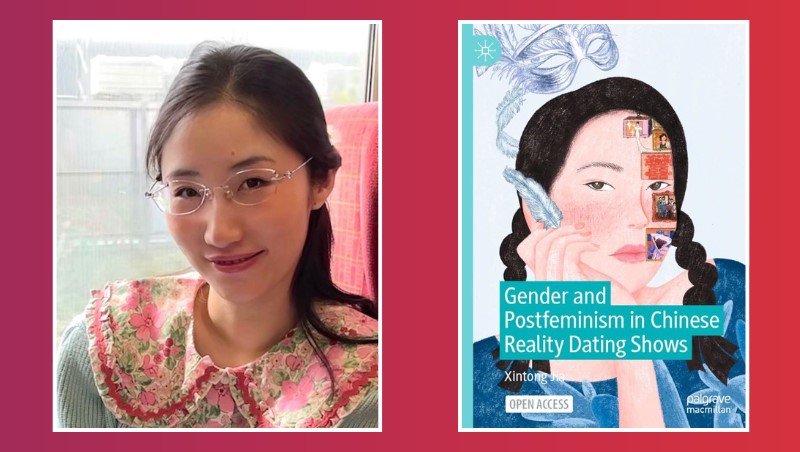
I’m sure readers will bring their own interpretations to the cover. What I love most is the relation between the masquerade and the female portrait. Initially, I had the woman wear the masquerade as a crown, but I later decided to keep some distance between them, with a feather and a quill pen acting as the connecting elements. I assume donning a masquerade may be inevitable for all human beings — but I still hope that each person can be the author of their own life and decide how their story will be written.
The Open Access digital edition of Gender and Postfeminism in Chinese Reality Dating Shows is free to download now.
If you would like to request financial support for a book or chapter that you would like to publish Open Access, please contact the University’s OA team using this form.
(Please note, the fund can currently only consider works due to be submitted to publishers from 1 August 2026 onwards.)