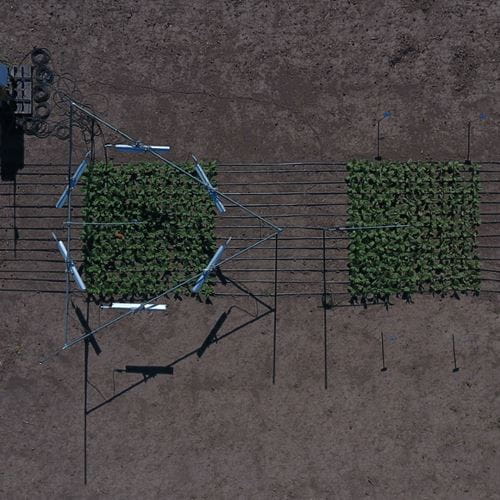
A biologist has received £2.8m to develop high-yielding maize that uses less water to help farmers fight climate change.
Dr John Ferguson, from the School of Life Sciences, is leading this pioneering project and has been awarded a UK Research and Innovation (UKRI) Future Leaders Fellowship.
The four-year project will see Dr Ferguson develop new varieties of the cereal crop maize, which is a vital source of food, feed and fuel across the world.
These new hybrids will be developed to support industrial agriculture and also subsistence farming within Sub-Saharan Africa.
The research will place, for the first time, stomatal physiology at the centre of a large-scale breeding initiative – helping to tackle yield losses due to climate change.
Stomata are microscopic pores found on the leaf surface that regulate gas exchange with the atmosphere and account for around 95% of plant water loss.
This work will lead to the breeding of high-yielding maize hybrids with increased stomatal resistance to water loss. Enhancing resistance to water loss without compromising photosynthesis will allow greater yields of maize to be produced with improved water-use efficiency.
Dr Ferguson said: “This fellowship will pioneer the development of high-yielding hybrids and gene edited lines with enhanced water-use-efficiency that will drive the future of sustainable agriculture and food security.
“Commercial maize breeding has traditionally focused on maximising yield under favourable, well-watered conditions. Water-use efficiency, the amount of yield a crop produces for the water it uses, has received much less attention, in part because improving yield potential has offered a clearer economic return.
But as climate change makes drought and water shortage an increasingly important constraint on crop production, we need to rethink how maize varieties are developed. Our project builds on fundamental research showing that reducing the number of stomata on the leaf can help plants conserve water and maintain yields during drought.
By taking these discoveries from the laboratory into a molecular-assisted breeding pipeline, we hope to demonstrate the value of putting plant physiology at the heart of crop improvement. We’re particularly excited to work with Dr Jill Cairns at the International Maize and Wheat Improvement Centre in Zimbabwe, helping us translate these findings into improved maize varieties for regions where drought already poses a major threat to food production”
Dr Ferguson, has a strong track record in ecophysiology and quantitative genetics. He has built an international reputation for his maize research, including a recent study with Dr Leonardo Caproni and colleagues at the Scuola Superiore Sant’Anna in Pisa that identified a genetic variant limiting photosynthesis in European maize. Dr Caproini will continue this collaboration as a key partner in the new project.
Professor Terence McGenity, Head of School of Life Science, has praised the work of Dr Ferguson.
He said: "John joins a team that is internationally recognised for its work in plant productivity, and his expertise in quantitative genetics and field-based phenotyping is a perfect complement to our existing strengths in photosynthesis and water-use efficiency.
“As climate change puts growing pressure on crop yields worldwide, this fellowship will help position Essex at the forefront of breeding the resilient, high-yielding varieties that global food security will depend on."



.png?mw=300)