Scientists help develop chair that creates altered states in minutes
-
Date
Tue 27 Jan 26

Scientists have collaborated with a British wellness innovation company to develop a chair that can bring people into altered states within minutes.
Researchers from the Department of Psychology have worked with DavidHugh Ltd to develop the design, which shares similar effects as sensory deprivation floatation tanks.
Floatation tanks were catapulted into popular culture by the Netflix series Stranger Things, where the main character Eleven used them to unlock supernatural powers.
However, this chair, known as Aiora, uses a new principle, known as pure planar motion mechanics, to achieve a total disconnect from the outside world.
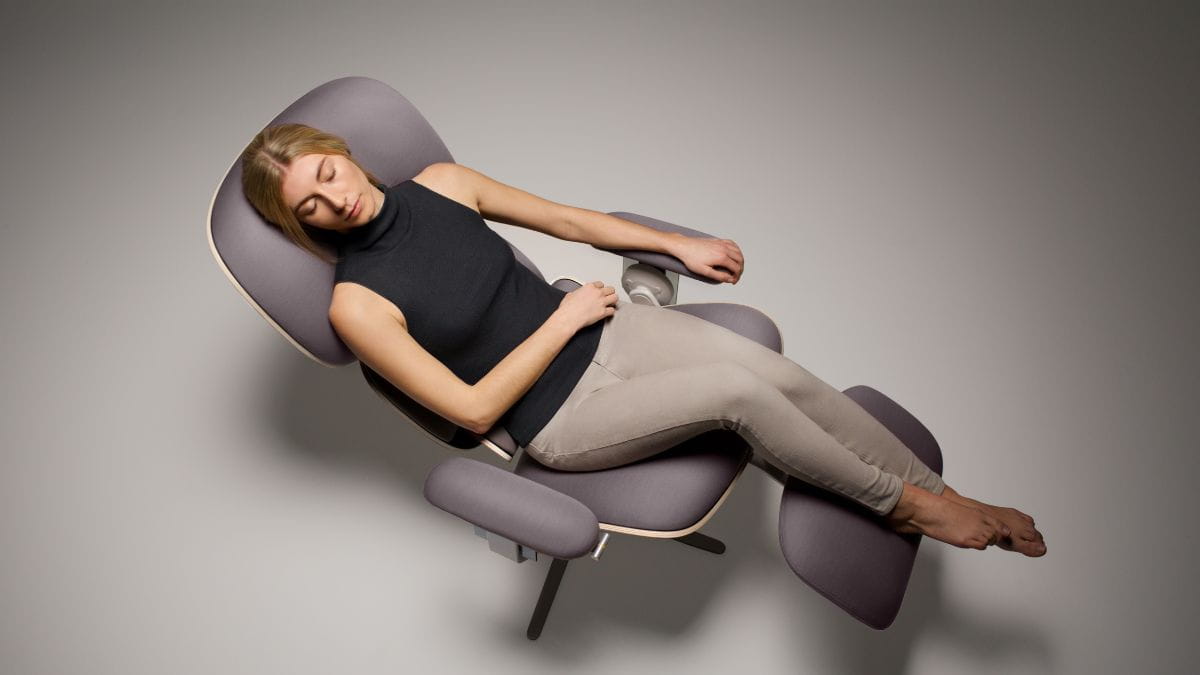
“With eyes closed, everything disappears from the experience,” said Dr David Wickett, the designer of the chair and co-founder of DavidHugh Ltd.
“It is so sensitive, even breathing can lift the entire body.
“Whilst floating in weightlessness is extraordinary in itself, what is even more remarkable is what people report after experiencing the chair with eyes closed.
“People often report being in a boundless space, experiencing illusions of movement, and being without thought.”
Since 2018, researchers at the Centre for Brain Science, led by Dr Nick Cooper, have been studying the technology using brain-scanning technology to examine changes in brain activity.
In controlled laboratory studies, the Aiora chair was compared to a mechanically fixed zero-gravity chair and an electronic zero-gravity massage chair.
“We have now completed several investigations,” said Dr Cooper.
“The combined neural and experiential effects we observed are clearly associated with the floatation dynamics, rather than equivalent static support.
“Several of our studies have revealed patterns of brain activity similar to those reported in long-term Buddhist meditators, and remarkably, in people with no prior meditation experience.
“We are preparing our first peer-reviewed publications and look forward to continuing to investigate this intriguing technology.”