26th South East Mathematical Physics Seminar
11:00 - 17:00
Workshops, training and support
Mathematics, Statistics and Actuarial Science, School of
George Papamikos g.papamikos@essex.ac.uk
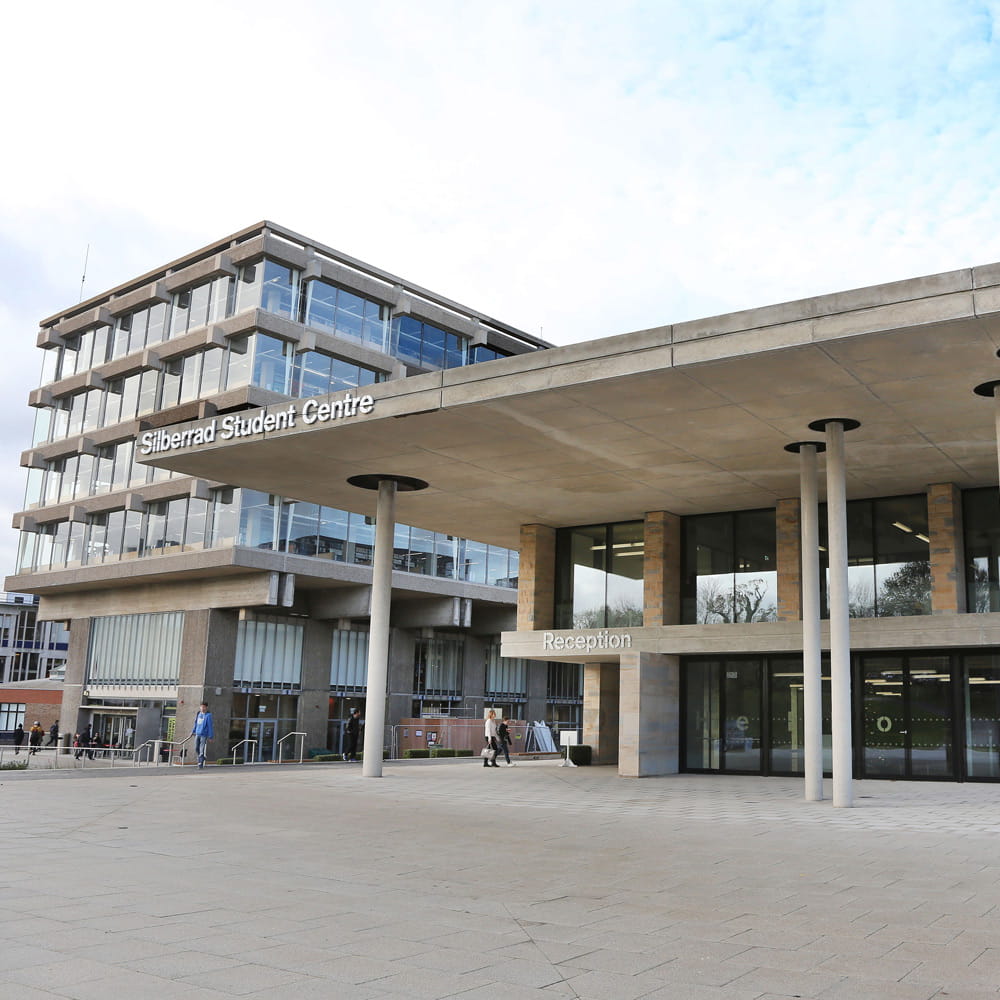
The 26th South East Mathematical Physics Seminar (SEMPS 26) will be held at Colchester campus.
There are no registration fees for this event. There are limited resources to cover travel expenses of participants, with priority given to early career researchers.
Please use the register button below to give us an idea of the number of people that will be attending SEMPS26.
For inquiries contact the local organiser George Papamikos (g.papamikos@essex.ac.uk)
We are thankful to the London Mathematical Society (LMS) and to the School of Mathematics, Statistics and Actuarial Science (SMSAS) at Essex for the financial support.
Title: Phase Dependence in Excited MSTB Kink-Antikink Scattering
Abstract:
The Montonen–Sarker–Trullinger–Bishop (MSTB) model is a (1+1)-dimensional complex-scalar field theory, effectively extending the well-known ϕ⁴ model with an additional field coupled to the first, and an orthogonal mode of the kink excitable in this extra field.
In this talk, we demonstrate the effects of the additional excited mode on the fractal pattern of kink-antikink collisions within the MSTB model, with a particular focus on excitation phase. This contrasts with the effect of the longitudinal mode of ϕ⁴, known to participate in the resonant energy transfer mechanism driving the fractal. We observe interesting and simplified patterns of phase-dependence underlying previously observed effects, through a 2-dimensional understanding of initial excitation. We further demonstrate a transition in behaviour beyond a particular threshold, and the emergence of phase-independence as we further increase the model parameter and corresponding mode frequency.
Title: Lagrangian formulation of the Darboux system
Abstract:
The classical Darboux system governing rotation coefficients of three-dimensional metrics of diagonal curvature possesses an equivalent formulation as a sixth-order PDE for a scalar potential (related to the corresponding tau-function).
We demonstrate that this PDE is Lagrangian and can be viewed as an explicit scalar form of the `generating PDE of the KP hierarchy' as discussed recently in Nijhoff in the Lagrangian multiform approach to the Darboux and KP hierarchies. Scalar Lagrangian formulations for differential-difference and fully discrete versions of the Darboux system are also constructed. In the first three cases (continuous and differential-difference with one and two discrete variables), the corresponding Lagrangians are expressible via elementary functions (logarithms), whereas the fully discrete case requires special functions (dilogarithms).
Based on joint work with Lingling Xue and Maxim Pavlov:
Title: Spaces of initial conditions for Hamiltonian systems of Painlevé and quasi-Painlevé type
Abstract:
In my talk I will discuss an generalisation of the Okamoto’s spaces of initial conditions for Hamiltonian systems to equations of quasi-Painlevé type. This class of equations is an important extension of equations with the Painlevé property, allowing for movable algebraic poles as well as ordinary poles to occur as movable singularities of the solutions in the complex plane.
The space of initial conditions, via its surface diagram, allows us to identify the type of the equation under bi-rational, symplectic transformations and thus allows a classification of these Hamiltonian systems. The Newton polygon of the polynomial Hamiltonian gives us a better overview over all such systems. As special cases, for Newton polygons with exactly on interior point, we recover Painlevé systems for all possible degrees of a polynomial Hamiltonian, leading to the standard Painlevé or modified Painlevé equations. Joint work with Marta Dell’Atti, based on the two articles [1] and [2].
References:
Title: Symplectic Cluster Maps and Integrable Deformations
Abstract:
We study the integrability of cluster maps arising within the framework of cluster algebras. In particular, we consider birational maps generated by specific sequences of cluster mutations that preserve the associated quiver. These maps admit an invariant two-form and can be reduced to symplectic maps on lower-dimensional spaces. We also introduce deformations of these maps and investigate their integrability using the properties of the underlying cluster algebra.
Title: Glamorous solutions from the discrete Painlevé I hierarchy
Abstract: The discussion will be centred on the study of special solutions of the second member of the hierarchy of discrete Painlevé I equations (dPI-2). These special solutions are recurrence coefficients associated with a sequence of polynomials which are orthogonal with respect to a sextic Freud weight. The problem arises in a variety of contexts, other than orthogonal polynomials, most notably within the context of random matrix theory.
In this talk, I will expand on the connection to Hermitian random matrix models and our contribution to the theory in both analytical and asymptotic perspectives.
The talk will be based on joint work with P Clarkson and K Jordaan.
Please note that some of these times may be subject to change.
There are several ways to get to our Colchester campus including by car, bike, or public transport.
If you arrive to Colchester by train (North station) you can:
SEMPS26 will take place at room NTC.2.01 (North Teaching Centre). To find your way around campus, use Find Your Way.