The BA Childhood Studies at Essex is a unique interdisciplinary degree exploring the social and emotional worlds of children and young people from birth to 25.
You’ll deepen your understanding of children’s lives, development, wellbeing, and identity while preparing for careers working directly with children or influencing policy, advocacy, and research that shapes childhood experiences.
Why this course
Childhood Studies is a vibrant and expanding field bringing together ideas from psychoanalysis, psychology, sociology, social work, and the arts and humanities to better understand children’s lives and experiences.
You’ll explore how childhood is shaped by culture, society, relationships, and emotional development, while examining the challenges children and young people face today, including inequality, climate change, online media, mental health difficulties, and bullying.
This course combines academic learning with practical experience through placements in Years 1 and 2, helping you connect theory with real-world work alongside children and young people.
Whether you want to work directly with children, support families and communities, or progress into postgraduate training and professional practice, you’ll graduate with the knowledge and insight to make a positive impact on children’s lives.
Who should apply
Students fascinated by child development, behaviour, identity, and emotional wellbeing
Future professionals interested in education, social care, advocacy, mental health, or family support
Learners wanting to combine academic study with practical placement experience
Those already working with children who wish to deepen their knowledge and professional skills
What you’ll learn
Child development: Study emotional, social, and psychological development across childhood and adolescence
Attachment and wellbeing: Explore attachment theory, resilience, safeguarding, and developmental trauma
Childhood across cultures: Examine how ideas of childhood differ across societies and historical periods
Neurodiversity and mental health: Learn about ADHD, ASD, emotional wellbeing, and the unconscious mind
Teaching and group dynamics: Understand psychodynamics of learning, teaching, and working with groups
Your learning experience
Placements in Years 1 and 2: Gain hands-on experience working with children and young people in real-world settings
Infant observation: Develop professional insight through focused observational practice in Year 2
Interdisciplinary teaching: Learn from experts across psychoanalysis, psychology, sociology, and social work
Coursework-based assessment: Assessment is mainly through coursework rather than exams
Research-informed learning: Study within an internationally recognised department specialising in unconscious processes, mental health, and society
Careers and outcomes
A BA in Childhood Studies prepares you for careers supporting children, young people, and families across a wide range of settings:
Education and schools: Supporting learning, wellbeing, and child development in educational environments
Children’s services and advocacy: Working with children experiencing emotional, behavioural, or social difficulties
Health and social care: Supporting children and families within community and care settings
Further professional training: Progressing into postgraduate study in teaching, psychotherapy, social work, or speech and language therapy
Research and policy: Influencing childhood policy, advocacy, and services that improve children’s lives
You’ll graduate with a strong balance of theoretical understanding, reflective practice, and practical experience that prepares you to make a meaningful difference to children and young people.
Employers of graduates from this course
Graduates from this course progress into roles across education, health, social care, and child-focused organisations, including:
Schools and early years settings
Children’s homes and family support services
Community and mental health organisations
Advocacy and safeguarding services
Charities and organisations supporting children and young people
Why we're great.
You'll be taught by a team of lecturers who bring both academic and practical knowledge to the field of childhood studies
Our degree will lay the foundations for a career working with infants, children and young people, whether in frontline practice or in child-centred sectors and organisations
The opportunity to complete two placements with support from our staff
Visit the home of Psychosocial and Psychoanalytic Studies at Essex
Meet the lecturers, discover our famous alumni, and learn about undergraduate student life in the Department of Psychosocial and Psychoanalytic Studies.
Our research-led teaching is continually evolving to address the latest challenges and breakthroughs in the field. The following modules are based on the current course structure and may change in response to new curriculum developments and innovation.
We understand that deciding where and what to study is a very important decision for you. We'll make all reasonable efforts to provide you with the courses, services and facilities as described on our website and in line with your contract with us. However, if we need to make material changes, for example due to significant disruption, we'll let our applicants and students know as soon as possible.
Components and modules explained
Components
Components are the blocks of study that make up your course. A component may have a set module which you must study, or a number of modules from which you can choose.
Each component has a status and carries a certain number of credits towards your qualification.
Status
What this means
Core
You must take the set module for this component and you must pass. No failure can be permitted.
Core with Options
You can choose which module to study from the available options for this component but you must pass. No failure can be permitted.
Compulsory
You must take the set module for this component. There may be limited opportunities to continue on the course/be eligible for the qualification if you fail.
Compulsory with Options
You can choose which module to study from the available options for this component. There may be limited opportunities to continue on the course/be eligible for the qualification if you fail.
Optional
You can choose which module to study from the available options for this component. There may be limited opportunities to continue on the course/be eligible for the qualification if you fail.
The modules that are available for you to choose for each component will depend on several factors, including which modules you have chosen for other components, which modules you have completed in previous years of your course, and which term the module is taught in.
Modules
Modules are the individual units of study for your course. Each module has its own set of learning outcomes and assessment criteria and also carries a certain number of credits.
In most cases you will study one module per component, but in some cases you may need to study more than one module. For example, a 30-credit component may comprise of either one 30-credit module, or two 15-credit modules, depending on the options available.
Modules may be taught at different times of the year and by a different department or school to the one your course is primarily based in. You can find this information from the module code. For example, the module code HR100-4-FY means:
HR
100
4
FY
The department or school the module will be taught by.
In this example, the module would be taught by the Department of History.
In this module you will explore childhood from a local and a global perspective. You will discover a broad range of topics related to children and childhood, including psychology, sociology, history, media, law and education.
How do unconscious dynamics work in individuals, groups and organisations? How can psychodynamic insight be applied to this? Explore how individuals affect one another, how institutions affect those who work there and vice versa. Understand key concepts in psychodynamic thinking and how to apply this to individuals, groups and workplaces.
What skills are involved in psychodynamic observation? How do you apply psychodynamic theory to everyday events? Gain a theoretical and practice-based understanding of psychodynamic observation. Develop your psychodynamic approach to reflective practice. Undertake your own observations, in the community and on placement, and present your findings in seminars.
Assignment and Research Writing for Psychosocial and Psychoanalytic Studies
(15 CREDITS)
Want guidance in understanding your course? Know how your academic skills will transfer to the world of work? Develop your abilities to undertake independent research. Learn to read critically and to write clearly. Build the employability skills that will help you during your studies and after graduation.
Living a Good Life: Critical Approaches to Wellness and Happiness
(15 CREDITS)
This first-year module will inspire you to build a meaningful philosophy of life.
As an interdisciplinary module within the fields of Psychoanalytic and Psychosocial Studies, Childhood Studies, therapeutic and clinical practice, Happiness Studies, the Sociology of Health and Medical Humanities, it will enable you to reflect on what we think we need to be happy and what a good and meaningful life entails for individuals and societies. You will also be encouraged to explore how small changes in our ways of thinking may help us to live better lives.
A key question for this module is how we can find space for happiness, wellness, and mindfulness in a globalised world shaped by climate crises, war and violence, pandemics, oppression and inequality and the biopolitical organisation of our lives. Through reflective activities and class discussions you will be encouraged to use theoretical ideas to research your own lives, your established ways of thinking and your current perspective on life. As such, the module will motivate you to invest in developing an individual philosophy of life, and reflect on how a pragmatic and realistically optimistic outlook for life can be pursued, both at an individual, as well as a social level.
In this module you will learn about child development, focusing on infancy. You will have the opportunity to gain first-hand experience in observing the early developments of an infant, within a family setting or in the nursery setting. You will learn the unfolding of the infant’s awareness of self and others and the developing of personality and identity within the context in which it is happening.
You will also be learning about the role of the observer. Understanding and developing how this role supports the development of skills and sensitivity around role management and boundaries in preparation for professional life – where working therapeutically or with ordinary children or other settings.
Therapeutic Practice and Responsibility: Statutory Frameworks
(15 CREDITS)
What are the frameworks around therapeutic work? How do you ensure responsible practice? Examine professional conduct and ethical considerations. Build your psychodynamic understanding of the issues and dynamics involved. Gain knowledge of your wider responsibilities to your organisation, discipline, clients and yourself.
In this module you will develop your understanding of childhood studies and childcare practice and explore employability and career options within this field. You will have the opportunity to think about your future career aspirations and learn about the graduate employment market.
Consider the ways in which childhood has changed throughout history. In this module you will explore how the concept of childhood has developed particularly from eighteenth century onwards. This module covers a variety of aspects including religion, education, rights and policies, culture, gender and sexuality.
Childhood Wellbeing: Play, Socialisation and Resilience
(15 CREDITS)
Explore children’s well-being through play, socialisation and resilience. Discover how well-being can vary across cultures, both nationally and globally. In this module you will also learn about current issues facing children today such as technology, internet and the effects that this may have on well-being.
Teaching and Learning with Children: A Psychosocial Approach
(15 CREDITS)
Understand what facilitates education and the factors that can also hinder learning. You will explore all areas that can affect a child’s ability to learn, from anxiety to new experiences. You will learn the aspects of learning through a sociological and psycho-social perspective.
Throughout the year students will be pursuing a research project based on a subject of their choice.
There will be an introductory workshop to help with choosing the project, followed by a series of lectures and workshops and three 30-minute supervision meetings with a named member of staff to monitor progress and offer support.
Students will draw on the theory from the three years of the course and apply these to a subject of their choice, exploring the conscious and unconscious dynamics involved.
Disney's World: Childhood, Culture, and Global Media
(15 CREDITS)
How does diversity impact children? How is childhood constructed differently based on differences in race, gender, class, sexuality, nationality, religion, or disability? How do children themselves navigate the larger inequalities of society and eventually internalize an understanding of their own diverse identities?
This module emphasizes the importance of diversity and identity for understanding childhood and offers a critical introduction to some of the main identity categories that impact children's everyday lives. Taking a topical, week-by-week approach, this module considers, for instance, how children navigate racial identities in a landscape of social inequality and how gender differently affects children's development of relational qualities like confidence and caring.
On a placement year you will gain exciting and relevant work experience within an external organisation, where you can gain the competitive edge you need in the graduate job market, make key contacts in the sector and further develop the competencies and experience needed to build your CV. The rest of your course remains identical to the three-year degree.’
Year abroad
On your year abroad, you have the opportunity to experience other cultures and languages, to broaden your degree socially and academically, and to demonstrate to employers that you are mature, adaptable, and organised. The rest of your course remains identical to the three-year degree.
Teaching
Undergraduate students in the Department of Psychosocial and Psychoanalytic Studies typically attend a one-hour lecture and a one-hour seminar for each module per week. There are some variations in place depending on the module.
Teaching takes place through lectures and seminars often in relatively small groups, with a focus on group interaction and discussion
Discussion in seminars includes discussing theoretical ideas, how these might apply to practice and discussing your own experiences and observation on placement
You will also participate in skills based workshops, debates, observation seminars, reflective groups and teach others through presentation of theoretical readings and practice case examples
Assessment
Your grade is made up mainly of coursework marks, including essays, case studies and reflective reports. There are exams, but these are infrequent
Entry requirements
UK entry requirements
112 UCAS tariff points from a minimum of 2 full A-levels.
IB: 29 points in the IB Diploma or 112 UCAS tariff points to include a minimum of 2 Higher Level subjects.
We accept A-levels, AAQs, BTECs, Access to HE Diploma, T-levels and most other qualifications that hold UCAS tariff points. Acceptability of some non A-level qualifications (such as BTECs) may depend on the subject studied and units taken.
You can calculate your UCAS tariff points on the UCAS website.
Whilst International A-levels and BTECs aren't on the UCAS tariff calculator, we assign them the same tariff points as their UK counterparts.
We are committed to ensuring that all students with the merit and potential to benefit from an Essex education are supported to do so. We make Contextual Offers, of up to two A-level grades (or equivalent) below our standard conditional offer, to applicants from underrepresented groups residing in the UK. Our Contextual Offers policy outlines the full eligibility criteria.
If you haven't got the grades you hoped for, have a non-traditional academic background, are a mature student, or have any questions about eligibility for your course, more information can be found on our undergraduate application information page.
Additional requirements:
A satisfactory enhanced DBS check (including child and adult barred list check) will be required prior to starting any placement(s) for this course, This will be organised by the University. Please contact our DBS team if you have any questions relating to this.
A satisfactory Overseas Criminal Record/Local Police Certificate is also required, in addition to a DBS Check, where you lived outside of the UK in the last 5 years for 6 months or more.
International & EU entry requirements
We accept a wide range of qualifications from applicants studying in the EU and other countries. Get in touch with any questions you may have about the qualifications we accept. Remember to tell us about the qualifications you have already completed or are currently taking.
Sorry, the entry requirements for the country that you have selected are not available here. Please contact our Undergraduate Admissions team at ugquery@essex.ac.uk to request the entry requirements for this country.
English language requirements
English language requirements for applicants whose first language is not English
IELTS 6.0 overall with a minimum of 5.5 in each component, or specified score in an equivalent test that we accept.
Details of English language requirements and the tests we accept for applicants who require a Student visa (excluding Nationals of Majority English Speaking Countries) can be found here
If we accept the English component of an international qualification it will be included in the academic levels listed above for the relevant countries.
Pre-sessional English courses
If you do not meet our IELTS requirements then you may be able to complete a pre-sessional English pathway that enables you to start your course without retaking IELTS.
Additional Notes
If you’re an international student, but do not meet the academic requirements for direct admission to this degree, you could prepare and gain entry through a pathway course. Find out more about opportunities available to you at the University of Essex International College
Fees and funding
Home/UK fee
£9,790 per year
International fee
£21,500 per year
Fees will increase for each academic year of study.
If your course has the option to include a placement year or study abroad, and you choose to do so, you will pay the following:
Our events are a great way to find out more about studying at Essex. We run a number of Open Days throughout the year which enable you to discover what our campus has to offer.
You have the chance to:
tour our campus and accommodation
find out answers to your questions about our courses, student finance, graduate employability, student support and more
meet our students and staff
Check out our Visit Us pages to find out more information about booking onto one of our events. And if the dates aren’t suitable for you, feel free to book a campus tour here.
Our UK students, and some of our EU and international students, who are still at school or college, can apply through their school. Your school will be able to check and then submit your completed application to UCAS. Our other international applicants (EU or worldwide) or independent applicants in the UK can also apply online through UCAS Apply.
The UCAS code for our University of Essex is ESSEX E70. The individual campus codes for our Loughton and Southend Campuses are 'L' and 'S' respectively.
You can find further information on how to apply, including information on transferring from another university, applying if you are not currently at a school or college, and applying for readmission on our How to apply and entry requirements page.
If you receive an undergraduate offer to study with us in October 2026 and live in the UK, you will receive an email invitation to book onto one of our Open Days. These events provide the opportunity to meet your department, join interesting taster sessions, tour our campus and accommodation, and chat to current students. You can visit our Open Days event page for more information, including terms and conditions.
Visit Colchester Campus
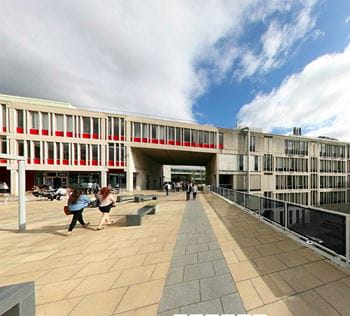
Set within 200 acres of award-winning parkland - Wivenhoe Park and located two miles from the historic city centre of Colchester – England's oldest recorded development. Our Colchester Campus is also easily reached from London and Stansted Airport in under one hour.
If you live too far away to come to Essex (or have a busy lifestyle), no problem. Our 360-degree virtual tour allows you to explore our University from the comfort of your home. Check out our Colchester virtual tour to see accommodation options, facilities and social spaces.
At Essex we pride ourselves on being a welcoming and inclusive student community. We offer a wide range of support to individuals and groups of student members who may have specific requirements, interests or responsibilities.
The University makes every effort to ensure that this information on its programme specification is accurate and up-to-date. Exceptionally it can be necessary to make changes, for example to courses, facilities or fees. Examples of such reasons might include, but are not limited to: strikes, other industrial action, staff illness, severe weather, fire, civil commotion, riot, invasion, terrorist attack or threat of terrorist attack (whether declared or not), natural disaster, restrictions imposed by government or public authorities, epidemic or pandemic disease, failure of public utilities or transport systems or the withdrawal/reduction of funding. Changes to courses may for example consist of variations to the content and method of delivery of programmes, courses and other services, to discontinue programmes, courses and other services and to merge or combine programmes or courses. The University will endeavour to keep such changes to a minimum, and will also keep students informed appropriately by updating our programme specifications. The University would inform and engage with you if your course was to be discontinued, and would provide you with options, where appropriate, in line with our Compensation and Refund Policy.
The full Procedures, Rules and Regulations of the University governing how it operates are set out in the Charter, Statutes and
Ordinances and in the University Regulations, Policy and Procedures.
3.png?mw=300)