What is the Integrated Master in Economics: Economics?
The Integrated Master in Economics: Economics is a three-year degree, with an optional fourth year for a placement or study abroad, taught at our Colchester campus.
You’ll develop a deep understanding of how economies work, how individuals and organisations make decisions, and how economic policies shape societies. You’ll graduate with strong analytical, quantitative, and problem-solving skills that are highly valued across a wide range of careers.
Why this course
The Integrated Master in Economics: Economics explores the forces that shape our world, from individual decision-making and business strategies to government policies and global economic challenges. You’ll learn how economies function, why crises occur, and how economic ideas can be used to develop solutions to real-world problems.
Economics at Essex goes beyond financial markets and investment. You’ll examine how economic decisions affect the wellbeing of societies, exploring issues such as inequality, employment, growth, and public policy.
You’ll build a comprehensive understanding of modern economics, studying core areas including microeconomics, macroeconomics, econometrics, and data analysis. You’ll also have the opportunity to explore specialist topics that allow you to develop your interests and career goals.
By the time you graduate, you’ll have the skills to analyse complex economic issues and contribute to decision-making in business, government, research, and beyond.
Who should apply
Students interested in understanding how economies, markets, and societies operate
Future economists, analysts, policymakers, consultants, and business professionals
Learners who enjoy using evidence and data to investigate real-world challenges
Anyone looking for a rigorous degree that develops analytical and critical thinking skills
What you’ll learn
Microeconomics: Explore how individuals, firms, and markets make decisions and respond to incentives.
Macroeconomics: Understand economic growth, inflation, unemployment, and the policies used to manage economies.
Econometrics and data analysis: Develop skills to analyse economic data and test theories using quantitative methods.
Economic policy: Examine fiscal policy, monetary policy, and the role of governments in shaping economies.
Specialist economics topics: Explore areas including strategic behaviour, public choice, labour markets, growth theory, international trade, and financial economics.
Your learning experience
Research-led teaching: Learn from academics at the forefront of economic research and debate.
Critical thinking: Challenge established economic ideas and explore alternative approaches to understanding markets and policy.
Data-driven analysis: Develop practical skills in econometric methods and the use of data to investigate economic questions.
Choice and flexibility: Select specialist modules that allow you to explore areas of economics aligned with your interests.
Global perspective: Understand economic challenges affecting societies and economies around the world.
Careers and outcomes
An Integrated Master in Economics: Economics prepares you for careers where analytical thinking, quantitative skills, and economic understanding are highly valued:
Economic analysis: Apply economic knowledge to research, forecasting, and decision-making roles.
Government and public policy: Support policy development and evaluate economic challenges.
Finance and banking: Use analytical skills to understand markets, investment, and financial decisions.
Consultancy: Advise organisations using economic research and evidence-based analysis.
Business and management: Apply economic insight to strategy, planning, and organisational decision-making.
You’ll graduate with a highly transferable skill set, giving you the confidence to tackle complex problems and succeed across a wide range of industries.
Teaching excellence
This course is taught within the Department of Economics, where research excellence informs your learning and connects economic theory with real-world issues.
Study in a department ranked 4th in the UK for research power in economics and econometrics (Research Excellence Framework 2021).
Learn from academics whose research contributes to leading international journals, including the American Economic Review, Econometrica, and the Review of Economic Studies.
Benefit from expertise in areas including game theory, strategic interactions, econometrics, and labour economics.
Why we're great.
9th for student positivity in economics (National Student Survey 2026, English broad- discipline higher education institutions)
8th in UK for economics (The Guardian University Guide 2027)
Get hands-on experience in the world of investment banking with the Essex Equity Fund (EEF) - a unique initiative in the East of England. Participate in an investment bootcamp run by Essex alumni who are now investment bankers, before pitching your investment recommendations and monitoring their success.
Study abroad
Your education extends beyond the university campus. We support you in expanding your education through offering the opportunity to spend a year or a term studying abroad at one of our partner universities. The five-year version of our degree allows you to spend the third year abroad or employed on a placement abroad, while otherwise remaining identical to the four-year course.
Studying abroad allows you to experience other cultures and languages, to broaden your degree socially and academically, and to demonstrate to employers that you are mature, adaptable, and organised.
If you spend a full year abroad you'll only pay 15% of your usual tuition fee to Essex for that year. You won't pay any tuition fees to your host university.
Placement year
Alternatively, you can spend your third year on a placement year with an external organisation, where you learn about a particular sector, company or job role, apply your academic knowledge in a practical working environment, and receive inspiration for future career pathways. You will be responsible for finding your placement, but with support and guidance provided by both your department and our Employability and Careers Centre.
If you complete a placement year you'll only pay 20% of your usual tuition fee to Essex for that year.
Our expert staff
Study and work alongside some of the most prominent economists.
Our researchers are at the forefront of their field and have even received MBEs, with students coming from across the globe to study, research or work with us. Our Department of Economics is a richly diverse home to staff and students from all over the world who have a strong sense of belonging and want to think, learn and change the world together.
Many of our researchers also provide consultancy services to businesses in London and other major financial centres, helping us to develop research for today's society as well as informing our teaching for the future.
Specialist facilities
Take advantage of our extensive learning resources to assist you in your studies:
Extensive software for quantitative analysis is available in all computer labs across the university
Access a variety of economics databases and multiple copies of textbooks and e-books in the Albert Sloman Library
A comprehensive online learning environment (Moodle) for each module
A top class computer Lab (ESSEXLab) to run economic research experiments
Your future
Many employers want economists with critical thinking skills who can tackle large data sets and practical problems. Our course helps you to become more employable and takes you closer to that dream job or postgraduate course when you graduate.
Our students are in demand from a wide range of employers in a host of occupations, including financial analysis, management, public administration and accountancy.
Our recent graduates have gone on to work for a wide range of high-profile companies including:
Bank of England
Barclays Capital
Citigroup
Deloitte
Ernst and Young
Morgan Stanley
Bank of New York
Santander
We also work with the University's Student Development Team to help you find out about further work experience, internships, placements, and voluntary opportunities.
Course content
Course structure
Our research-led teaching is continually evolving to address the latest challenges and breakthroughs in the field. The following modules are based on the current course structure and may change in response to new curriculum developments and innovation.
We understand that deciding where and what to study is a very important decision for you. We'll make all reasonable efforts to provide you with the courses, services and facilities as described on our website and in line with your contract with us. However, if we need to make material changes, for example due to significant disruption, we'll let our applicants and students know as soon as possible.
Components and modules explained
Components
Components are the blocks of study that make up your course. A component may have a set module which you must study, or a number of modules from which you can choose.
Each component has a status and carries a certain number of credits towards your qualification.
Status
What this means
Core
You must take the set module for this component and you must pass. No failure can be permitted.
Core with Options
You can choose which module to study from the available options for this component but you must pass. No failure can be permitted.
Compulsory
You must take the set module for this component. There may be limited opportunities to continue on the course/be eligible for the qualification if you fail.
Compulsory with Options
You can choose which module to study from the available options for this component. There may be limited opportunities to continue on the course/be eligible for the qualification if you fail.
Optional
You can choose which module to study from the available options for this component. There may be limited opportunities to continue on the course/be eligible for the qualification if you fail.
The modules that are available for you to choose for each component will depend on several factors, including which modules you have chosen for other components, which modules you have completed in previous years of your course, and which term the module is taught in.
Modules
Modules are the individual units of study for your course. Each module has its own set of learning outcomes and assessment criteria and also carries a certain number of credits.
In most cases you will study one module per component, but in some cases you may need to study more than one module. For example, a 30-credit component may comprise of either one 30-credit module, or two 15-credit modules, depending on the options available.
Modules may be taught at different times of the year and by a different department or school to the one your course is primarily based in. You can find this information from the module code. For example, the module code HR100-4-FY means:
HR
100
4
FY
The department or school the module will be taught by.
In this example, the module would be taught by the Department of History.
How do consumers make decisions? Or firms conduct different market strategies? What impact does government policy have on inflation? Or unemployment? Develop your knowledge of economics in relation to a range of contemporary issues. Learn how to apply both micro and macroeconomic principles to the analysis of such problems.
Are you ready for graduate employment? Like to improve your core skills? Need to know more about the working world? Attend workshops, events and activities to build your knowledge, abilities and experience with this compulsory, zero credit module that runs during your three years of undergraduate study.
What tools can you use for macroeconomic analysis? And how can these then be applied to macro-policy issues? Learn how to build alternative macroeconomic models and apply analytical reasoning. Examine real-life macroeconomic questions, on topics such as government budgets or wage-price flexibility, and critically evaluate macroeconomic policies.
How do consumers behave in a competitive market? And what about producers? How do various imperfections affect the outcome of decentralised markets? Study the fundamental concepts and methods in microeconomics. Understand the tools and methods of analysis for economic reasoning, and develop your critical approach to economic issues and policies.
What mathematical methods can analyse economic problems? And what mathematical tools are needed to understand economic models? Gain an introduction to the mathematical methods commonly used in economics, build your knowledge of mathematical tools for work in economics and develop your understanding of the mathematical language used in economic literature.
Which econometric methods can analyse economic data? How do you critically assess applied economic literature? Learn how to carry out statistical and econometric calculations, plus gain experience of using the Stata software package. Demonstrate your subsequent understanding of the linear regression model with your own investigation on an empirical issue.
Are you ready for graduate employment? Like to improve your core skills? Need to know more about the working world? Attend workshops, events and activities to build your knowledge, abilities and experience with this compulsory, zero credit module that runs during your three years of undergraduate study.
What interests you? Design and implement your own research project, under the guidance and supervision of our world-leading academic staff. Demonstrate your knowledge of economic ideas in greater depth, building your professional research skills and developing further understanding of a topic that fascinates you.
Are you ready for graduate employment? Like to improve your core skills? Need to know more about the working world? Attend workshops, events and activities to build your knowledge, abilities and experience with this compulsory, zero credit module that runs during your three years of undergraduate study.
Wish to conduct your own research using econometric methods? Understand econometric methods and learn to apply them to a wide variety of situations. Examine methods of linear regression and hypothesis testing. Study time series concepts of unit roots and co-integration. Explore ideas around model selection and panel data models.
What mathematical concepts are vital to understanding modern economic theory? Gain the essential mathematics skills needed to study economics at Masters-level, such as optimisation theory and the role of equilibrium. Understand how economic arguments work and improve your problem solving skills by using real-world economic problems.
Undergraduate students in the Department of Economics typically attend a two-hour lecture and a one-hour class for each module per week. Postgraduate students in the Department of Economics typically attend a two-hour lecture and a one-hour class or lab for each module per week.
Teaching is arranged to allow freedom in how you organise your learning experiences
Optional support classes
Assessment
You are assessed each year through a mixture of coursework and end-of-year examinations
The balance is set at 50% coursework and 50% exam
For many of your second- and final-year modules, coursework takes the form of an extended essay
Complete your final year project in consultation with a personal supervisor
Entry requirements
UK entry requirements
GCSE: Mathematics B/5.
Plus one of the level 3 qualifications below:
136 UCAS tariff points from a minimum of the equivalent of 2 full A-levels.
IB: 33 points in the IB Diploma or 136 UCAS tariff points to include a minimum of 2 Higher Level subjects.
We accept A-levels, AAQs, BTECs, Access to HE Diploma, T-levels and most other qualifications that hold UCAS tariff points. Acceptability of some non A-level qualifications (such as BTECs) may depend on the subject studied and units taken.
You can calculate your UCAS tariff points on the UCAS website.
Whilst International A-levels and BTECs aren't on the UCAS tariff calculator, we assign them the same tariff points as their UK counterparts.
Don't meet the entry requirements?
We know everyone's journey is different. If your achieved or predicted grades don’t match our entry requirements, you have a non-traditional educational background, or you're returning to study as a mature student, we'd still encourage you to apply. We review every application individually and may be able to offer you a place on this course, or an alternative route such as a foundation year.
Find out more about applying, personal statements, references, visas, deferred entry, extenuating circumstances, and support for mature students on our undergraduate application information page.
Contextual Offers:
We are committed to ensuring that all students with the merit and potential to benefit from an Essex education are supported to do so. We make Contextual Offers to applicants from underrepresented groups residing in the UK. Our Contextual Offers policy outlines the full eligibility criteria.
GCSE Mathematics B/5 plus
128 UCAS tariff points from a minimum of 2 full A-levels.
International & EU entry requirements
We accept a wide range of qualifications from applicants studying in the EU and other countries. Get in touch with any questions you may have about the qualifications we accept. Remember to tell us about the qualifications you have already completed or are currently taking.
Sorry, the entry requirements for the country that you have selected are not available here. Please contact our Undergraduate Admissions team at ugquery@essex.ac.uk to request the entry requirements for this country.
English language requirements
English language requirements for applicants whose first language is not English
IELTS 6.0 overall with a minimum of 5.5 in each component, or specified score in an equivalent test that we accept.
Details of English language requirements and the tests we accept for applicants who require a Student visa (excluding Nationals of Majority English Speaking Countries) can be found here
If we accept the English component of an international qualification it will be included in the academic levels listed above for the relevant countries.
Pre-sessional English courses
If you do not meet our IELTS requirements then you may be able to complete a pre-sessional English pathway that enables you to start your course without retaking IELTS.
Additional Notes
If you’re an international student, but do not meet the academic requirements for direct admission to this degree, you could prepare and gain entry through a pathway course. Find out more about opportunities available to you at the University of Essex International College
Fees and funding
Home/UK fee
£10,050 per year
International fee
£23,750 per year
Fees will increase for each academic year of study.
If your course has the option to include a placement year or study abroad, and you choose to do so, you will pay the following:
Our events are a great way to find out more about studying at Essex. We run a number of Open Days throughout the year which enable you to discover what our campus has to offer.
You have the chance to:
tour our campus and accommodation
find out answers to your questions about our courses, student finance, graduate employability, student support and more
meet our students and staff
Check out our Visit Us pages to find out more information about booking onto one of our events. And if the dates aren’t suitable for you, feel free to book a campus tour here.
Our UK students, and some of our EU and international students, who are still at school or college, can apply through their school. Your school will be able to check and then submit your completed application to UCAS. Our other international applicants (EU or worldwide) or independent applicants in the UK can also apply online through UCAS Apply.
The UCAS code for our University of Essex is ESSEX E70. The individual campus codes for our Loughton and Southend Campuses are 'L' and 'S' respectively.
You can find further information on how to apply, including information on transferring from another university, applying if you are not currently at a school or college, and applying for readmission on our How to apply and entry requirements page.
If you receive an undergraduate offer to study with us in October 2026 and live in the UK, you will receive an email invitation to book onto one of our Open Days. These events provide the opportunity to meet your department, join interesting taster sessions, tour our campus and accommodation, and chat to current students. You can visit our Open Days event page for more information, including terms and conditions.
Visit Colchester Campus
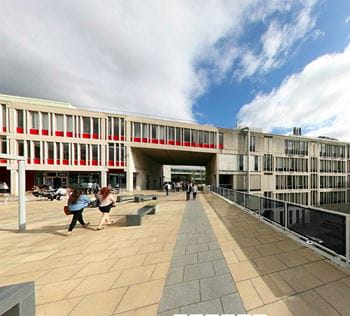
Set within 200 acres of award-winning parkland - Wivenhoe Park and located two miles from the historic city centre of Colchester – England's oldest recorded development. Our Colchester Campus is also easily reached from London and Stansted Airport in under one hour.
If you live too far away to come to Essex (or have a busy lifestyle), no problem. Our 360-degree virtual tour allows you to explore our University from the comfort of your home. Check out our Colchester virtual tour to see accommodation options, facilities and social spaces.
At Essex we pride ourselves on being a welcoming and inclusive student community. We offer a wide range of support to individuals and groups of student members who may have specific requirements, interests or responsibilities.
The University makes every effort to ensure that this information on its programme specification is accurate and up-to-date. Exceptionally it can be necessary to make changes, for example to courses, facilities or fees. Examples of such reasons might include, but are not limited to: strikes, other industrial action, staff illness, severe weather, fire, civil commotion, riot, invasion, terrorist attack or threat of terrorist attack (whether declared or not), natural disaster, restrictions imposed by government or public authorities, epidemic or pandemic disease, failure of public utilities or transport systems or the withdrawal/reduction of funding. Changes to courses may for example consist of variations to the content and method of delivery of programmes, courses and other services, to discontinue programmes, courses and other services and to merge or combine programmes or courses. The University will endeavour to keep such changes to a minimum, and will also keep students informed appropriately by updating our programme specifications. The University would inform and engage with you if your course was to be discontinued, and would provide you with options, where appropriate, in line with our Compensation and Refund Policy.
The full Procedures, Rules and Regulations of the University governing how it operates are set out in the Charter, Statutes and
Ordinances and in the University Regulations, Policy and Procedures.
3.png?mw=300)