Tasos Giapoutzis: Q and A on his new Open Access publication
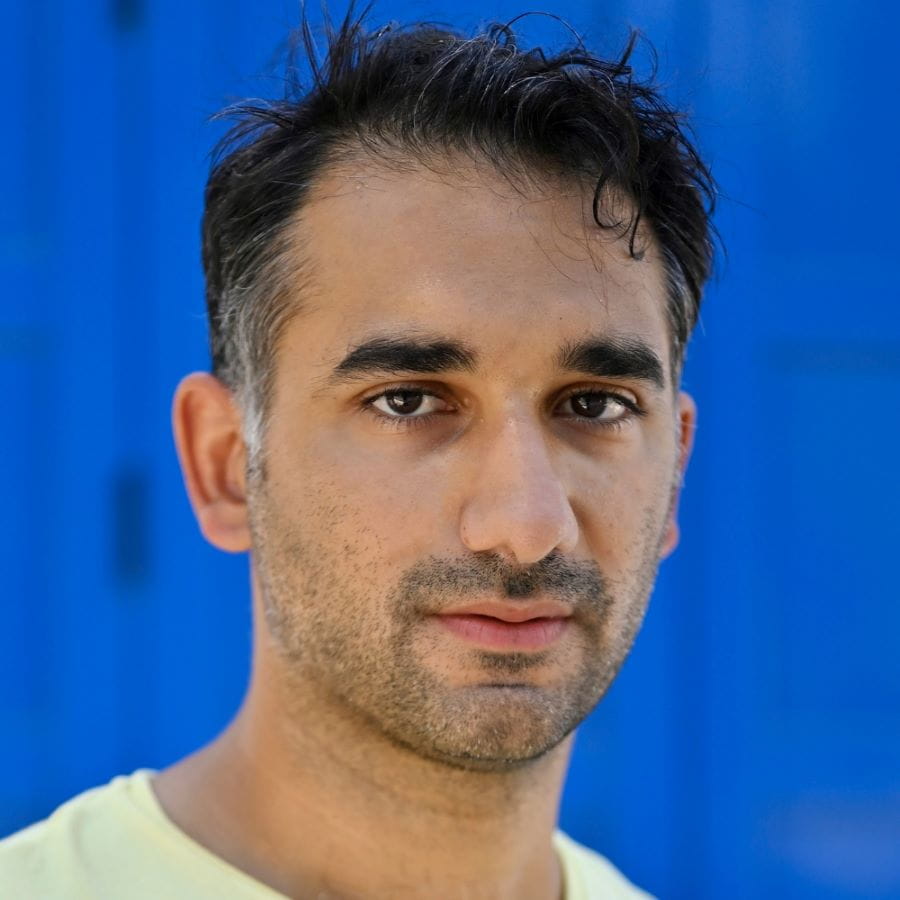

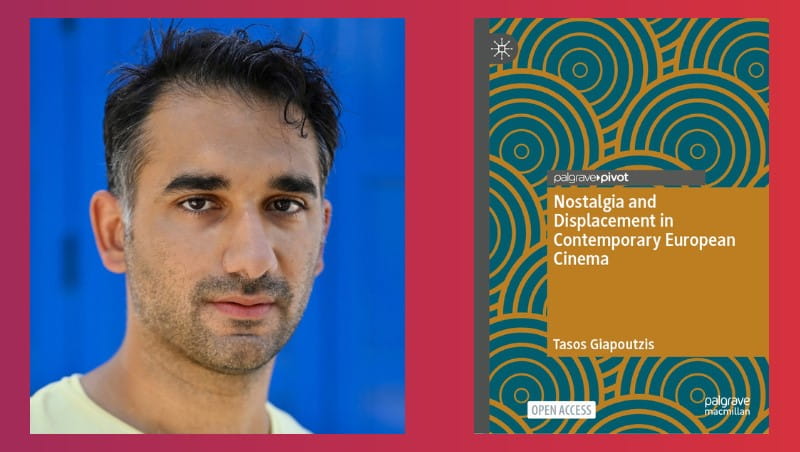
Dr Tasos Giapoutzis, Lecturer in Film, Subject Head of Film Studies, and filmmaker, is the author of Nostalgia and Displacement in Contemporary European Cinema, an Open Access (OA) monograph published by Palgrave Macmillan.
The book can be downloaded free of charge here.
Congratulations, Dr Giapoutzis! How does it feel to see your work in print and freely available online?
It’s a strange mix of relief and quiet disbelief. This book has been with me for some time, in different forms (notes, fragments, ideas that didn’t quite fit yet) and suddenly it exists as something complete and public. The Open Access aspect makes it feel even more meaningful. There’s something quite moving about knowing that anyone, anywhere, can encounter the work without barriers. Given that the book is about displacement and access to ‘home,’ that feels symbolically right.
How many films does your book examine? Can you tell us about a few of them?
The book engages closely with five films, each offering a distinct way of thinking about nostalgia and its relationship to different forms of displacement. What brings them together is not a single definition of displacement, but the range of ways it is experienced and expressed. For example, Tabu allows me to approach nostalgia not simply as memory, but as something politically and historically charged, particularly in relation to Portugal’s colonial past. Then there’s The Edge of Heaven, which explores migration through interwoven lives across Germany and Turkey, where “home” becomes something negotiated rather than fixed. Alongside these, the book also considers films where displacement is less about visible movement across borders and more about quieter, internal experiences, subtle forms of estrangement that emerge within everyday life. What interested me was precisely this spectrum, from the overtly geopolitical to the deeply personal.
Do they come from all across Europe or are they focused around certain centres?
They come from across Europe, but not in a way that tries to be geographically comprehensive. I wasn’t interested in mapping Europe as much as tracing a sensibility that emerges in different places: Portugal, Germany, Scotland, Turkey, Transnistria. What connects them is less their national origin and more a shared preoccupation with memory, loss, and belonging in a continent shaped by movement, crisis, and historical residue.
The book looks at displaced protagonists and their longing for belonging and nostalgia for home, or maybe just a home? Tell us about their different forms of displacement.
Displacement in these films is not one thing. It is layered. Some characters are migrants or exiles, moving across borders and negotiating new cultural realities. Others are what we might call “internally displaced.” They remain in the same place, but that place has changed around them, economically, socially, emotionally. And then there are those who experience a more existential form of displacement: a sense that “home” is not recoverable, or perhaps never fully existed. What I found compelling is that nostalgia doesn’t always point to a real, stable past. It often gestures toward something imagined, constructed, or even impossible.
In what ways do films manifest something as intangible as nostalgia?
Cinema is uniquely equipped for this because it works with time in such a tactile way. Nostalgia can emerge through image texture – grain, colour palettes, the use of black and white – or through rhythm, pacing, and repetition. But it’s also about absence. What is not shown, what is remembered imperfectly, what is reconstructed through voiceover or fragmented narrative. In many of the films I discuss, nostalgia isn’t simply represented, it is felt structurally. The viewer experiences it through the film’s form rather than just its story.
Why are these themes so important to you?
They come from a very personal place. Having lived and moved between countries myself, I’ve often been interested in that feeling of being slightly out of place, of belonging, but not entirely. Cinema became a way for me to think through that experience. Not to resolve it, necessarily, but to sit with it, to understand its textures. Over time, that personal curiosity developed into a research focus, and now also into my own filmmaking practice.
It sounds like these pictures could all be desperately sad experiences. Are they?
Not necessarily. There is sadness, of course, but also tenderness, humour, even moments of quiet joy. Nostalgia is not only about loss. It can be comforting, creative, even productive. Some of these films find beauty in small gestures, in everyday routines, in the act of remembering itself. So while they engage with difficult experiences, they’re not defined by despair. They often offer a more nuanced emotional landscape.
Do you have a favourite among the films that you write about? And if we wanted to watch any, which do you recommend we start with?
I’m always hesitant to choose a favourite, but Tabu has stayed with me in a particular way. It’s formally inventive, but also deeply reflective about history and storytelling itself. For a starting point, I would suggest The Edge of Heaven. It’s emotionally accessible while still being complex, and it captures beautifully the idea of lives intersecting across borders. It’s a film that resonates quite immediately.
What made you decide to publish Open Access and how did you find the process?
The decision felt aligned with the ethos of the project. Writing about displacement and access while placing the work behind a paywall didn’t sit comfortably with me. Open Access allows the book to circulate more freely, academically, but also beyond academia. The process itself was quite smooth, though it does require thinking differently about dissemination and audience from the outset. It’s not just about publishing. It’s about how the work will live in the world.
What advice would you give to any colleagues thinking about publishing OA?
I would encourage them to think of Open Access not just as a publishing model, but as part of a broader research strategy. Who do you want your work to reach? How might it travel? It’s also important to plan early, especially in terms of funding and institutional support, but the benefits in terms of visibility and accessibility are significant.
How do you plan to take advantage of OA to share your work?
I’m interested in connecting the book to events, screenings, and discussions that bring together academic and non-academic audiences. For example, working with film festivals, cultural institutions, or community organisations. The idea is not just for the book to be read, but to become part of a conversation, something that can be engaged with in different formats, including talks, workshops, and screenings.
And finally, what is next for you? We understand you also have a feature-length film due soon?
Yes, I’m currently working on a feature-length docufiction film titled Mnemonic Muse. It extends many of the themes of the book, but through practice, through images, sounds, and lived encounters rather than analysis. It brings together different individuals who have experienced displacement in various ways, blending documentary and fictional elements. In many ways, it feels like a continuation of the same questions, but approached more intuitively. I’m excited (and slightly anxious) to see how it will come together.
Nostalgia and Displacement in Contemporary European Cinema can be downloaded free of charge here.
If you would like to request financial support for a book or chapter that you would like to publish Open Access, please contact the University’s OA team using this form.
(Please note, the fund can currently only consider works due to be submitted to publishers from 1 August 2026 onwards.)