Koldo Casla: Q&A on Open Access Publication
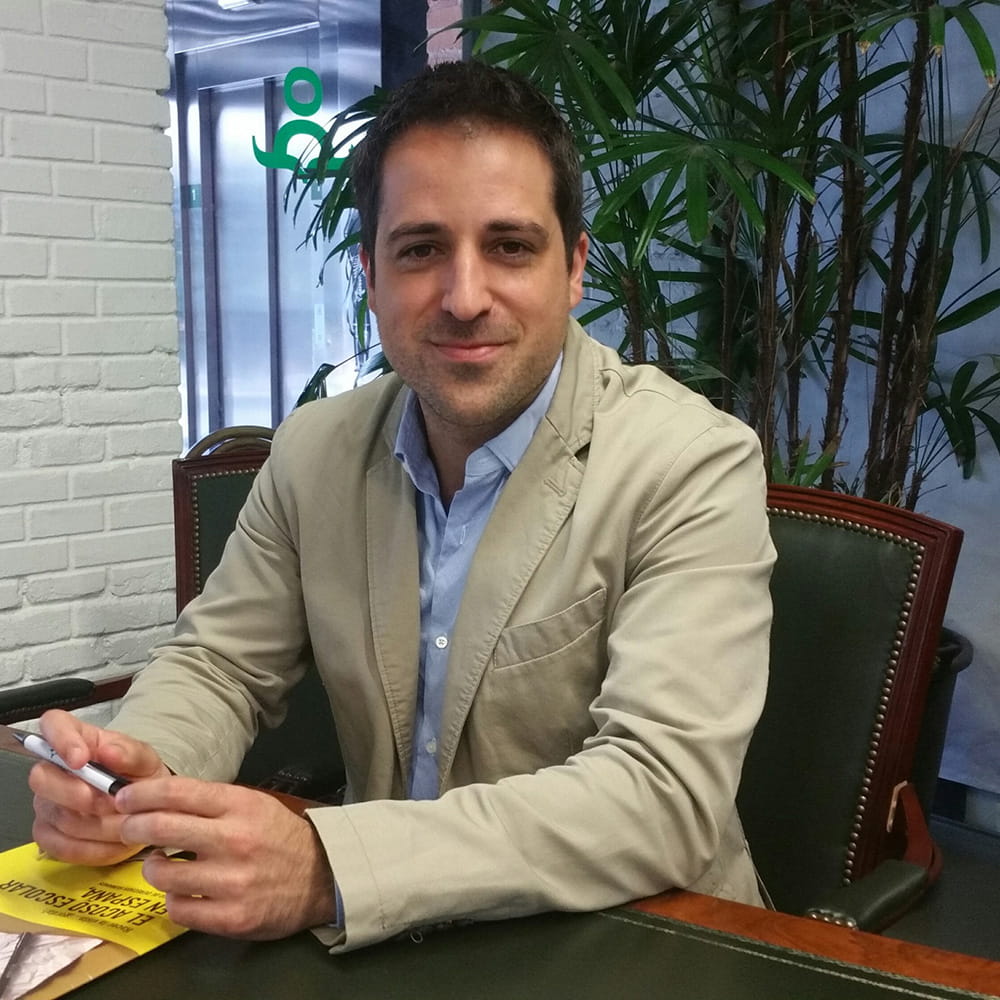

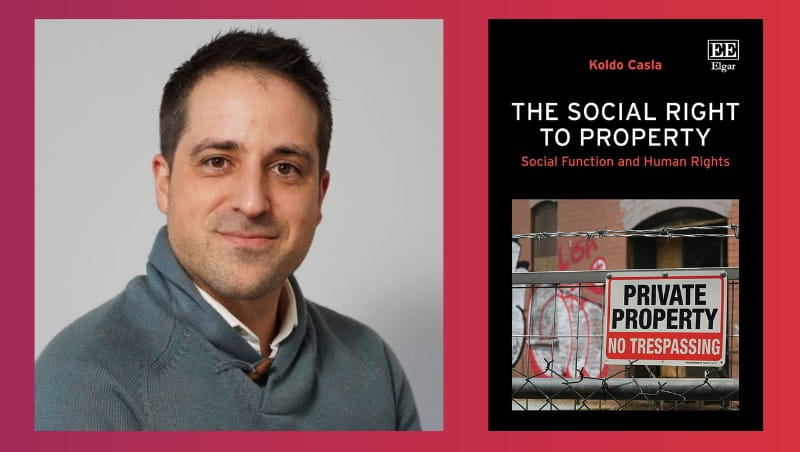
Dr Koldo Casla, Senior Lecturer, Essex Law School, is the author of The Social Right to Property: Social Function and Human Rights, a monograph arguing for a bold new approach to property and social rights.
Supported by the University’s dedicated fund, it was published Open Access (OA) by Edward Elgar and can be downloaded and shared free of charge.
Congratulations! Your book is published both in print and freely available. Let’s dive straight in: how do you define a social right to property? And what form does property take in your study?
In this book I argue that it is time to recalibrate the meaning, scope and limits of ownership in light of all the rights States are meant to respect, protect and fulfil, particularly social rights, like the right to adequate housing, social security and the right to health.
Ownership does not exist in a vacuum. In most instances, it is not the result of mere talent and effort in a framework of equal opportunities. Property is often inherited. And even when it is not, its accumulation relies on infrastructures and policies that enable it in the first place and that rely on the sustenance and support from the collective.
A reinterpretation of property is very much needed, not as an exclusivist, absolutist and individualist right, but as a social right with an inherent social function. Property in general, and private property in particular, is a socially created institution that confers power and is constituted by rules and regulations. This institution serves both individual and social functions. The resources that are owned are inherently limited and scarce, which can lead to various competing claims, both individual and collective. Proper regulation of property is necessary, grounded in a range of values that society aims to uphold through the institutions it creates.
Is the right to property already considered a basic human right, alongside the rights to life, liberty, education, etc?
The right to property is recognised in international law, but it is missing from some treaties where one would expect to find it, and it has been interpreted in a variety of ways by global and regional bodies in the human rights system. That’s why, in chapter 2, I put the international recognition of the right to property between mutism and polysemy. In a way, though, the fact that property is proclaimed in international human rights law plays to our advantage, because so are social rights like housing, health and social security. The challenge lies in developing a holistic interpretation of rights to strike the right balance between them. That’s the aim of the book.
What would be the implication of the social right that you propose?
In chapter 5, I develop a proposal to reinterpret property as a social right with a social function, with five components: a) property is a social right, b) some of the maximum available resources to satisfy social rights are privately owned, c) there is no free abusus under the social right to property (meaning one should have the right to eliminate or destroy the property they own), d) we should reconsider the role and price of compensation for public takings of property when the general interest is the fulfilment of social rights, and e) not all holdings and amounts of property are the same and deserve the same consideration and protection from human rights law.
In chapters 6 and 7, I operationalise these principles in relation to two critically important human rights topics: housing (issues such as empty properties, rent controls and corporate landlords) and the private provision of public services (dealing with privatisation, regulation of international investments, public transport, and the just energy transition).
How would you introduce and enforce the social right to property at the national level?
Both international human rights law and comparative constitutionalism embrace both the right to property and social rights, like housing, health and social security, as human rights. In relation to the former, property is indeed one of the most popular rights, proclaimed in 97% of national constitutions, in 73% of cases with an explicit recognition of some necessary limitations. In relation to the latter, an increasing number of social rights are recognised in one way or another in most national constitutions, and domestic and international courts have applied social rights in different cases and scenarios. In this book, I suggest ways to build on this dual normative recognition to reinterpret property in light of its social function, meaning, the idea that property is meant to serve the individual interests of the owner, but also the general interests of the community in which the owner is operating.
Tell us about the different case studies that you feature. Where were they based and what did they add to your study?
Chapter 3 is devoted to Comparative Law. I went through the full dataset of constitutions in the Comparative Constitutions Project (190+ of them), and I found that 23 States recognise the social function of property explicitly, while 11 more use similar formulations, like ‘social responsibility’, ‘social benefit’ or ‘social obligation’. In addition, I devoted some time to some of the constitutional debates around property in the United States, Canada, Ireland, Germany, Scotland, India, Mexico and Colombia. Far more detailed was the discussion of three examples of constitutional, legal and jurisprudential interpretation of property and its social function in three case studies: South Africa, Spain and Chile. Despite their historical, social and geographical disparities, the three countries provide most valuable insights in relation to historical legacies, land distribution, the use of international accountability mechanisms, and judicial restraint and overreach. The three countries belong to the civil law tradition; South Africa’s legal system is considered mixed, but where private law is based on civil law. Chile and Spain have recognised the social function of property in their constitutions, while it can be deemed implicit in the constitutional interpretation of South Africa’s bill of rights. Finally, they have all signed and ratified the main global and regional treaties in relation to social rights.
The book already has an impressive number of praise quotations from academics literally all around the world. This must be very gratifying, but I expect it also speaks to the very fundamental global aspect of your work?
Thanks very much. The book covers an unexplored area, such as the dialogue between International Human Rights Law, Comparative Law and Property Theory, three subareas of knowledge that have largely ignored one another thus far. I am delighted to see that scholars I have a lot of respect for in these different epistemic communities have read so carefully and seen some value in my contribution. Beyond the book itself, I wholeheartedly believe that the synergy between comparative, philosophical and international legal analysis can help us critique, deconstruct and reconstruct a new idea of property more fitting to assist societies in the satisfaction of social and environmental rights for everyone.
Did you always want to publish it Open Access? Have you published OA before?
Yes, I try to make my research as open as possible. As much as I value scholars engaging with my work, I care very much about disseminating my research beyond academic spaces, to policy circles and with civil society. In this new book, I articulate an unorthodox conception of property, critiquing and seeking to overcome the exclusivist and individualistic conceptions of ownership that have been prevalent historically. It is only fitting that a book that aims to do that should be published with a Creative Commons licence. I did not want the exorbitantly high cost of academic books to become an obstacle.
What advice would you give colleagues who might be considering OA?
I hope Essex will find ways to continue supporting colleagues to publish open access. If the financial support is no longer there, I for one intend to steer my publication plans towards journals that are open access by default. There is a growing number of excellent journals that reject the paywall.
How do you plan to make the most of the open free-to-share aspect of your book? And what do you have planned next?
On 31st March 2026, the UN Human Rights Council appointed me as Special Rapporteur on Adequate Housing. We are living in critically dangerous times for the United Nations' international human rights system, directly under attack by governments and political and economic actors all around us. Today it is more urgent than ever to use the resorts that international law provides us with to promote access to housing as a matter of human rights. I receive the appointment as Special Rapporteur of the UN as a great honour, but above all as a huge responsibility. I will now hold this position independent from the UN and its Member States, but operating from within the system engaging with international agencies, governments, NGOs and other private actors to seek avenues to advance in the progressive realisation of the right to adequate housing. The social function of property will have a central role in these endeavours.
The Social Right to Property: Social Function and Human Rights can be read and downloaded for free.
The University’s OA fund helps Essex academics publish their research Open Access. Funding requests for book and chapter manuscripts that are due to be submitted from August 2026 onward are welcome now – please use this form.