Written by Aigerim Seitenova, LLM International Human Rights Law.
On an unusually hot summer day in July 2021, I was sitting in my room in Wivenhoe, participating in a webinar on the humanitarian impact of nuclear weapons. It was my first public speaking engagement on this topic, although the subject was closer to me than one might think. I was born in Semey (formerly Semipalatinsk), in the north-east of Kazakhstan, just 120 kilometres from a former Soviet nuclear test site, where more than 400 nuclear weapons were detonated between 1949 and 1989.
In 2018, I visited a former Semipalatinsk Nuclear Test Site. At the time, however, it did not spark any interest in working on the issue. I was working as a human rights expert in Kazakhstan, and nuclear weapons were not central to my professional life. While the topic felt distant from my everyday work, it has always been present in my life: in my family’s history and the collective trauma carried by our communities whose lives have been scarred by four decades of nuclear-induced violence.
By 2021, that distance had narrowed. As I was close to finishing my Master’s programme, speaking at that webinar felt very different. Months of conversations with peers about transitional justice and human rights violations around the world, alongside the cases we studied and the knowledge gained through lectures, seminars, and reading, reshaped how I understood my own experience and my community’s long struggle for justice in the absence of meaningful redress and transformative changes in our lives.
That summer, in the tranquillity of a beautiful house in Wivenhoe, I gained an eye-opening sense of the mission I wanted to pursue. It was rooted in my place of birth, in Kazakhstan, where Soviet nuclear testing left long-lasting and devastating consequences for local communities that continue to this day.
More than four years have passed since then. Today, I am a co-founder of the
Qazaq Nuclear Frontline Coalition, which works to
achieve justice for communities affected by Soviet nuclear testing carried out between 1949 and 1989, as well as for the generations that followed.
After graduating and deciding to commit myself fully to pursuing justice for my community, the knowledge I gained in the UK helped me navigate the complexities of the nuclear disarmament field. I approach this work through a human rights legal framework rather than a traditional security lens, as nuclear weapons remain one of the gravest existential threats to humanity. Too often, conversations about nuclear weapons are dominated by narratives of realpolitik and deterrence, framing them as almost necessary for state security and to keep the peace. Far less attention is paid to their real impact on people and communities, particularly those who have borne the catastrophic costs of nuclear testing and production, often marginalised and colonised populations. More than 2,000 nuclear tests have been conducted globally, on indigenous or lands impacted by colonialism and extractivism: the United Kingdom in Australia and Kiribati; the United States in New Mexico and Nevada, on the lands of the Diné (Navajo Nation) and the Western Shoshone Nation, as well as in the Marshall Islands; France in Algeria and Maohi Nui (French-occupied Polynesia); and the Soviet Union in Kazakhstan and Novaya Zemlya, the land of the Nenets people.
My studies, particularly in Human Rights Law, did not simply provide theoretical knowledge; they also encouraged a critical examination of the inequalities caused by human rights violations. My time at the University of Essex was instrumental in shaping my thinking and practice.
Essex Law School and the
Human Rights Centre had modules such as TWAIL (Third World Approaches to International Law), Human Rights and Women, Gender, and Peace, Security and the Law enabled me to critically assess how nuclear weapons, as products of patriarchy and militarism, have dominated global security debates and been glorified as symbols of power and masculinity. This perspective also helped me reflect on how exposure to ionising radiation has affected reproductive health in my community, especially among women.
Bringing these perspectives together and resisting epistemic injustice, I produced my first documentary,
JARA-Radioactive Patriarchy: Women of Qazaqstan. The
film tells the stories of women whose lives have been shaped by forty years of nuclear legacy. It premiered on the 5 March 2025 at the
United Nations Headquarters in New York and has since been screened at Harvard University, across Europe, in Austria, Germany (Hamburg, Bonn, Frankfurt and Berlin), UK (London and Edinburgh including at the Scottish Parliament), France, Switzerland (Geneva and Basel), Norway, Japan (Hiroshima and Tokyo) as well as for students of universities in New Zealand, Canada and South Korea.
In addition to my advocacy work at the multilateral level, engaging with the UN and collaborating with parliamentarians in different countries, I have increasingly focused on national legislation, aiming to secure concrete improvements in the lives of those affected by nuclear testing and to reform existing law that is outdated and leaves many affected groups behind.
Most of the time, communities like mine have been excluded from decision-making spaces, but I see how it has been changing since I joined the field. I am truly inspired by my community and my friends from nuclear-impacted communities around the world. We keep telling truth to power, by fighting not only weapons of mass destruction, but also systems of oppression, such as colonialism, patriarchy, militarism, racism and imperialism, that enabled their existence in the first place. Despite all the obstacles, our resistance is growing, and we use all the instruments we have to fight against it. While writing this blog post, a lot of memories have emerged, and I am proud that my understanding of the mission I am currently serving was born in that cozy room in Wivenhoe.
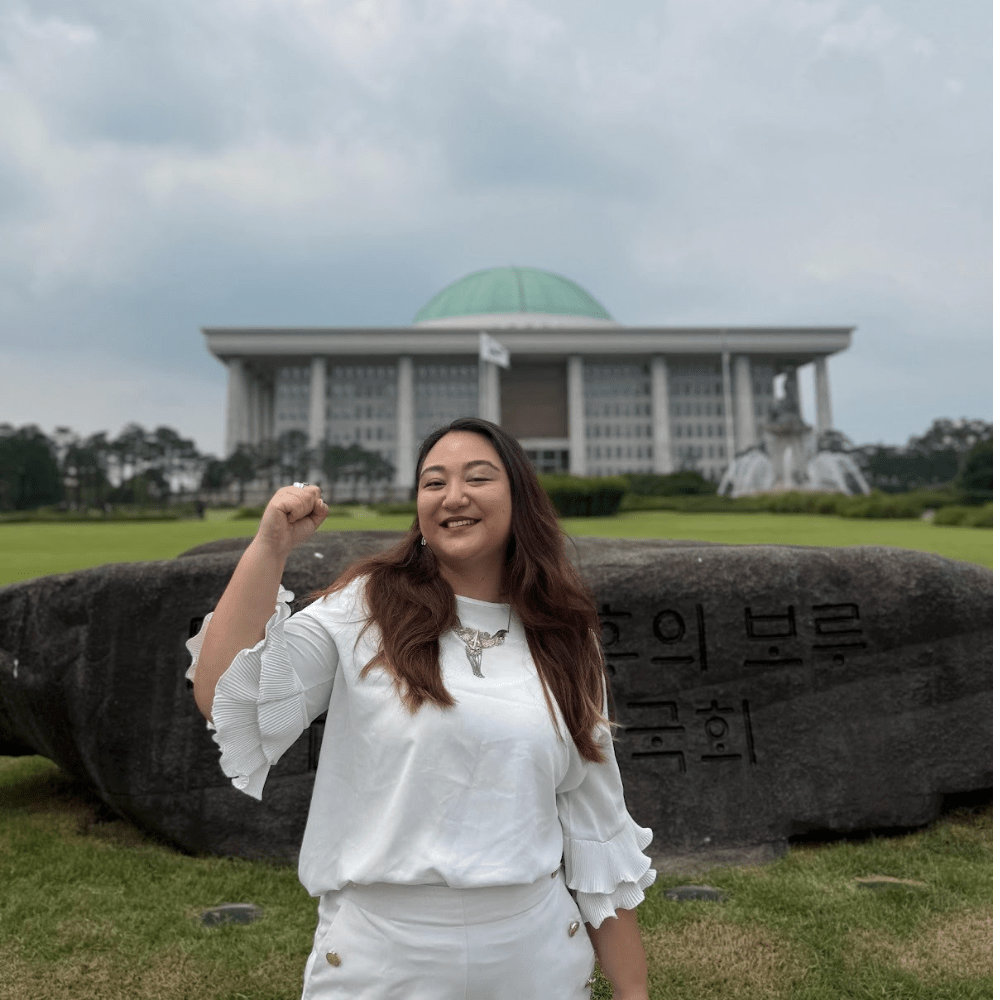
Pictured: Aigerim Seitenova, Co-Founder, Qazaq Nuclear Frontline Coalition, Author of the documentary ‘JARA-Radioactive Patriarchy: Women of Qazaqstan.