Counting What Counts: Research Impact and the Quantified World of Work

Success in contemporary academia is often narrated through metrics: citations, grants, rankings, outputs. The career of Professor Phoebe V. Moore clearly demonstrates success in metric terms, but also in a markedly different orientation to success, one grounded in intellectual critique, political engagement, and sustained collaboration with international organisations, governmental bodies, and overall, worker representative groups. Moore does not just analyse the quantified world of work. She actively intervenes in how that world is governed.
Across more than two decades of scholarship, policy engagement, and public intellectual work, Moore has developed a distinctive and influential body of research focused on labour, power, and technology. Her success lies not only in academic recognition, but in shaping how institutions, regulators, and trade unions understand, adopt, and contest digitalisation at work.
Degrees and Early Trajectory
Moore’s academic formation spans sociology, management, and digital political economy. Moore completed her bachelor’s degree in Sociology, with minors in Spanish and Racial & Ethnic Relations, at the University of Texas at Austin. This early grounding in social inequality, race, and labour relations would later become central to her critical engagement with digitalisation and work.
Moore completed her MA, funded by the Monbusho scholarship, in Asia Pacific International Relations at the International University of Japan, Niigata. Dedicated to study, Moore went on to gain a PhD funded studentship in the discipline of International Political Economy, at the University of Nottingham. Moore’s doctoral work examined globalisation, labour governance, and power, focussing on South Korea.
Moore’s concerns about recurrent crises for the world of work due to global shifts, would soon be articulated through the lens of digitalisation, which she began to write about during her ESRC Postdoctoral Fellowship which she did at the University of Manchester. This competitive Fellowship enabled Moore to consolidate her critical approach and establish herself as as a digital labour researcher.
Professorship, Institutional Leadership, and Editorships
Since the 2nd of May 2022, Moore has been working in the position of Professor of Management & the Futures of Work at the University of Essex, Essex Business School. Alongside teaching, MA and doctoral supervision, Moore is the School Director of International Partnerships, Research. To identify differences in policy approaches to AI across various governments internationally, Moore founded the Essex AI Policy Observatory for the World of Work (E-AIPOWW), where several Essex colleagues from Essex Business School, Essex Law School, as well as several international researchers, make up the the seven jurisdiction teams (India, Canada, Brazil, China, USA, UK, and the EU). The Observatory features regularly updated reports on the state of play on AI and a Tracker comparing governments’ activities.
Moore is CoDirector for the Centre for Commons, Organising, Values, Equalities and Resilience (COVER) and in this role, she founded the Cluster for Critical Studies in AI And Digitalisation (CSAID); and leads the in-person AI Rights and Wrongs research seminar series as part of the COVER events calendar.
Moore is the Founding Editor, and Chief Co-Editor of Global Political Economy (until 2026), and serves on several other editorial boards.
All these roles reflect a form of success centred on impact for institution-building, where she actively creates platforms for critical scholarship and sustaining spaces for perspectives within digital political economy and management studies.
Visiting Professor Award
In Autumn 2025, Moore was awarded the Otto Mønsted Visiting Professorship at Copenhagen Business School (CBS). Hosted within the Law Unit of Business, Humanities and Law (BHL) at CBS, Prof Moore taught on the module Datafication, delivered seminars on the work she is doing on AI Standards setting, trade union engagement, and worked on her new theory of digitalised consent.[1] This awarded Visiting Professorship signals international recognition of Moore’s work beyond disciplinary boundaries, underscoring its relevance to law, policy, and business education.
The Quantified Worker and Critical Political Economy
Moore is widely recognised for her pioneering work on quantification at work. Long before ‘people analytics’ or ‘algorithmic management’ were widely known activities and terms, Moore was examining how workers were being transformed into data subjects, rather than workers with autonomy and agency, and productivity into optimisation targets.
Moore’s third single-authored book, The Quantified Self in Precarity: Work, Technology and What Counts [2] represents a major scholarly success. The book challenges celebratory narratives of self-tracking and workplace analytics, demonstrating instead how these systems intensify precarity, reshape subjectivities, and displace responsibility onto workers themselves and away from structural and material conditions.
Rather than treating quantification as neutral or inevitable, Moore situates it within a political economy of power, management control, and labour discipline. The book’s influence is reflected in its wide uptake across sociology, management, law, and policy studies, contributing to Moore’s citation count which sits at over 3,000 in early 2026 [3].
Algorithmic Management with Emotion Recognition
Moore has been documenting how biometric data, sentiment analysis, and behavioural nudging are being deployed within organisational settings since 2016. By foregrounding affect as a site of extraction, Moore’s work has helped reframe debates about AI at work, challenging assumptions that emotional and other forms of biometric data is benign. Moore published, in Body and Society, [4] an important piece that looks at the Quantified Workplace experiment at a multinational company based out of Rotterdam. Moore was awarded a grant to observe how workers responded to a self-tracking data sharing exercise in 2019. Her findings demonstrated how emotions are becoming increasingly understood as pertaining to work, but that quantifying emotions is both difficult and potentially, dangerous, when it comes to separating work from life.
Moore’s more recent contribution on emotion tracking is her conceptualisation of ‘algorithmic affect management’, developed with colleagues Gwendolin Barnard and Anna Thomas for the Institute for the Future of Work, where Moore is a Senior Fellow. Data on Our Minds’ [5] success lies in its interdisciplinary reach and policy relevance because it extends debates beyond task allocation and productivity monitoring. It examines how emerging technologies increasingly target workers’ emotional and psychological states. Moore was then quoted in The Observer in August 2025 on these topics.
Funded Research and Collaborative Leadership
Moore has led and co-led numerous externally funded projects for organisations including the European Commission Directorate-General for Employment, Social Affairs and Inclusion [6]; the European Agency for Safety and Health at Work on AI and OSH [7] and AI and robotics and OSH [8]; and now is working on projects funded by the Biotechnology and Biological Sciences Research Council on the project with Essex researchers called EyeWarn, and the FemLab@AI project funded by the Cariplo Foundation.
Moore’s success as a Principal and Co-Investigator lies not only in funding acquisition, but in building interdisciplinary teams, mentoring early career researchers, and producing outputs that are both academically rigorous, impactful, and politically meaningful.
From Scholarship to Regulation: European Impact
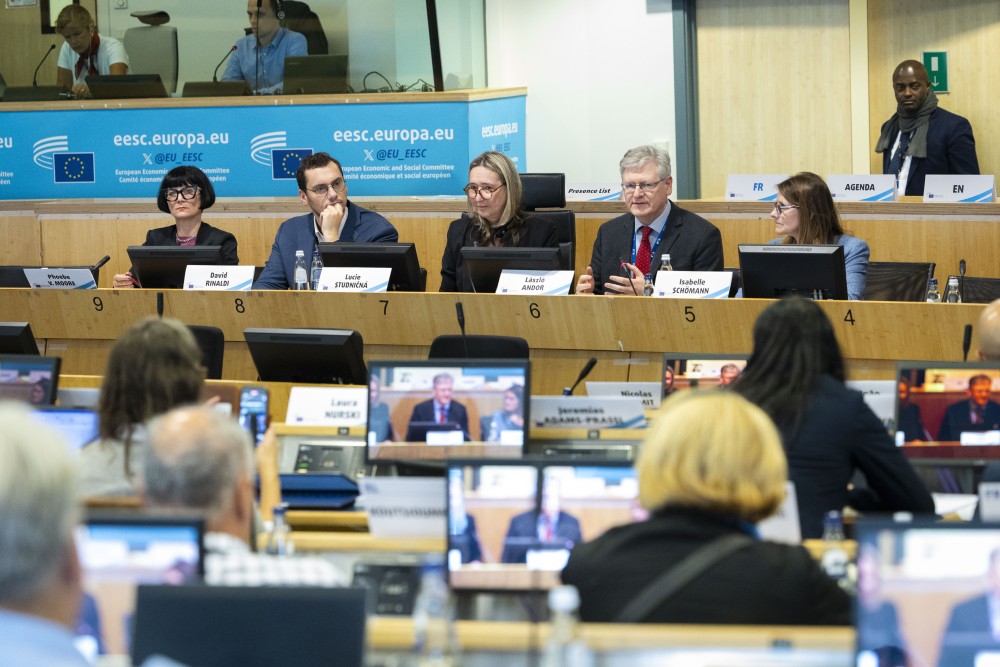
A defining feature of Moore’s career is her sustained engagement with European and international institutions. From 2025–2026, she is serving as the European Trade Union Confederation (ETUC) representative on the European Commission’s mandated work on harmonised technical standards for the AI Act, operating through CEN-CENELEC processes. See Moore's website for some of her insights from Standards setting work.
Moore represents workers’ interests within highly technical standard-setting arenas that have historically marginalised labour perspectives. This appointment reflects long-standing trust between Moore and trade union organisations, as well as recognition of her expertise in AI governance. Indeed, this exemplifies Moore’s broader success, where she aims to ensure that workers’ fundamental rights are embedded within the technical architectures of regulation, rather than treated as secondary considerations.
International Labour Organization and Convention No. 190
A consequential impact of Moore’s research has been her collaboration with the International Labour Organization, particularly through ACTRAV and the Research Department. Moore’s 2018 ACTRAV commissioned report, The Threat of Violence and Harassment in the Digitalized World of Work, [9] was a foundational document in the deliberations leading to ILO Convention No. 190 on Violence and Harassment at Work.
From 2022, Moore worked with Dr Ekkehard Ernst in the Unit of Macroeconomics, Policy and Jobs. Moore aided him and the Work in the Digital Economy (WiDE) group in setting up the ILO’s AI Observatory. Later, Moore set up the Essex Observatory [10] and published the country reports and Trackers, and E-AIPOWW’s Observatory in Global Political Economy Symposium in GPE, with Dr Ekkehard and all country teams.

European Union Influence
As Principal Investigator for the European Parliament STOA report Data Subjects: Digital Surveillance, AI and the Future of Work, [11] Moore led a comprehensive analysis of workplace surveillance, data protection, and workers’ rights. Moore’s Report challenges the tendency to conflate workers with consumers in data protection debates, demonstrating how employment relationships fundamentally alter the meaning of consent and privacy. Her success lies in reframing the policy term ‘data subjects’ as labour subjects, where her point is that work is a subjective condition as well as objective, and that workers’ right to have subjectivity is reducing, as objective, quantification of work conditions are mounting.
Rethinking What Success Means
Professor Phoebe V. Moore’s career challenges conventional academic narratives of success. Rather than relying on technological optimism, Moore’s work consistently represents the voice of workers, navigates expanding regimes of surveillance, quantification of work and affect, and identifies how theory and practice are changing in the context of affect and algorithmic management.
Moore’s success lies in refusing depoliticised accounts of technology, insisting instead that digital systems are always social, always political, and always contested. By connecting rigorous scholarship with regulatory impact via worker representation, Moore is ensuring that ‘what counts’ in the digital world of work is decided in democratic and just ways.
References
- See: Moore, P. V. (2023). Workers’ right to the subject; Moore, P., Bloom, P., Nunes, R. (2025). Consent, coercion, colonialism: A manifesto for digital rights from the left, accepted for publication Globalizations (in press); and Moore’s Global Political Economy Handbook chapter, P. Moore (2023) Problems in protections for working data subjects: Becoming strangers to ourselves.
- See: Moore, P. V. (2019). The Quantified Self in Precarity.
- See: Moore’s Google Scholar.
- See: Moore, P. V. (2018). Tracking Affective Labour for Agility in the Quantified Workplace. Body & Society, 24(3), 39-67.
- See: Moore, et al. (2024) Data on our Minds and Algorithmic Affect Management.
- See: Legal and Social Study of Algorithmic Management DGEMPL.
- See: Moore, P.V. (2019). Risks and Benefits of AI and OSH, European Agency for Safety and Health at Work (EU OSHA)
- See: Cognitive Tracking and Robotics. EU OSHA.
- See: OSH Risks in Digitalized Work.
- See: E-AIPOWW team.
- See: European Parliament STOA: Data subjects, digital surveillance, AI and the future of work. European Parliament DG for Research Services.