Detention and the Right to Liberty: Addressing Gaps in Protection at the European Court of Human Rights Q&A



Detention and the Right to Liberty: Addressing Gaps in Protection at the European Court of Human Rights, by Sabina Garahan (Essex Law School), was recently published Open Access by Routledge.
The book can be downloaded, free of charge.
Dr Garahan’s research acknowledges the support of UKRI funding, which now requires Open Access publication of long form works (monographs, chapters, edited collections) published on or after 1 January 2024. UKRI established a process for this which begins with checking a work’s eligibility and concludes with refunding a fixed amount of the Open Access publication charge after publication.
For the entire process, though, authors need the support of their institutions as only they can liaise with UKRI, pay a publisher’s Open Access fee, and arrange the (limited) refund. At the University of Essex, the Open Access team is happy to do this work on behalf of our authors.
Dr Garahan’s monograph is the first Essex publication to complete this new UKRI process.
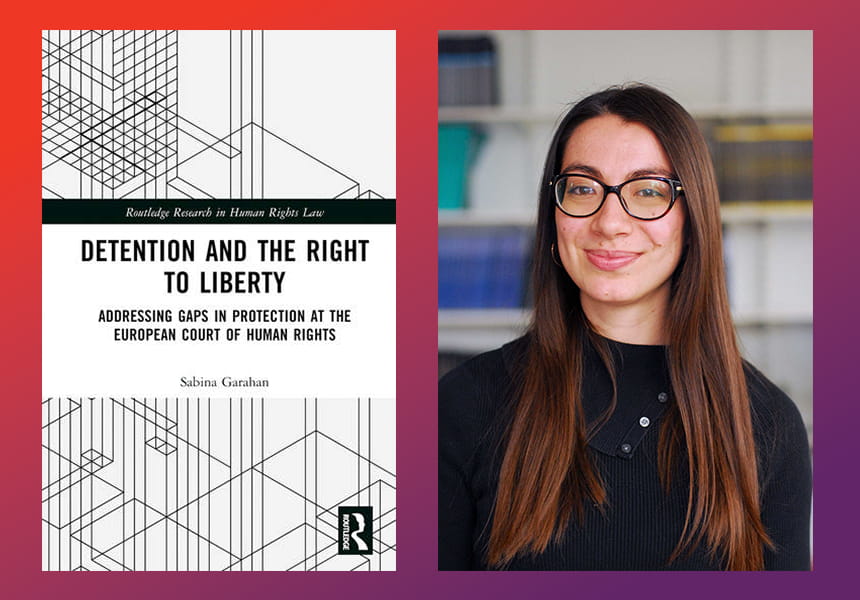
Double congratulations are therefore due! How does it feel to see your work online and in print at last?
Thank you! I’ve had these ideas in my head for such a long time that being able to see a published version of them is really exciting. It’s especially rewarding to share my work with those I’ve kept in mind throughout the process. These range from the European Court of Human Rights judges who I interviewed as part of the research (one of whom was kind enough to write the book’s foreword) to those working to defend detainees’ rights. I’ve long thought about how best to share my key findings so that the ultimate goal of writing the book – improving the protection of rights in detention – can be met. Going through those vital steps now reminds me of why I wrote the book in the first place. I also dedicated the book to my parents, and having them see that in print was a really special moment.
As the first to successfully complete it, how did you find the UKRI route to Open Access?
It all ran very smoothly – an answer I wouldn’t be able to give without the Open Access team at Essex, who were brilliant throughout. They answered any questions I had so I knew exactly what was happening at each stage. When I’ve presented the book at conferences or events, and people ask where they can get a copy, it’s great to be able to just direct them to a free online link. So the process was absolutely worth it!
Your book focusses on how the European Court of Human Rights interprets the European Convention on Human Rights, specifically Article 5. Please tell us about Article 5.
Article 5 is the Convention provision that enshrines the right to liberty and security – one of the most fundamental human rights which appears in every major human rights treaty. A person who is detained, in whatever context, is entirely under the authorities’ control. It’s therefore crucial that Article 5 provides the strongest possible protections to prevent any abuses, especially since arbitrary detention itself often leads to further human rights breaches, including torture and repression of dissent. In the book, I identify gaps that have arisen in the protection that Article 5 provides, and develop an original framework aimed at strengthening the capacity of Article 5 to guard against arbitrary detention.
You suggest that Article 5 remains “a largely underdeveloped and unexplored area of European human rights law”. How so, with what consequences, and who could suffer most as a result?
There is a prevailing view that the right to liberty is set in stone – that it is constant, and unaltered by societal change. This is because Article 5 only permits detention in a limited set of circumstances. As a result, the Court does not consider it to be a right which needs updating in the same way as, for example, the right to family life (protected by Article 8) which has developed in line with changing ideas of what family means.
My book reframes Article 5 and explains why a similarly progressive interpretation of the right to liberty is not only preferable but in fact necessary to maintain the right’s effectiveness. Conceptions of justifications for detention have progressed since the Convention was adopted in 1950 – Article 5 must progress with them. The consequences of neglecting this kind of progressive (or evolutive) reading of the right to liberty has led to significant gaps in protection. Those who have suffered – and continue to suffer – include individuals held pre-trial, as children, in immigration detention, following protest, or as a result of their political dissent or human rights activism. The Court has not developed its Article 5 review by considering the shifting contexts or specialised research linked to those areas, which may affect whether or not it views detention as justified. Since it has failed to adapt, Article 5 has become weakened in its ability to protect against arbitrary detention in modern societies across Europe.
How do you plan to take advantage of your book being Open Access?
My goal in writing the book was to draw attention to the ways in which protections against arbitrary detention have ceased to be effective. At the same time, I wanted to show that there is a solution. In doing so, I hope to empower rights advocates, lawyers, and policymakers with knowledge of both the gaps and opportunities in the European human rights law on detention. Having the book published Open Access means a greater number of people, in a wider range of countries, will be able to use the research to effectively challenge arbitrary detention. I’ve already taken advantage of this in the way I’ve begun to disseminate the book’s findings – for example, by delivering a session to members of Fair Trials’ LEAP network, which brings together lawyers and advocates from across Europe.
Do you use Open Access materials in your teaching?
Absolutely – including those written by my brilliant colleagues. For example, this year, I was able to add Professor Carla Ferstman’s book on arbitrary detention to a reading list for the Foundations of Human Rights module.
What’s next for you? Do you have any new projects lined up?
My book’s subtitle refers to “addressing gaps in protection”, which is what all my projects aim to do. Unfortunately so many gaps remain in upholding detainees’ rights that the prospective list of projects is endless! In building on the research in my book, I’m currently looking at how we can respond to increasing and alarming tendencies among States to detain migrants for populist aims. I am also exploring how the European human rights system could be reframed to offer greater protection of the right to life, to ensure more effective suicide prevention in custody.
Detention and the Right to Liberty: Addressing Gaps in Protection at the European Court of Human Rights is available now to download free of charge.
Want to know more about UKRI’s Open Access requirements? Start on the Library’s information pages.