Research participation: Current opportunities
Current studies are listed below. There is an associated email list and Essex users can register on the "participants" list.
If you are not a member of staff or a student at the University of Essex and wish to be added to the email list please contact us.
If you are a researcher seeking participants and you would like to advertise your study on this page, please complete the request form and send it to reo-governance@essex.ac.uk.
Take part in a research project
Psychologists’ Perspectives on Client Psychedelic Use
Information about the study
A study exploring clinical approaches to a working with a hypothetical client reporting psychedelic experiences.
Eligibility/criteria for taking part
- Trainee and qualified clinical/counselling psychologists in the UK are eligible.
What the participants have to do?
The study involves a 10 to 15-minute online survey with a chance to win one of ten £50 vouchers.
How do participants take part and who should they contact?
Participants can take part online.
Please contact Alex Irvine if you require any further information.
Ethical approval
Ethical approval was granted by the University of Southampton Research Ethics Committee (Ref: ERGO 113763.A1).
Data collection period
Study runs until 27 September 2026
Overnight sleep monitoring with wearables (PRISM)
Information about the study
This study will assess how accurately commercial wearable devices track sleep in young adults (18-30 years), by comparing it with gold-standard sleep laboratory measurements (polysomnography, or PSG). It requires participants to spend one night in our sleep laboratory, sleeping while wearing several tracking devices as well as PSG.
Eligibility/criteria for taking part
Participants must be aged 18–30 years and NOT require medication to fall asleep, experience night terrors or sleepwalking, have a severe sleep disorder requiring treatment, have a skin condition that prevents the use of wristworn devices or disposable gel electrode stickers, or be experiencing an acute mental health crisis. Following a 30-minute screening survey for eligibility, participants may be invited to choose a night in September / October for sleeping in the lab. Each participant will receive £70 in vouchers as a thank-you for their time and participation in the overnight study. Participation is entirely voluntary, and choosing not to take part will not result in any disadvantage.
What the participants have to do
Participants will complete a screening questionnaire and, if eligible, attend an overnight sleep recording session at the University of Essex iSpace sleep laboratory. During the session, participants will wear commercial sleep-tracking devices alongside professional sleep monitoring equipment (polysomnography, or PSG). Sensors will record brain activity, eye movements, muscle activity, heart activity and breathing while participants sleep. The research team will explain the procedure, help fit the equipment and monitor the recording overnight. These recordings will allow researchers to compare the wearable devices with laboratory sleep measurements.
How do participants take part and who should they contact?
To express interest in taking part, potential participants should complete the PRISM sleep study contact form, following which they will be sent a personalised link for the screening survey. The research team will review their responses and contact eligible participants with further information and to arrange an overnight session.
For questions or help with the form, they can contact SleepLab.
Funding
This project is funded by a University of Essex Innovation Fund (RCP 19996).
Ethical approval
This project has been reviewed on behalf of the University of Essex Ethics Committee, and had been given approval with the following Application ID: ETH2526-0808.
Data collection period
The end date for the study’s data collection period: October 2026
Developing and Validating a Perinatal Mental Health Questionnaire for Neurodivergent Women and Birthing People
Information about the study
Some people who have babies experience mental health challenges during the perinatal period (from the start of pregnancy until a year after the end of pregnancy). Currently the questionnaires that are used to check for mental health challenges during the perinatal period were developed based on the experiences of neurotypical people, meaning people who are not autistic and do not have ADHD. There is no questionnaire to check for mental health challenges during the perinatal period in neurodivergent people. This may make it harder to spot mental health issues, meaning they may not be getting the support they need when they need it most.
The purpose of this study is to develop and test a new questionnaire to check for mental health challenges during the perinatal period in autistic and ADHD people. The study has two goals: 1) to create a questionnaire based on the experiences of autistic and ADHD people, clinicians, and existing research; 2) to test how well this new questionnaire works.
Eligibility/criteria for taking part
You can only take part in this study if all of these statements apply to you:
- You are at least 18 years old
- You are currently resident in the United Kingdom
- You identify as a woman or birthing person
- You have experienced perinatal mental health challenges over the past year (Please note that we define perinatal mental health challenges as emotional or psychological difficulties that can happen from the start of pregnancy, up to one year after the end of your pregnancy.)
You do not have to identify as being neurodivergent/autistic/ADHD to take part.
What the participants have to do?
This study will require you to answer a series of questions including general questions about yourself as well as questions about your mental health. You will also be asked to complete some questionnaires examining autism and ADHD characteristics.
This is an anonymous survey; no identifying information will be collected meaning you cannot be recognised from your responses.
The survey should take around 15-20 minutes to complete. You will need to complete the survey in one sitting as answers cannot be saved as you go, so please start when you think you will have the time to complete it.
On the final page of the survey there is a link which will take you to separate page where you can choose to provide your email address to opt-in to a prize draw to win one of four £25 shopping vouchers and for contact if you would like to hear about the results of this study. Your email address will be held separate to your survey responses meaning your responses remain completely anonymous.
How do participants take part and who should they contact?
To take part, complete the online survey
If you have any questions regarding your participation in this study, then you can contact Valeria Garau or Seonaid Cleare (supervisor).
Ethical approval
Ethical approval has been granted by the University of Glasgow College of Medical, Veterinary, and Life Sciences ethics committee, Ref. 200250182.
Data collection period
The expected end of the data collection period will be May 2027 at the latest.
Intersectionality as a source of strength: exploring the experiences of queer trainees of the global majority within clinical psychology
Information about the study
This study is looking at the inherent strengths’ trainee clinical psychologists’ hold, because of marginalised experiences of being both queer and of the global majority (GM). Current literature looks at marginalised experiences, from a deficit perspective and this project will be part of reframing this narrative, to explore the positives gained from intersectional identities.
The Clearing House for Postgraduate Courses in Clinical Psychology (CHCCP) Equal Opportunities data for 2024 entry show that 23.3% of current second-year trainees identify as lesbian, gay or bisexual (LGB), and 25% identify as being from a global majority ethnic background (CHCCP, 2024). The Clearing House does not currently collect data on transgender identity; however, this study welcomes participants from transgender communities as well as those from global majority backgrounds. These figures highlight that a substantial proportion of the future clinical psychology workforce belong to communities that may experience marginalisation.
The aims of this study are:
To explore the inherent intersectional strengths held by clinical psychology trainees who identify as the global majority and queer.
To explore how their lived experience of marginalisation has impacted their experience on training.
To inform future research on Intersectionality, specific to exploring the strengths within the GM-queer population and how this can inform clinical work to focus on the protective factors and strengths that clients hold.
Eligibility/criteria for taking part
You have been invited to take part in the study because you self-identify as a:
“Global majority” - people from Black, Asian, Brown, dual-heritage, Indigenous Global South backgrounds, people of colour only.
Member of the queer community (not heterosexual).
Current trainee clinical psychologist on either 1st, 2nd or 3rd year of training
On a UK Doctorate in Clinical Psychology (DClinPsy) programme
What the participants have to do?
What will happen if I take part?
First, you will be asked how you self-identify with regards to your ethnicity, gender identity and sexuality. It will also ask for your pronouns and preferred name, which will be used throughout the interview.
Screening Questionnaire
As part of this study, I will ask you a question from the Patient Health Questionnaire-9 (PHQ-9) around thoughts of self-harm or suicidal ideation. This will be used to determine risk and determine your eligibility for participation. Your response will be reviewed by the researcher, and you may be asked a follow-up question to determine if the study is appropriate for you.
If you are not eligible to take part after completing the questionnaire, you will be informed promptly and provided with a debrief form containing further information and relevant support resources.
If you are eligible, you will be invited to a 1:1 interview with the researcher. This will be conducted online via Microsoft teams. If you prefer, you can opt to have your camera off to protect your anonymity. The researcher will have their camera on. You will then be asked a series of questions regarding your experiences of marginalisation as a queer, GM individual, what strengths you believe you have gained from this and how this has impacted your training. The interview format is semi-structured so follow up questions may be asked depending on what you say. This will take approximately 1 hour to complete.
The interviews will be recorded on Microsoft Teams; however, this will only be done with your consent, and you will be made aware of when the recording starts. You will be reminded of the right to withdraw at any point during the interview and be reminded you can take regular breaks if needed. An activation warning prior to starting the interview will also be made, stating that the nature of marginalisation can be emotive and you will be reminded to only share what you are comfortable with sharing.
How do participants take part and who should they contact?
If you would like to take part, please email the researcher Jess Wood, (DClin trainee at Exeter), who will be able to send you further information.
Ethical approval
This research has been approved by Psychology Research Ethics Committee (PREC) at the University of Exeter. The Application ID number is 11470096.
Data collection period
Data collection period ends on September 25th 2026.
From The State as Parent, to Becoming a Parent: How care experience shapes the meaning-making of parent-child relationships
Information about the study
The study explores how adults who grew up in state care make sense of their children and their own parenting, and how these meanings are shaped by their experiences of being parented by the state. The research aims to better understand parent–child relationships among care-experienced parents, with particular attention to attachment, meaning-making, and growth after trauma.
Eligibility/criteria for taking part
I am recruiting adults who grew up in state care for 5+ years and now have biological children who are under the age of 18.
What the participants have to do?
It is up to 90 minutes semi structured interview either online via Teams or face to face, depending on their preference
How do participants take part and who should they contact?
Or email the lead researcher
Ethical approval
Ethics approval for this study listed below has been approved by the Health, Science, Engineering and Technology Ethics Committee with Delegated Authority.
Study Title: From State as Parent to Becoming a Parent: How care experience shapes the meaning-making of parent-child relationships
Your UH protocol number is: 1937 ST HSET 2026
Data collection period
From August 2026 until January 2027
The Organisational and Individual Benefits of Mature Students: A Quantitative HR Research Study of Human Capital Development and Knowledge Transfer.
Information about the study
It forms part of my research for my dissertation for my MSC in Human Resource Management. I will be researching mature students and their benefits to their organisation and themselves of being a mature student
Eligibility/criteria for taking part
You will need to be a either a current mature student or studied previously as a Mature Student in the UK. There is an online Questionnaire via Qualtrics to complete .
You will be asked about the effect of HE study on you as a mature student, what knowledge or skills you were able to acquire and what HR and Manager support you did (or did not) receive as a Mature Student.
What the participants have to do?
Answer a short anonymous survey which takes about 10 minutes.
Participant Information Sheet (.pdf)
How do participants take part and who should they contact?
Participate via Qualtrics online survey
Researcher : Teresa Alvarez
Ethical approval
My application was reviewed and approved by Ethics Sub-Committee at the University of Essex.
Ethical Approval number : ETH2526-1106
Data collection period
15th August 2026 ( may be extended by a further week to generate additional responses)
A longitudinal study exploring key psychological mechanisms of resilience in mental health practitioners
Information about the study
The purpose of the study is to better understand work-related stress and levels of resilience amongst mental health practitioners. Around 70-75% of mental health professionals report finding their jobs stressful. If unaddressed, work-related stress can lead to many negative consequences, including burnout, which can have a significant impact on the physical and mental wellbeing of practitioners. Given this, the study aims to explore which psychological processes are associated with levels of resilience amongst individuals working in the mental health profession. By understanding which psychological processes help to promote resilience in mental health practitioners, we can then develop interventions to reduce stress and increase resilience in mental health professionals experiencing high levels of work-related stress.
Eligibility/criteria for taking part
We are seeking both trainee or qualified practitioners in Clinical Psychology or High Intensity Cognitive Behavioural Therapy (CBT) who are aged 18 years old or above working part-time or full-time in the NHS or a service treating NHS patients (e.g., Any Qualified Provider service). Participants must be currently working (e.g., not retired, on long-term leave, or interrupting their studies). To ensure that participants are in clinical practice, they must deliver at least three individual clinical sessions per week. Participants must be based in the UK, have normal or corrected-to-normal vision, and be fluent in English.
What the participants have to do?
If you choose to take part in the study, you will be invited to complete an online survey containing a series of questionnaires and a task. The online survey will take approximately 30 minutes to complete.
The questionnaires will include questions on work-related stressors and resilience. The task will require you to unscramble a set of words to make sentences. Some questionnaires will consist of answering questions about feeling stressed, worried, or low in mood.
Four months after completion of the first set of questionnaires, you will receive an email from the research team containing the link to a follow-up survey. The follow-up survey can be completed online and will take approximately 15 minutes to complete. It will include similar questionnaires to the ones presented in the first survey. The research team may send you reminders to complete the online survey via email.
After you have completed the second survey, you will be provided with further information regarding the aims of this study.
To thank you for your time and contribution towards completing the initial survey, you will be offered the chance to be entered into a prize draw to win an online shopping voucher worth £50, £75, or £100.
There will be a further incentive once you complete the four-month follow-up survey. If you decide to enter the prize draw for this survey, you will have the chance to win an online shopping voucher worth £75, £100, or £150.
How do participants take part and who should they contact?
If you would like to take part in the study, please email Yogini Sawjani
You can also complete the initial survey via the link.
Ethical approval
Ethical approval was granted by King’s College London Research Ethics Committee on 19th November 2025. Ethical Approval Reference Number: HR-24/25-52837
Data collection period
Data collection is due to end on 28 February 2027
Testing elements of gamification of the Understanding Society Youth Panel Questionnaire
Information about the study
One of the biggest challenges to collecting data is recruiting and retaining participants, this is especially true for young people. We would like your child’s expert opinion on how we can encourage young people to participate in surveys and whether inclusion of gaming elements may be one way to increase participation. Gaming elements can range from inclusion of emojis or photos to including simple games or rewards for answering certain questions to developing avatars and worlds through which participants travel. The primary objective of this project is to better understand how different gaming elements may improve survey participation amongst young people and what, if any, impact the gaming elements may have on how young participants answer questions. You will be involved in the first step of this project by participating in workshops that will explore motivations for participating in surveys, the types of gaming elements that could be included in surveys to increase their enjoyment of participating, and to discuss how certain gaming elements may influence how young people might answer certain types of questions.
Eligibility/criteria for taking part
- Young people between the ages of 10-15
- Parents/guardians/caregivers are able to provide informed consent
- Child must be able to speak English
- Child has access to a device with a webcam for the workshop
What the participants have to do?
If your child takes part in this study, they will participate in an online workshop with 5 other young people of similar ages to discuss gamification and design gamification activities for a survey. The workshop will take about 1 hour to complete and they will receive £20 for participating.
How do participants take part and who should they contact?
If you are interested in your child participating please contact Pedram Allah Veysi.
Funding
ESRC (externally funded) - Grant Number: ES/Y003071/1
Ethical approval
This study has been approved by the University of Essex Ethics Committee, ERAMS Reference ETH2526-0118.
Data collection period
Data will be collected through August 2026.
Develop novel and holistic assessment to enable evidencing of the success of Simply Stride’s innovative movement-based well-being intervention
Information about the study
Simply Stride have been running a successful, unique walking programme. The programme improves walking posture by combining yoga, pilates and mindset techniques into a single walk-based training. Practitioners of this programme apply this training daily to achieve sustainable physical and mental wellbeing. As the programme directly targets both physical and mental well-being we want to evidence and provide data on whether well-being, vocal and movement-based outcome measures show change across a 4-week session of the Simply Stride programme.
Eligibility/criteria for taking part
People who are aged between 30-60, able to complete a 1- hour walking programme, do not have a musculoskeletal or neurological condition or a diagnosed speech disorder, and have not had any injuries in your lower limbs in the last 6 months.
What the participants have to do?
Participants will be randomly assigned either to the Simply Stride walking programme or to a control group. Those in the walking programme will attend two 1‑hour walking sessions each week at Saltwater Café in Chalkwell across specific Wednesday and Saturday dates in September and early October. Control group participants will not take part in walking sessions during the study but will complete the same assessments at the start and end, and will be offered the walking programme later in November and early December. All participants will attend the Human Movement Lab at the University of Essex before and after the 4‑week period to complete questionnaires on health and well‑being, a vocal assessment using a small microphone, and a series of balance, walking and heart‑rate assessments. These include wearing heart‑rate leads, performing balance tasks on a force plate, and completing walking and daily‑living movement tasks while retroreflective markers are attached to specific body landmarks. Each movement task is repeated several times, with rest provided as needed. For each assessment at the University of Essex you will be offered £25 per visit for your time at the assessment. We will also offer travel reimbursement costs for up to £55 per visit. Each assessment session lasts around two hours, and all data will be collected by Mahbi Razavi.
How do participants take part and who should they contact?
Your data will be collected by Mahbi Razavi on the day. For any further questions, please contact Mahbi
This study is being funded by the University of Essex Innovation Fund (RCP20131)
Ethical approval
The project underwent ethical review (reference ETH2526-0955) and a favourable ethical opinion by the University of Essex Ethics Committee was received.
Data collection period
8 September for the first round and 18 October for the second round of data collection.
Evaluating an Online Self-Help Program Combining Education and Self-Compassion for People with Psoriasis
Information about the study
This study is being conducted as part of a Doctorate in Clinical Psychology and aims to evaluate a new online self-guided programme designed to support people living with psoriasis. The programme combines self-compassion approaches, psoriasis education, and practical psychological skills and tools to support emotional wellbeing. Psoriasis can affect more than just physical health, and this study aims to explore whether this type of support may be helpful for people living with the condition.
Eligibility/criteria for taking part
- Be aged 18 years or over.
- Have a diagnosis of psoriasis for at least a year.
- Be able to read and understand English sufficiently to complete the study materials.
- Have access to the internet and a device capable of accessing the online programme and questionnaires.
- Be willing to complete the programme and study questionnaires over the study period.
What the participants have to do?
Participants will be asked to:
- Complete five online self-guided sessions over a period of five weeks (each session takes approximately 30 minutes).
- Complete questionnaires before starting the programme, immediately after completing it, and four weeks after the programme has finished.
- Provide feedback about their experiences of taking part to help improve support for people living with psoriasis in the future.
How do participants take part and who should they contact?
In order to take part, participants can contact the lead researcher Abbey Hackman.
Ethical approval
This study has been granted ethical approval at Royal Holloway University, reference ID: 916
Data collection period
Data collection ends on the 1st December 2026
What makes clinical supervision identity affirming? Perspectives from gender diverse psychology professionals.
Information about the study
This research study aims to explore the experiences of gender diverse psychology professionals in clinical supervision. Before deciding whether to take part, it’s important to understand the purpose of the study and what it involves. Please read this information carefully. If anything is unclear or if you need more information, contact the main researcher.
If you choose to take part, you will be asked to sign a consent form. You are free to withdraw from the study at any time without providing a reason. You will not be penalised for this and will not lose out on any benefits gained for taking part (e.g. gift vouchers).
Eligibility/criteria for taking part
Psychology professionals, aged 18 years and above, who self-identify as gender diverse are invited to participate in this study. Gender diverse identities encompass a broad range of identities that are not cisgender, including but not limited to transgender people, non-binary people, genderfluid people and genderqueer people.
To participate in this study, you must have received clinical supervision in the UK for at least one year while working in a clinical psychology professional role from any area of psychological work, for example, clinical psychologist, counselling psychologist, assistant psychologist, psychological therapist and counsellor. When referring to clinical supervision, we use the BPS Division of Clinical Psychology definition "the formal provision, by approved supervisors, of a relationship-based education and training that is case-focused and which manages, supports, develops and evaluates the work of junior colleagues".
- You are 18 years old or older.
- You identify as gender diverse (e.g., transgender, non-binary, agender, genderqueer etc.).
- You have received clinical supervision for at least one year.
- You received clinical supervision while working in a clinical based/professional psychology role from any area of psychology work.
What the participants have to do?
If you decide to participate in this study, you will be asked to complete one interview lasting around 1 hour. The interviews will be conducted online via Microsoft Teams. In this interview, the researcher will ask you some questions about your clinical supervision and invite you to share specific examples of good and bad practice and your personal experiences.
Once the data has been analysed, you will be offered the opportunity to take part in a focus group to check the researcher’s interpretation of the results and offer contributions toward the development of a model of affirmative clinical supervision in psychology.
How do participants take part and who should they contact?
You must have access to, and be able to use, Microsoft Teams to participate in this study. If you have no internet access, we would be able to hold a telephone interview as a way to support your participation.
If you are less familiar with this technology, you may want to consider seeking support from others who are able to help. This may include family members or friends. However, please be mindful of confidentiality and privacy issues if enlisting help.
To protect your privacy and ensure confidentiality, you are advised to find a quiet and private space where you are able to share personal information without any interruptions.
For further information please contact: Principal Investigator: Oliver Watts
Research Poster (.pdf)
Funding
This research is being completed at Newcastle University as part of a thesis for the Doctorate in Clinical Psychology. No external funding is attached to this research.
Ethical approval
This study was approved by the Faculty of Medical Sciences Research Ethics Committee, part of Newcastle University’s Research Ethics Committee. This Committee includes members who are internal to the faculty. This study was reviewed by members of the Committee, who must provide impartial advice and avoid significant conflicts of interests.
Data collection period
May 2026 - December 2026
A qualitative study investigating Trainee Clinical Psychologists’ experiences of Wellbeing Support Initiatives currently offered by courses during training
Information about the study
Like many other health professions, clinical psychology training is acknowledged to be academically and emotionally demanding, and there is evidence that trainee clinical psychologists report their wellbeing is significantly impacted during training. This includes issues such as imposter syndrome (feeling like a fraud despite contradictory evidence of accomplishments), which has a high prevalence in clinical psychology trainees.
In response to this, clinical psychology training programmes have recently increased the number of wellbeing support initiatives they provide for their trainees. This has included various provisions such as specialist workshops on topics like ‘imposter syndrome’ and the introduction of regular peer support reflective practice groups across cohorts. However, currently there is limited evidence into trainee clinical psychologists' experiences of these initiatives, and little is known about the impact of these on their wellbeing. Therefore, this study is aiming to investigate how trainees perceive current wellbeing initiatives offered by courses during training, which is essential if courses are to provide beneficial systems of support.
Eligibility/criteria for taking part
In order to be the most beneficial, we are asking that participants are:
- Current trainee clinical psychologists.
- Must have experienced at least one wellbeing initiative specifically provided for trainee clinical psychologists by your university.
People will not be able to participate in the research if:
- They are not currently a trainee clinical psychologist.
- They are a trainee clinical psychologist currently training at the University of East Anglia.
- They have not experienced at least one wellbeing initiative provided for trainee clinical psychologists by your university.
However, it is important to note that they would be eligible to participate if they have engaged with an initiative on one single occasion, even if they later decided to withdraw from the support initiative.
Additionally, participants should not share which university they attend with the research team. This ensures that they feel they can be completely honest and open throughout the interview.
What the participants have to do?
After accessing the participant information sheet using the QR code on the research poster, participants will be prompted to complete a consent form and short demographic questionnaire. Once they have provided formal consent and completed the questionnaire, they will be contacted to arrange a convenient date/time to complete an online semi-structured interview with the lead researcher, which will be conducted via Microsoft Teams. We will allow up to 1 hour 15 minutes for the total duration of the interview. At the start of the interview, they will be asked to provide some brief information about the wellbeing provisions offered by their training provider. The main part of the interview will then begin. This will involve asking participants about their opinions and experiences of the wellbeing support initiatives currently offered to trainee clinical psychologists on their course. They will be encouraged to speak openly and honestly about their experiences to help ensure a meaningful and productive interview session. As the interview draws to a close, they will be provided with a ‘Participant Debrief Form’ and offered a £10 Love2Shop voucher to thank them for their participation in the study. This can be spent in-store or online. They will be asked if they would like to receive a copy of the completed research paper when it is complete and contact details will be recorded (if required).
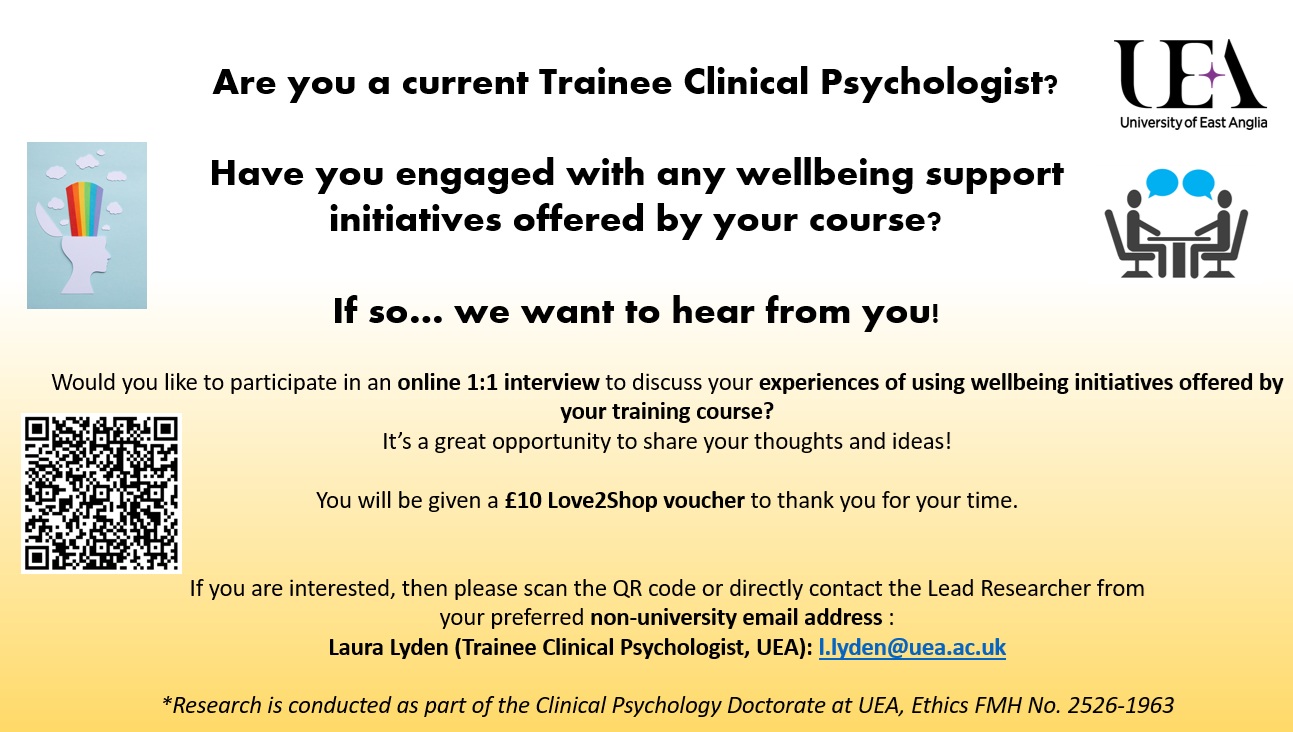
Research Poster (.jpg)
How do participants take part and who should they contact?
Participants should use the QR code on the research poster to access the Participant Information Sheet, Consent form and Demographic Questionnaire. Participants will be asked to provide a non-university email address in this questionnaire. Once they have provided formal consent and completed the questionnaire, they will be contacted by the lead researcher to arrange a convenient date/time to complete an online semi-structured interview, which will be conducted via Microsoft Teams.
Contact the lead research Laura Lyden (Trainee Clinical Psychologist, UEA) with any questions.
Funding
This research will form part of the lead researcher’s thesis portfolio for submission to obtain the award of Doctorate in Clinical Psychology (ClinPsyD). The lead researcher is a trainee clinical psychologist currently training at the University of East Anglia. The project is funded by the NHS as part of the doctoral training programme.
Ethical approval
This research has been reviewed by multiple research professionals and has been ethically approved by the UEA Faculty of Medicine and Health Sciences Research Ethics Committee.
Current trainee clinical psychologists from the University of East Anglia have also been consulted throughout the planning process to ensure that the questions used to guide the semi-structured interview are appropriate and address the aims of this research project.
Data collection period
The researcher will cease data collection once the required number of participants has been reached (between 8 and 12). The estimated date of completion for this project is currently September 2027.
Exploring the Use of Combined Risk Assessments amongst Mental Health Practitioners
Approved mental health professionals can be responsible for informing assessments which can result in patients being detained under the Mental Health Act. This study aims to explore the ability to categorise different types of risk when presented with a mental health patient in one initial screening. This study categorises risk as risk to self (self-harm and suicide) and risk to others (violence). This study does not intend to replicate the Mental Health Assessment in its entirety, but rather addresses the much broader topic of risk decision-making.
Eligibility/criteria for taking part
Eligibility:
- Aged over 18
- Classified as an Advanced Mental Health Professional, which includes but is not exclusive to Psychiatrists, Psychologists, Mental Health Nurses, Mental Health Social Workers, and Mental Health Occupational therapists (Trainees in these Professions are also eligible).
- UK-based with a fluent understanding of English
What the participants have to do
This study uses Artificial Intelligence to create a video simulation of a mental health patient, which participant will view, alongside a written vignette. After each vignette a questionnaire will be presented for participant to assess risk as part of the research task. If you decide to take part in this study, you will be involved in it for up to 20 minutes for your completion of the full study.
How do participants take part and who should they contact?
Participants can access the study online.
If you have any questions, contact the Lead Researcher.
Funding
This study has received sponsorship from the University of Hertfordshire
Ethical approval
University of Hertfordshire sponsorship of your research project following approval of the substantial amendment (amendment 2) by the relevant UH Ethics Committee with Delegated Authority (ECDA) 0733-Sa-HSET-2025.
HRA and HCRW Approval given with the IRAS Project ID number – 357392.
Amendment No./Sponsor Ref: 0733 Sa 2
Data collection period
February 2026, or until the maximum participant number has been reached.
Multidomain Evaluation and Data-driven Approaches to Predict Recurrent Neck Pain (END-RNP)
Research has shown that neck movement, muscle activity, sensation, and psychosocial factors are affected in people with neck pain. What is not known, is whether these changes are also present in people with recurrent neck pain even during the period of recovery (remission), and if these ongoing alterations lead to recurrence of neck pain. Therefore, the main purpose of the study is to investigate neck muscle activity, movement, sensation, and psychosocial factors in people with recurrent neck pain, compare the data with pain-free volunteers, and then follow-up people in remission from neck pain over time to understand whether any features can predict the recurrence of neck pain. Also, we will look at how the development of new neck pain episodes is related to changes in behavioural and environmental factors, such as work-related characteristics, physical activity, psychosocial function, and sleep quality.
Eligibility/criteria for taking part
You can participate if you meet the following criteria:
- Age between 18 and 70 years.
- Experience of two or more episodes of NP (lasting more than 24 hours) separated by periods of remission (30 days or more) during the previous 12 months.
- Episodes of neck pain with intensity that required treatment (e.g., from a healthcare professional or painkillers) or limited your function (average intensity greater or equal to 2 out of 10, with 10 being the worst pain you can imagine and 0 no pain).
- Neck pain-free over the last 30 days.
You must also not have any of the following:
- Previous shoulder or spinal surgery.
- History of neck trauma e.g., whiplash injury.
- Cervical radiculopathy.
- Previous fracture in the neck or shoulder region.
- Spinal deformity.
- Neurological or cardiovascular disorders.
- Rheumatic joint disease.
- Current pregnancy.
- Currently receiving treatment of neck pain from the NHS.
- Contraindications to exercise.
What the participants will have to do?
After you sign the online consent form, you will be asked to complete a short questionnaire to confirm you meet the eligibility criteria (e.g., history of neck pain, contraindication to exercise, and conditions listed above). Once a researcher has reviewed your answers and confirmed your eligibility, they will invite you to attend the laboratory session. The experiment will take place in a laboratory at the School of Sport, Exercise and Rehabilitation Sciences at the University of Birmingham OR at the School of Sport, Rehabilitation, and Exercise Sciences at the University of Essex based on what site is more convenient for you.
You will be asked to attend one data collection session, taking approximately 2 hours. This session can be organised at a time that will suit you. During this session, we will ask you to complete a series of questionnaires related to psychological factors like stress, anxiety and fear of pain.
We will then test your pain sensitivity, and to do this we will apply pressure over points on your neck and your leg and will ask you to tell us as soon as you feel pain. Then an inflatable pressure cuff will be mounted on your non-dominant arm. The cuff will be inflated and you shall indicate when you first detect pain. The pressure will then continue to be increased until your tolerance limit, this cuff pressure will be recorded and the cuff will be immediately deflated. The same procedure will then be repeated on your dominant arm.
We will then analyse your neck movements while sitting using a sensor placed on your forehead and back of your neck.
We will then use a technique called “surface electromyography” where we will place sensors on your skin to record the activity of your neck muscles and we will ask you to perform a series of maximum and submaximal contractions of your neck muscles. This will also include contractions of your neck muscles where we ask you to hold the contractions as long as you can so that we can test your neck muscle endurance.
We will ask you to bring a singlet or sports bra for this session in order to perform movements in a comfortable way. For your comfort, you can request in advance a researcher of the same sex or gender to conduct the experimental session. This includes procedures like placing sensors on your skin (neck region) and preparing you for each test.
Furthermore, over the course of 12 months, we will ask you to fill out and submit an additional electronic questionnaire every two weeks. We will use it to collect data about the recurrence of painful episodes (Part-A) and other behavioural and environmental factors (Part-B) related to your physical activity, job environment, psychosocial condition, and sleep quality. The first two reminders will be sent via email, and the final reminder will be a telephone call from a researcher on our team.
If you experience a repeated episode of pain during this 12-month timeframe, we will invite you to attend the laboratory again for a 2-hour session to repeat the exact same measures taken at the baseline session. This is optional and you can decide whether or not you would like to participate for these additional measures.
How to participate and who should they contact?
If anyone would like to participate, they can contact Mr Benjamin Butler for more information.
Funding
The University of Birmingham is the sponsor for this study based in the United Kingdom. The Medical Research Council (MRC) is kindly funding this research.
There is no cost for this study, but you will be compensated £20 for attending the laboratory session in the form of an Amazon gift voucher. Moreover, you will receive an additional £10 for every two follow-up questionnaires completed. This compensation will also be in the form of electronic Amazon vouchers.
Ethical approval
Ethical approval for this study was obtained from the University of Essex Research Ethics Committee (Reference: ETH2526-0098).