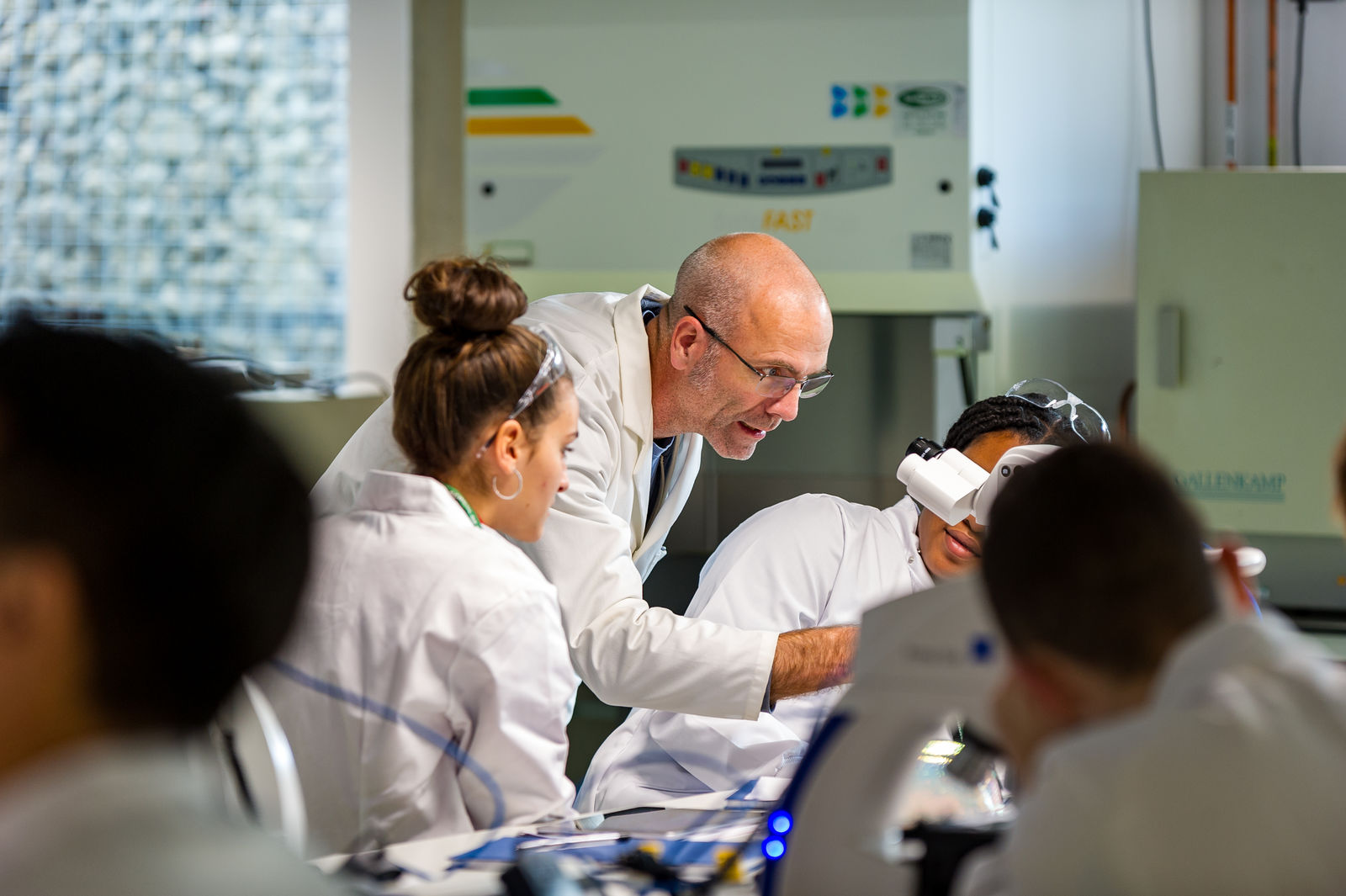
Biomedical science applies the concepts of biochemistry and cell biology to the study of health and disease in the human body. This is a rapidly expanding science that has become significant in public opinion since the COVID-19 pandemic. There has never been a more exciting time to study biomedical science.
Biomedical science is a broad area of life sciences which underpins much of what is regarded as modern medicine.
Many biomedical scientists work in healthcare laboratories to research the causes and diagnosis of diseases as well as the effectiveness of the medicines that cure them. Urine, blood and tissues samples are all analysed by biomedical scientists, so the vast majority of people in the UK benefit from a biomedical scientist during in their life.
At Essex, you'll learn about the onset, progression, diagnosis and treatment of diseases, and you'll be taught by research-active experts and practicing biomedical scientists from NHS hospitals. Our primary research focuses on genetic diseases, infection and immunity, and age-associated conditions such as cancer.
You’ll be equipped with skills that allow you to follow a professional career in industry or continue for further academic qualifications, such as a Masters or PhD. Some of our biomedical science students also use it as a launchpad to study Medicine or Dentistry.
Embark on a career as a biomedical scientist, with options for a placement or year abroad.
BSc (Hons) Applied Biomedical Science (NHS placement)
Embark on a career as a biomedical scientist, with options for a placement or year abroad.
BSc (Hons) Biomedical Science (Including Foundation Year)
Embark on a career as a biomedical scientist.
Integrated Master in Science: Biomedical Science
Embark on a career as a biomedical scientist, with options for a placement or year abroad.
Get ahead of results day. Explore your Clearing options now and be ready to secure your place with us when the time comes.
Graduates with life sciences degrees are in high demand across the world, especially after the global COVID-19 pandemic.
Once you've graduated from Essex with a biomedical science degree, you’ll be able to move into a wide variety of related careers, including working in the NHS, pharmaceuticals, research, health and safety, and teaching.
Many of our students have gone onto work for major pharmaceutical companies such as Astra Zeneca and Pfizer.
Others have secured highly respectable jobs as biomedical scientists in an NHS laboratory at Grade 5. Their work ranges from focusing on water quality, environmental research and rare pathogens. After several years in the lab and completing a Masters degree, our graduates often move up to senior levels with greater responsibility.
Find out more about career prospects within the School of Life Sciences.
“The NHS placement year that I opted for helped prepare me for my current role. It showed me what to expect while working within an NHS laboratory. It not only gave me technical skills and theoretical knowledge, but also ideas for leadership and team management.”
Our teaching and research is constantly evolving to reflect the latest findings and their applications in biomedical sciences and biotechnology, from cancer to synthetic biology.
Our lecturers are active researchers as well as world-leading experts, so the latest research is embedded in our teaching.
You will also learn in a friendly and supportive atmosphere in our School of Life Sciences alongside students studying cancer biology, biotechnology, molecular medicine, health genomics, and more.
We have scholarships and bursaries available for talented postgraduates, ranging from research council studentships and University of Essex scholarships, to awards funded by charities and other external organisations.
Transform the way we understand and treat human diseases, from cancers to neurodegenerative disorders.
Gain the specialised skills required for genome sequencing as it revolutionises the field of medicine.
"I studied both my undergraduate and Masters degrees at Essex. Studying MSc Biotechnology, I was fortunate to conduct research at the National Institute for Biological Standards and Control, where I learnt a lot both in terms of the science and working with people. I really appreciate the steep learning curve and independence I had with the research project. It was probably the most enjoyable time of my Masters course."
Our School of Life Sciences provides you with a stimulating environment for your research training. The research our students and staff conduct covers the whole spectrum of biology from genes, protein and cells through to whole organisms, communities and entire ecosystems. We employ a range of state-of-the-art techniques covering all the biological sciences:
Explore our biomedical science research by theme or your area of interest and find a supervisor that can support your through your studies. More information can be found about research degrees on our school pages. Our courses below will help guide you through the various research degree programmes we offer.
Explore funding opportunitiesOur biochemistry research projects encompass studies of fundamental biochemical mechanisms as well as the biochemical basis of disease states.
We have research expertise in medical microbiology, environmental microbiology, and biochemical and genomic analysis of species and communities.
We offer supervision in all areas of staff expertise in cancer biology and our research is at the basic-clinical interface and we employ a range of techniques.
We have research expertise in cancer and stem cell biology, viruses and infection, immunology, proteomics, drug design, genomics and computational biology.
MSc (by Dissertation) Biochemistry
Our biochemistry research projects encompass studies of fundamental biochemical mechanisms as well as the biochemical basis of disease states.
MSc (by Dissertation) Microbiology
We have research expertise in medical microbiology, environmental microbiology, and biochemical and genomic analysis of species and communities.
PhD Cell and Molecular Biology
We have staff expertise in cancer and stem cell biology, immunology, medical microbiology, biochemistry, structural biology, chromatin structure and more.
MSc (by Dissertation) Cancer Biology
We offer supervision in all areas of staff expertise in cancer biology and our research is at the basic-clinical interface and we employ a range of techniques.
MSc (by Dissertation) Molecular Medicine
We have research expertise in cancer and stem cell biology, viruses and infection, immunology, proteomics, drug design, genomics and computational biology.
MSc (by Dissertation) Cell and Molecular Biology
We have staff expertise in cancer and stem cell biology, immunology, medical microbiology, biochemistry, structural biology, chromatin structure and more.
Sign up for updates about our courses, accommodation, funding and student life.
We understand that deciding where and what to study is a very important decision for you. We'll make all reasonable efforts to provide you with the courses, services and facilities as described on our website. However, if we need to make material changes, for example due to significant disruption, or in response to COVID-19, we'll let our applicants and students know as soon as possible.