Our studies
TRIO Studies
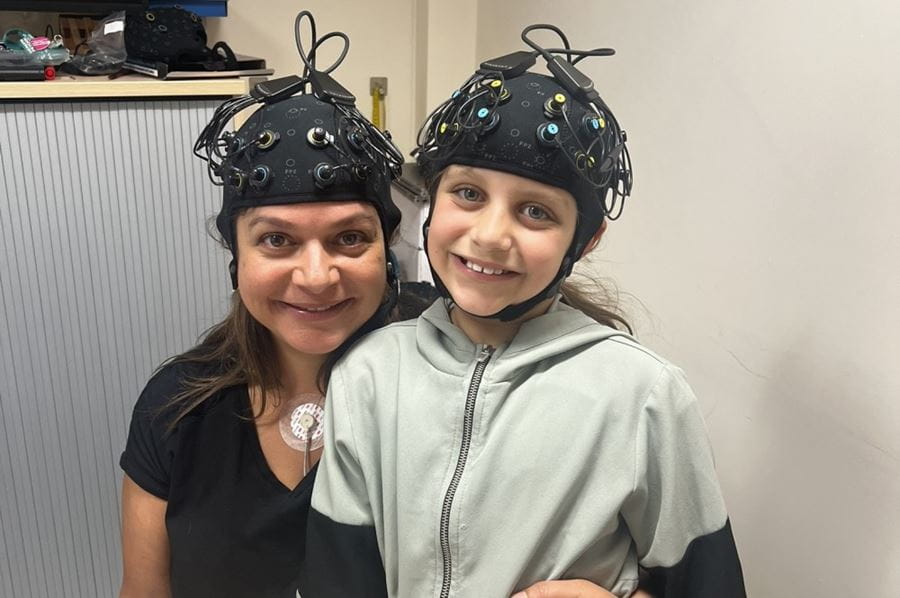
Since 2024, we are conducting a new series of interdisciplinary and multi-method studies looking at bio-behavioural synchrony in families. This includes mother-child and father-child pairs and mother-child-father triads.
We acknowledge and celebrate that families come in all shapes and sizes. For our TRIO Studies, we are currently looking for participant families that include a cisgender mother and father and their biological child.
While the first TRIO Study is carried out in neurotypical participants, different parts of TRIO also include families with neurodivergent children and children with experiences of early adversity, care and/or adoption together with their foster parents and/or carers. You can read more information about this project and to learn how to participate or email us at psy-triostudy@essex.ac.uk.
SWITCH Study
Since April 2025, our SoNeAt Lab is part of an international research project ‘Targeting Social Wellbeing to Improve Transitions to School’, or in short SWITCH.
As part of SWITCH, we are investigating children’s social wellbeing during their transition to Reception and from there to Year 1. Starting school is one of the biggest transitions in a child’s life, with a profound impact on their wellbeing, mental health, and engagement with learning. How children settle into Reception shapes their confidence, friendships, and resilience for years to come.
To better understand these transitions, we are assessing parent-child and child-peer bio-behavioural synchrony and a range of other behavioural measures. Findings from SWITCH will provide critical insights to inform evidence-based guidance for schools and policy makers across Europe. You can read more information about this project and to learn how to participate or email us at switch@essex.ac.uk.
LEAD Studies
Since October 2025, we are building a new series of investigations to develop a novel attachment-informed leadership (AIL) framework. This includes the formulation of the underlying theory as well as online and laboratory-based studies in the context of “Leadership, Empathy and Attachment Dynamics” (LEAD).
The long-term goal is to develop and deploy fNIRS hyperscanning, initially in small but eventually in large groups of up to 30 people within corporate environments. This approach will allow us to investigate professional leader-follower relationships from a combined Relational Neuroscience and attachment theory perspective.
3.png?mw=300)